Geppetto and Pinocchio
Pinocchio (Tania Zamorsky Edition)Geppetto and Pinocchio are joined as father and son through both creation and care. Geppetto brings the piece of wood home and begins making the puppet he names Pinocchio; their relationship then takes shape not as unbroken obedience, but through recurring moments when hardship and affection meet. Geppetto’s tenderness becomes visible in the material sacrifices he makes, while Pinocchio’s impulsive love surfaces in kisses, embraces, and urgent concern for his father.
Origin and Unequal Beginnings
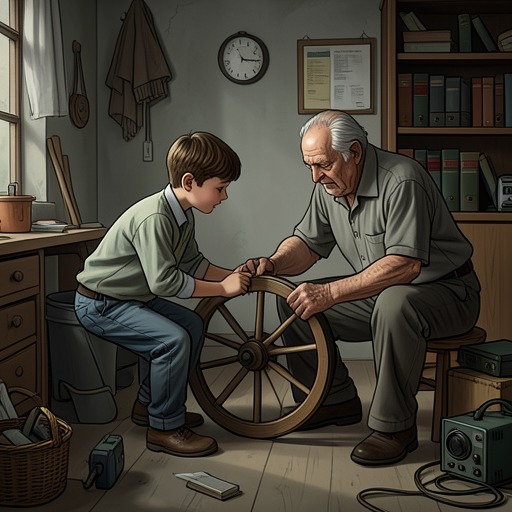
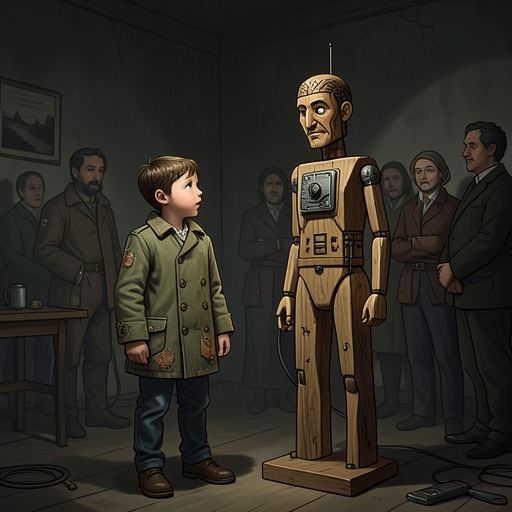
After his quarrel with Maestro Ciliegia, Geppetto takes the piece of wood home, limping as he goes. He begins to make a puppet and gives it the name Pinocchio. This origin makes their bond unusually literal: Geppetto is Pinocchio’s maker as well as the father the puppet calls his own. The household into which Pinocchio enters is poor—a ground-floor room lit from beneath a staircase, furnished with a worn chair, an inadequate bed, and a battered table. Even its painted hearth and boiling pot offer the appearance of comfort rather than its substance.
That material setting matters to the relationship. Geppetto’s care cannot be separated from scarcity, and Pinocchio’s needs repeatedly press against what his father can provide. Their closeness is not established by comfort or authority alone. It is shown in decisions made when food, clothing, and schooling compete with an already meager household’s resources.
Care in Hunger and Injury
When Geppetto returns and finds Pinocchio lying on the ground without feet, his first suspicion is that the puppet is playing another prank. Seeing the injury changes his response: he takes Pinocchio into his arms, kisses and caresses him, and weeps as he asks how the feet were burned. The physical gestures make his attachment plain before the circumstances are fully understood. Pinocchio gives him a long, confused account of the night, including his encounter with the Talking Cricket, the hammer he threw, his hunger, and the burning of his feet. Geppetto cannot make sense of the whole tale; what reaches him clearly is that Pinocchio is desperately hungry.
Geppetto responds by taking three pears from his pocket. They had been meant for his own breakfast, but he gives them to Pinocchio. The scene defines paternal care as immediate and practical: faced with a child who is hungry and hurt, Geppetto first attends to the need he can recognize. Pinocchio’s request that the pears be peeled adds a small, concrete demand to this act of generosity. The exchange also reveals a limit in their understanding of one another: Pinocchio recounts a whole night of misfortune, while Geppetto grasps its most urgent consequence and answers it with food.
Sacrifice and Affection Returned
The same pattern appears in the purchase of Pinocchio’s primer. Geppetto puts on his old fustian jacket, patched and mended, and leaves the house; when he returns, he has the book for his son but no longer has the jacket. It is snowing, and he is left in his shirtsleeves. Pinocchio asks what happened to the garment and learns that Geppetto sold it to obtain the schoolbook. The sacrifice gives their relationship an economic reality: schooling is not an abstract wish but something Geppetto buys at the cost of his own protection from the cold.
Pinocchio understands the meaning of Geppetto’s explanation at once. Unable to restrain his affectionate impulse, he jumps onto his father’s neck and kisses his face all over. The gesture does not undo the loss of the jacket or resolve the family’s poverty; instead, it answers the sacrifice with the resource Pinocchio can offer in that moment. Across the episode, care moves in both directions, though not in equal material forms: Geppetto parts with food and clothing, while Pinocchio responds with visible, uncontained affection.
Separation and Continuing Attachment
The bond is also made legible when Pinocchio encounters a pigeon that recognizes his name and asks whether he knows Geppetto. Pinocchio immediately identifies Geppetto as his father and asks whether the bird has news of him, whether it can take him to him, and whether he is still alive. The sequence of questions registers more than recognition: Pinocchio’s attention turns at once from himself to his absent father’s whereabouts and survival.
The pigeon says it left Geppetto on the seashore three days earlier. This report places Geppetto away from home and establishes the separation that gives Pinocchio’s questions their urgency. The evidence here does not show a reunion; it ends with information that sharpens Pinocchio’s concern. Set beside the earlier scenes of hunger, injury, and the sold jacket, the exchange shows that the relationship extends beyond the household’s acts of care. Even at a distance, Geppetto remains the person Pinocchio seeks and fears losing.
Narrative Significance
The relationship is developed through repeated concrete exchanges rather than through a sustained account of either character’s feelings. Geppetto’s love is expressed in taking the injured Pinocchio into his arms, surrendering his breakfast pears, and selling his patched jacket for a primer. Pinocchio’s attachment appears in his kisses and embraces, and later in his immediate alarm at the possibility that Geppetto may not be alive. These gestures make affection observable while preserving the strain between them: Pinocchio’s mischief can leave Geppetto exasperated or initially doubtful, yet his vulnerability draws out the older man’s tenderness.
Poverty gives the bond its recurring stakes. Food and clothing are scarce enough that generosity entails a real cost, and the primer represents an investment in Pinocchio’s schooling bought through Geppetto’s deprivation. The father-and-son relation therefore joins making to responsibility: Geppetto brings Pinocchio into being, then continues to answer his needs, while Pinocchio’s responses show an affection that can emerge even amid confusion and hardship. The later report from the seashore leaves that attachment unresolved by distance, but confirms how firmly Geppetto remains at the center of Pinocchio’s concern.