Le bugie hanno le gambe corte e il naso lungo
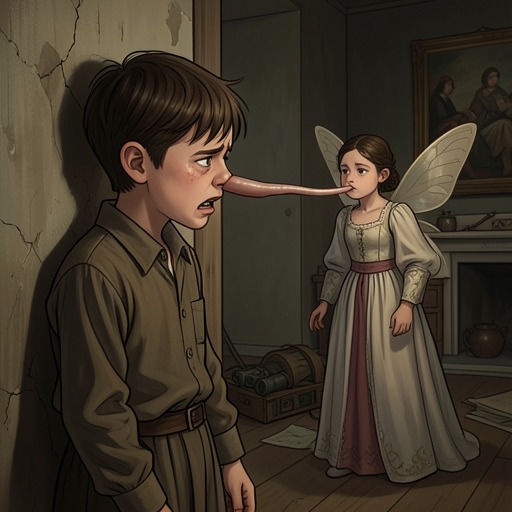
Pinocchio (Tania Zamorsky Edition)Le bugie hanno le gambe corte e il naso lungo names a moral rule made visible in Pinocchio’s body: when he lies to the Blue-Haired Fairy about the four gold coins, his nose grows, exposing his falsehood and eventually preventing him from leaving the room. The expression turns a familiar warning about deception into a physical, comic consequence that Pinocchio cannot conceal.
Meaning and Form
The maxim distinguishes two kinds of lies: those with short legs and those with long noses. The Blue-Haired Fairy identifies Pinocchio’s falsehoods with the second kind. In this scene, the image is more than a figure of speech: his nose literally lengthens, so the lie acquires a visible and increasingly inconvenient form.
The expression links exposure to consequence. Pinocchio’s words concern coins he says are lost, but his body contradicts him before he confesses anything. Deception cannot remain a private account when it produces an outward sign that grows with each successive lie.
The Four Coins and the Growing Nose
Asked where he put the four coins, Pinocchio claims to have lost them, although they are in his pocket. His nose, already long, grows by two fingers as soon as he lies. When the Blue-Haired Fairy asks where he lost them, he names the nearby wood; the nose grows again.
Pinocchio then changes his story: he says he did not lose the coins but swallowed them while drinking the Fairy’s medicine. This third lie makes his nose grow so extraordinarily long that he can no longer turn without striking the bed or windowpanes on one side, or the walls or door on the other. Raising his head risks poking the Blue-Haired Fairy in the eye. The escalation gives the saying a precise dramatic mechanism: each added falsehood enlarges the evidence against him.
Exposure and Comic Consequence
The Blue-Haired Fairy watches and laughs. Pinocchio, confused and worried by his rapidly growing nose, asks how she knows he has lied; she answers by explaining the distinction between short-legged lies and long-nosed lies. The maxim thus supplies the scene’s own interpretation, while the physical predicament has already demonstrated its force.
The consequence extends beyond embarrassment. Pinocchio tries to flee the room, but his nose has grown so large that it will not pass through the doorway. The expression therefore joins moral exposure to comic confinement: the lie does not merely reveal itself but obstructs the liar’s escape. Its memorable force comes from turning an abstract lesson in honesty into a concrete sequence of growth, collision, and blocked passage.