Pinocchio
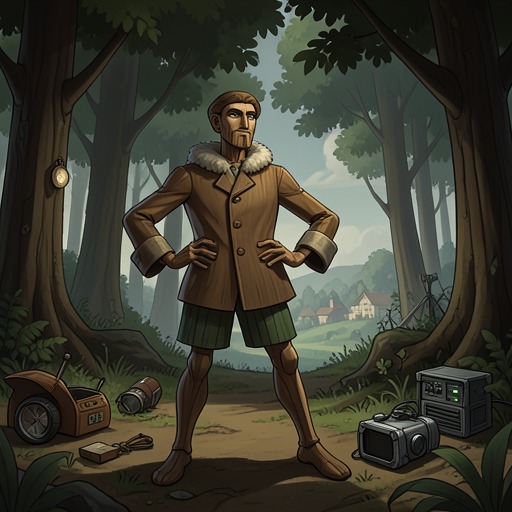
Pinocchio (Tania Zamorsky Edition)Pinocchio is a wooden puppet made by Geppetto from an ordinary piece of firewood, and the central figure in a story that tests whether he can become more than the unruly figure he first appears to be. His desire to become a real boy is fulfilled only after a succession of consequences—including transformation into a donkey, sale into performance and labor, and separation from his father—has brought him to sustained, practical care for Geppetto. The contrast between his wooden beginnings and his final human appearance gives visible form to a change achieved through conduct rather than wish alone.
Identity and Creation
Pinocchio begins as a plain piece of wood, not a precious material or a royal child. The wood comes to the workshop of Maestro Ciliegia and is then carved by Geppetto, who takes up his tools as soon as he returns home. Geppetto names his puppet Pinocchio, jokingly recalling a family of Pinocchios whose richest member begged for alms. The name is bestowed before the carving is complete: Geppetto first makes the puppet’s hair, forehead, and eyes. Pinocchio’s identity is thus both made and named by his father, although the story soon gives the wooden figure a will and a course of action beyond the workbench.
The surroundings of this beginning are spare. Geppetto’s home is a small ground-floor room lit from beneath a staircase, furnished with a poor chair, a worn bed, and a damaged little table. Its painted fireplace and painted pot create the appearance of domestic warmth without an actual fire or meal. Against this modest setting, the making of Pinocchio is a concrete act of care: Geppetto begins building him immediately, using the tools available to him. The puppet’s origin is not an escape from material hardship but a creation within it.
Desire and the First Failed Transformation
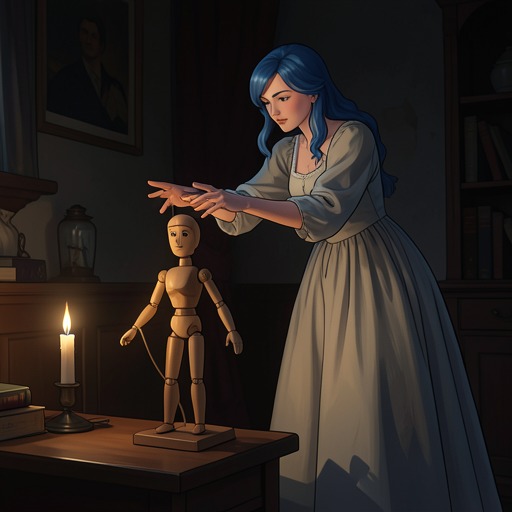
Pinocchio eventually grows dissatisfied with remaining a puppet. He protests that puppets are born, live, and die as puppets, and says he is tired of always being one; he wants to become a man like everyone else. The Blue-Haired Fairy tells him that this change is possible if he can make himself worthy of it. The condition matters: becoming human is presented not as a change of materials alone but as an outcome connected to how he behaves.
On the eve of the promised transformation, the Fairy tells Pinocchio that the next day he will cease to be a wooden puppet and become a well-behaved boy. His joy is so great that a celebration is arranged, with his school friends invited to breakfast and two hundred cups of coffee with milk and four hundred buttered rolls prepared. The promise makes the intended change public as well as personal: his companions are to witness the new beginning. But the narrator’s warning that a troublesome “but” can spoil a puppet’s life foreshadows another interruption. Pinocchio does not become a boy at that point. Instead, his earlier willingness to neglect study and heed bad companions carries him into the transformation he most fears.
Misconduct, Donkey Transformation, and Sale
In his own account of what happened, Pinocchio traces the change to his lack of desire to study and his decision to listen to bad companions. He says that he ran away from home and one day woke to find himself a donkey, complete with long ears and a tail. The shame he associates with the donkey’s body is immediate and intense. His change is not an abstract punishment: it alters the form in which others see and handle him, and turns him into something to be bought and sold.
The Little Man’s business makes that conversion part of a deliberate scheme. He travels with a cart, gathering children who dislike books and school through promises and coaxing, then takes them to Toyland to spend their time in games and noisy amusements. When continual play and the absence of study have turned them into donkeys, he sells them at fairs and markets. Pinocchio and Lucignolo are among the victims of this trade. Lucignolo is bought by a farmer whose donkey has died; Pinocchio is purchased by the director of a company of clowns and rope-jumpers, who plans to train him to leap and dance with the troupe’s other animals.
Pinocchio’s performing career ends in injury. In recounting his history to the buyer who later owns him, he explains that he was meant to become a great dancer and jumper through hoops, but fell badly during a performance and was left lame in both legs. The circus director, unable to use a lame donkey, sent him back to be sold. The next buyer paid twenty soldi for him and complains that the purchase has brought a loss. Pinocchio’s own narrative connects each reversal to the previous one: the pursuit of amusement and abandonment of study lead to donkeyhood; donkeyhood makes him saleable; and the attempt to turn him into an entertainer ends with injury and another sale.
Geppetto and the Turn to Responsibility
The reunion with Geppetto reverses Pinocchio’s isolation. Moving toward a light, he reaches a small table where an old man sits eating live little fish. Pinocchio recognizes his father and, overcome with joy, throws his arms around him, insisting through repeated gestures of attachment that he will not leave him again. Geppetto, rubbing his eyes, checks that the figure before him really is his dear Pinocchio. The reunion is a meeting of father and son, but it also prepares for a change in their dependence: Geppetto is now frail and in need of care.
From then on, Pinocchio rises before dawn for more than five months to turn a mill wheel and earn the glass of milk that helps his father’s poor health. He does not stop at that daily task. In his spare time he learns to make baskets and hampers from rushes, using the money to meet household expenses with care. He builds a small cart himself so that Geppetto can be taken out on fine days for a breath of air. Each undertaking answers a particular need: milk for Geppetto’s health, basket-making for their daily costs, and the cart for his comfort and time outdoors.
His work does not erase his desire to learn. In the evenings Pinocchio practices reading and writing. He buys a large second-hand book in a nearby town for a few cents, though it lacks both its title page and its index. For writing he uses a sharpened reed as a pen and blackberry and cherry juice in a small bottle in place of ink. The makeshift materials contrast with the educational neglect that helped lead him astray. Now study is not merely the rejected obligation associated with school; it is a practice he takes up alongside the labor required to sustain his father.
Through this effort Pinocchio keeps Geppetto almost comfortably supported and saves forty soldi for a new suit. In a dream, the Blue-Haired Fairy forgives his past mischief because he has lovingly assisted his parents in hardship and illness, while still urging him to use better judgment in the future. When Pinocchio wakes, he is no longer a wooden puppet but a boy. The change is accompanied by a furnished little room and new clothes, including a cap and leather boots. A small ivory purse bears the Fairy’s message of thanks and returns his forty soldi as forty new gold coins. Looking in the mirror, Pinocchio sees not the familiar wooden marionette but a lively, intelligent boy with brown hair and blue eyes. The final image joins physical transformation to the change already made visible in his daily actions: he has learned to support, accompany, and provide for Geppetto.