Pinocchio Is Sold to a Circus
Pinocchio (Tania Zamorsky Edition)Pinocchio Is Sold to a Circus marks the conversion of Pinocchio’s transformation into a donkey from a punishment into a source of profit for adults. The Little Man sells him to a circus director who intends to make him perform, and the boy’s new body is trained, displayed, and finally injured for the entertainment and gain of others. A glimpse of the Blue-Haired Fairy briefly interrupts that exploitation, but does not rescue him: the performance ends with a lame donkey and an empty box in the audience.
The Sale and Its Background
The Little Man arrives at the room where Pinocchio and Lucignolo are shut in, kicks the door open when they do not answer, and recognizes them by their braying. He first strokes and handles the two donkeys, then grooms them until their coats shine like mirrors. With halters on, they are led to the market, where buyers soon appear. The careful grooming makes the sale concrete: these are not children being returned to safety, but animals being prepared for market.
The boys are bought separately. A farmer takes Lucignolo because his donkey died the previous day; a circus director buys Pinocchio to train him to jump and dance with the company’s other animals. That contrast gives Pinocchio’s sale a particular destination and purpose. Lucignolo is needed as a replacement farm animal, while Pinocchio is selected as a prospective attraction whose labor is meant to earn money.
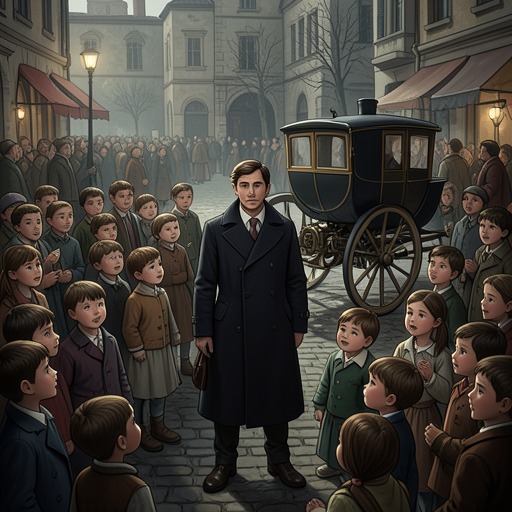
The narrator explains that the sale is part of the Little Man’s established business. He travels with a carriage, luring idle children who dislike books and school with promises and blandishments, and carries them to Toyland to spend their time playing. When they become donkeys through ceaseless play and lack of study, he takes them to fairs and markets. The account says that in a few years he has made a fortune and become a millionaire. Pinocchio’s transaction is therefore not an isolated misfortune: it is the profitable endpoint of a repeated scheme that turns the children’s transformation into merchandise.
Training for the Circus
The circus director makes the terms of the purchase explicit. Pinocchio had been chewing chopped straw and had reflected that his misfortune might teach disobedient children who do not want to study a lesson. The director answers that he bought the donkey to work and make him money, not simply to feed him. Pinocchio is taken to the circus to learn hoop-jumping, breaking paper-covered barrels with his head, and dancing the waltz and polka upright on his hind legs. The stated educational lesson and the animal’s actual treatment stand in sharp contrast: the transformed child can recognize a moral consequence, but that recognition does not spare him from being made to perform.
Training lasts three months and includes many whip strokes severe enough to remove his hair. The narration presents the skills as things Pinocchio has to learn whether he wants to or not. His circus competence is thus produced by duration and punishment rather than freely chosen talent. The director’s commercial aim governs both the lessons and the eventual show: Pinocchio must be made into a spectacle that can attract an audience.
On the night of the performance, the theatre is packed an hour before the show begins. The director’s public introduction dresses exploitation up as expertise. He boasts of difficulties in mastering the animal, describes Pinocchio as a wild creature from distant regions, and claims that a supposed feature in his skull explains his hair and dancing ability. His grand account supplies a theatrical origin for the act, while the actual history of the performer is the Little Man’s scheme and three months of beatings.
Debut, Recognition, and Injury
Pinocchio enters in elaborate circus finery: a new, shiny leather bridle with brass buckles and studs, white camellias at his ears, a mane divided into curls and tied with silver ribbons, and a tail braided with velvet ribbons in two colors. The audience’s applause swells into a roar when he appears. The contrast is pointed: the ornaments make him attractive as a show animal, but do not change the coercive circumstances that brought him there.
During the act, the director fires a pistol into the air. Pinocchio pretends to have been wounded and falls flat in the ring as if dying. When he gets up amid applause, shouting, and clapping, he raises his head and notices a beautiful lady in a box. A large gold necklace hangs at her throat, with a medallion bearing the portrait of a puppet. Pinocchio recognizes the portrait as his own and understands that the lady is the Blue-Haired Fairy. For a moment, the circus performance becomes a scene of recognition: the displayed donkey sees a sign of his former identity in the middle of the crowd that has come to watch him perform.
When Pinocchio looks up again, the box is empty. His eyes fill with tears and he weeps, but no one notices; the director instead orders him to continue with the hoop-jumping. Pinocchio tries two or three times and passes beneath the hoop rather than through it. At last he jumps through, but his hind legs catch in the ring, and he falls in a heap on the other side. The attempt to satisfy the act’s demand results in a physical injury, not a triumphant finish.
He gets up lame and can barely make it back to the stable. The children in the audience call for him to return, moved by the accident, but he does not reappear that evening. The audience’s sympathy arrives only after the injury, while the director’s earlier response to Pinocchio’s grief was to crack the whip and press on with the show. The distinction exposes the gap between spectators’ compassion and the conditions of the performance.
Consequences and Significance
The episode carries Pinocchio from sale to forced training, public display, and injury. Its reversals are tightly linked: the Little Man’s profit depends on the children’s transformation; the director’s purchase turns Pinocchio into an investment; and the skills acquired under punishment are tested before a packed theatre. The episode does not resolve his predicament through the Fairy’s appearance. She is recognized, then disappears, leaving Pinocchio to finish the act and return lame to the stable.
The circus’s decorations and invented boasts make the donkey’s body a fabricated spectacle, while the injury reveals the material cost beneath the display. Pinocchio’s glimpse of the portrait also sets his remembered identity against the role imposed on him. Yet the show cannot pause for that recognition: the director treats his tears as irrelevant and demands the next trick. By ending with the boy unable to return to the ring, the episode makes the promised entertainment give way to the bodily consequence of turning him into a profitable attraction.