Pinocchio Reunites with Geppetto Inside the Great Shark
Pinocchio (Tania Zamorsky Edition)Pinocchio’s reunion with Geppetto inside the Great Shark turns a journey through darkness into a sudden recovery of family. Pinocchio finds his father alive in a small, candlelit refuge within the creature, while Geppetto explains how a shipwreck supplied him with food and light for two years. The discovery joins the reunion’s immediate joy to the perilous circumstances that have kept them apart.
The Search Through the Great Shark
After saying goodbye to the Tuna, Pinocchio feels his way through the Great Shark’s body, advancing step by step toward a small, distant glimmer. The approach is physical and uncertain: his feet splash through a pool of greasy, slippery water, whose sharp smell of fried fish makes the darkness seem less like an empty space than an enclosing, hostile environment. The light gives his movement a direction, but the narrative delays what it will reveal, letting the dim point grow brighter and more distinct as he walks.
At its source Pinocchio discovers a small table set for a meal, with a lit candle lodged in a green crystal bottle. A little old man sits there, entirely white, and chews live little fish that sometimes escape from his mouth. The scene is strange in its details and precarious in its setting: a domestic arrangement, complete with table and candle, has been assembled inside the body of the Great Shark. Geppetto’s improvised refuge is at once recognizably a place to eat and live and a reminder that he remains enclosed within a monster.
Recognition and Reunion
The sight of Geppetto brings Pinocchio an overwhelming, unexpected happiness. He can scarcely shape what he wants to say; he tries to laugh, cry, and speak, but at first produces only confused murmurs and broken words. At last he cries out, opens his arms, and throws himself around the old man’s neck, insisting that he has finally found his father and will never leave him again. The embrace gives the long search an immediate answer: the distant figure is not merely a survivor but the person Pinocchio has been trying to reach.
Geppetto rubs his eyes and asks whether they are telling him the truth: whether the visitor really is his dear Pinocchio. The recognition is mutual, but its emotional force is not identical on both sides. Pinocchio arrives in a rush of relief and affection; Geppetto first has to verify what he sees. Pinocchio then asks whether his father has already forgiven him. His joy is therefore accompanied by awareness of their history and of his own part in it, rather than by reunion alone.
Pinocchio’s Account and Geppetto’s Captivity
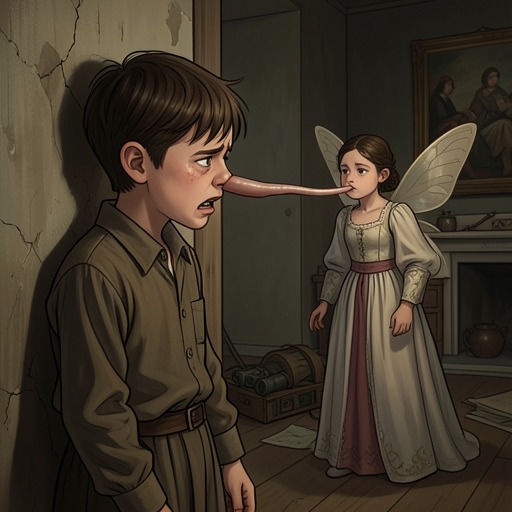
In a rapid, breathless account, Pinocchio recounts the chain of misfortunes that began when Geppetto sold his coat to buy him a primer. Instead of going to school, Pinocchio ran off to see the puppets; after the puppet master gave him five gold coins to carry home, the Fox and the Cat led him to the Red Lobster Inn. Later came the assassins, his hanging from the Great Oak, and the Blue-Haired Fairy’s rescue. Pinocchio also recalls lying to the doctors, the growth of his nose, the disappearance of the coins he buried with the Fox and the Cat, and his imprisonment after reporting the theft.
His story continues through the trap that caught him while he was reaching for grapes, the farmer who made him guard a henhouse with a dog collar, and his return to the Blue-Haired Fairy’s House. He then tells how the Dove carried him toward Geppetto: from the air, Pinocchio saw his father in a little boat and recognized him at sea. The compressed recitation makes the reunion a meeting of two interrupted journeys. Pinocchio brings the accumulated episodes of his wanderings into the hidden place where Geppetto has been waiting; the account also shows how much has happened since the coat was sold and the primer bought.
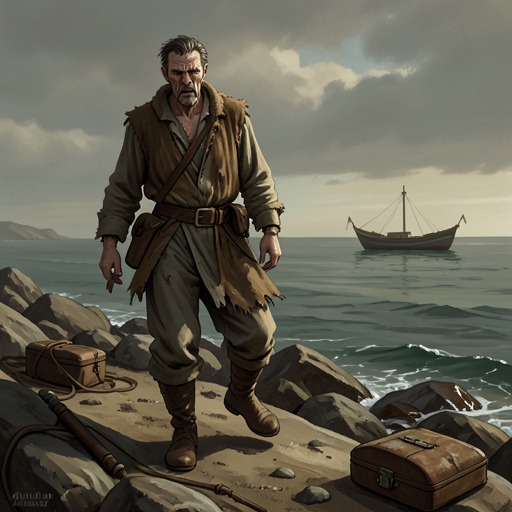
Geppetto explains why he could not return to shore when Pinocchio saw him. He recognized his son, but the sea was rough, and a large wave overturned his boat. The nearby Great Shark seized him in its tongue and swallowed him whole. Asked how long he has been inside, Geppetto answers that it has been two years, which have felt to him like two centuries. The reunion thus reveals the scale of the separation: Pinocchio’s father was not simply lost at sea but alive, confined in the creature throughout that time.
The Ship’s Stores and the Scene’s Turn
Geppetto’s survival depended on the same storm that wrecked his boat. It also sank a merchant ship. The sailors escaped, but the Great Shark swallowed the vessel after swallowing Geppetto; it expelled only the mainmast, which had caught between its teeth like a fish bone. The ship’s cargo included preserved meat in tin boxes, ship’s biscuit, wine, raisins, cheese, coffee, sugar, stearic candles, and wax matches. Those provisions enabled Geppetto to endure his captivity for two years and explain how he lit the candle Pinocchio sees.
That supply has now run out. Geppetto says the pantry contains nothing and the candle burning on the table is his last. The reunion consequently arrives at a point of acute danger: Pinocchio finds his father, but finds him at the end of the food and light that had sustained him. The table and its final candle make the encounter more than a recognition scene; they expose the narrow material margin on which Geppetto’s survival has depended. The passage closes this discovery with the means of survival exhausted, making their reunion the threshold to the problem of getting out, not the end of their ordeal.