Pinocchio Runs Away and Geppetto Is Imprisoned
Pinocchio (Tania Zamorsky Edition)Pinocchio Runs Away and Geppetto Is Imprisoned turns the puppet’s first independent run into an abrupt reversal: Geppetto loses control of the child he has just taught to walk, and public sympathy for Pinocchio sends the father to prison. The episode joins slapstick movement to a serious separation, while its comic misreadings complicate the story’s lesson about disobedience and responsibility.
The First Run
Geppetto begins by setting Pinocchio on the floor and leading him by the hand, teaching him to put one step after another. Once his stiff legs loosen, however, Pinocchio walks and runs around the room by himself, slips through the doorway, and bolts into the street. The change is immediate: a lesson in walking becomes a flight from the person giving it. Geppetto runs after him but cannot catch up; Pinocchio bounds like a hare, his wooden feet clattering on the pavement with a noise compared to twenty pairs of farmers’ clogs.
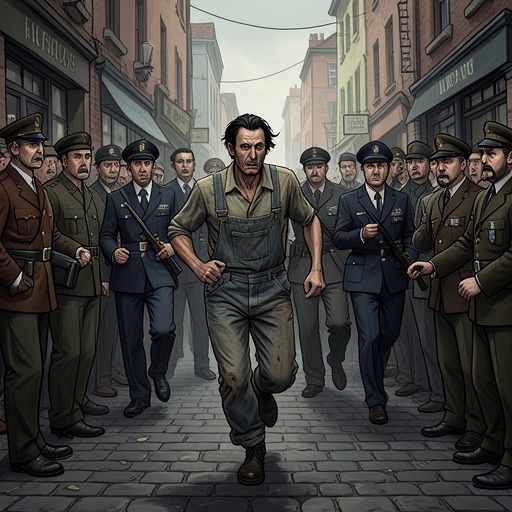
The commotion draws passersby, who stop to stare and laugh at the sight of a wooden puppet racing through the street. A Carabiniere arrives, believing the disturbance concerns a colt that has thrown off its master. He plants himself across the road to stop what he takes to be a dangerous runaway animal. Pinocchio sees the barrier and tries to dart between the officer’s legs, but the attempt fails. The chase ends not through Geppetto’s efforts, but through the intervention of an authority who has misunderstood what is happening.
Capture and a Missing Detail
The Carabiniere catches Pinocchio by his conspicuously large nose and returns him to Geppetto. Geppetto means to correct him by pulling his ears, but discovers that Pinocchio has none: in the haste of carving him, Geppetto forgot to make them. The detail turns the attempted punishment into another comic impasse. Pinocchio’s body, still bearing the marks of its incomplete making, frustrates the ordinary gesture by which Geppetto would discipline him.
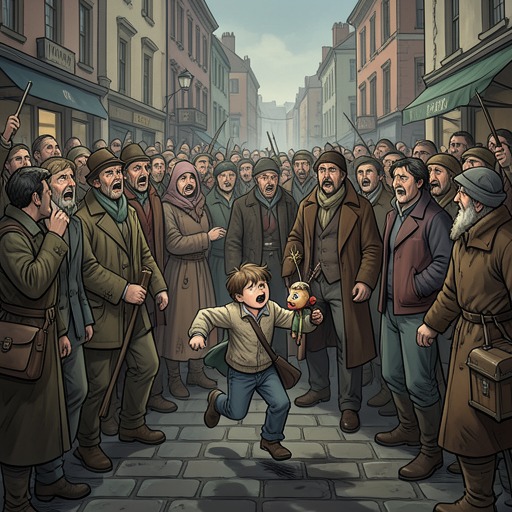
Geppetto instead takes Pinocchio by the nape and starts leading him home, warning that they will settle accounts there. At that prospect, Pinocchio throws himself to the ground and refuses to walk. Curious bystanders gather around them. Some call Pinocchio a poor puppet who is right not to return; others describe Geppetto as a tyrant who might break him to pieces. Their account is not based on witnessing Geppetto harm Pinocchio: it grows from the threat of correction and from the spectacle of an adult holding a resisting child.
The Crowd’s Reversal
The bystanders’ talk changes the outcome of the encounter. After the crowd’s accusations, the Carabiniere releases Pinocchio and takes Geppetto to prison instead. The authority who had first treated Pinocchio like a runaway colt now acts on the crowd’s image of an abusive maker. Geppetto cannot defend himself in the moment. He weeps as he is led away, lamenting the effort he had spent making Pinocchio into a good puppet and recognizing that he ought to have thought ahead.
The reversal is both comic and painful: Pinocchio’s refusal to go home protects him from immediate correction, while Geppetto, who has chased after him and tried to bring him back, bears the legal consequence. The episode does not show the crowd investigating what happened before the arrest. Instead, public pity, initially directed toward the puppet, becomes a force that separates him from his father. The result is not a reconciliation or a settled judgment, but Geppetto’s removal and Pinocchio’s freedom to continue alone.
Narrative Consequences
The narrator pauses to mark what follows as an astonishing story to be told in later chapters, then directs the reader toward the episode involving the Talking Cricket and children who dislike being corrected by those who know better. That transition places the escape inside a larger pattern of advice refused and consequences to come. A later chapter explicitly links Pinocchio’s failure to heed the Talking Cricket’s good counsel with his encounter with assassins, extending the warning beyond this street scene without making those later dangers part of the arrest itself.
The episode’s immediate moral arrangement remains deliberately uneasy. Pinocchio has run away as soon as he can move, and he resists being taken home; Geppetto’s effort to retrieve him ends in punishment for the parent, not the puppet. Yet the crowd sees only a possible victim and a possible tyrant, and acts on that impression. The first escape therefore establishes more than Pinocchio’s impulsiveness: it shows how quickly his actions can produce consequences for Geppetto, and how an apparent rescue can deepen their separation rather than repair it.