Pinocchio Runs Away with Lucignolo to Toyland
Pinocchio (Tania Zamorsky Edition)Pinocchio Runs Away with Lucignolo to Toyland is a decisive reversal: on the eve of a celebration for his promised transformation into a real, well-behaved boy, Pinocchio leaves secretly for a place where play replaces work and study. The departure begins as a refusal, becomes a surrender to temptation, and ends with the boys arriving at dawn in a country populated entirely by children.
The Promise and the Invitation
The escape is set against a future Pinocchio has just been told to expect. The Blue-Haired Fairy has arranged a breakfast at her house for the following day to celebrate the great event, preparing two hundred cups of coffee and milk and four hundred rolls buttered on both sides. Pinocchio is eager to share the news with his schoolmates, and the Fairy allows him to go into town to invite them, with one clear condition: he must return home before nightfall. The celebration, the invitation, and the deadline make his departure more than an impulsive outing; he is walking away from a promise at the very moment its fulfilment has been prepared for.
Within a little more than an hour, Pinocchio has invited his friends. Some accept readily, while others need persuading; the prospect of rolls buttered on the outside as well as the inside helps win them over. Pinocchio then searches for Lucignolo, his dearest school companion, making three unsuccessful visits before finding him hidden beneath the portico of a farmhouse. The detail gives the meeting a furtive quality before the journey has even begun: Lucignolo is not waiting among the invited schoolmates but tucked out of sight, already apart from the occasion Pinocchio is meant to be organizing.
Lucignolo’s Temptation and Pinocchio’s Reversal
Lucignolo is introduced by both his given name, Romeo, and the nickname by which everyone knows him. The nickname refers to his thin, lanky build, likened to a new wick for a night-lamp. He is the laziest and most mischievous boy in the school, yet Pinocchio loves him dearly. That affection helps explain why the invitation to breakfast turns into an invitation to follow him elsewhere: Pinocchio has gone looking for a friend, and instead encounters a companion whose example challenges the course he has promised to take.
Lucignolo describes his destination as the most beautiful country in the world, a place of abundance where the boys spend the day amusing themselves, go to bed, and begin again the next morning. Pinocchio is visibly drawn to this prospect, but at first refuses. He recalls that he has promised the Blue-Haired Fairy he will become a good boy and says he intends to keep his word. Because the sun is going down, he says goodbye and hurries off. In that moment, the choice appears settled: the promised breakfast and the Fairy’s instruction still outweigh the appeal of endless play.
The refusal does not hold. After night has fallen, a small light appears in the distance, accompanied by the sound of bells and a trumpet so faint and muffled that it resembles a mosquito’s whistle. As the prospect of departure becomes immediate, Pinocchio sighs three times and then asks to come along. The shift from a firm refusal to a request for a place captures the event’s central reversal. His stated intention has not changed—he has made no new commitment to Toyland’s way of life—but his resolve gives way as the journey draws near.
The Night Journey
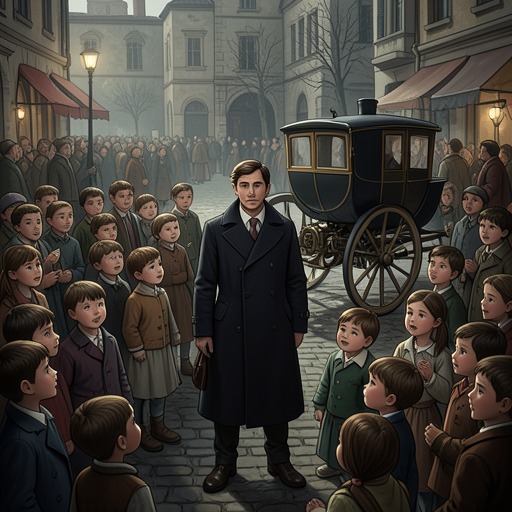
The available places on the Toyland Carriage are full. To show Pinocchio how welcome he is, the man in charge offers to give up his own place on the box. The accommodation turns the invitation into a practical passage out: Pinocchio is no longer merely imagining the country Lucignolo has described but has been given a seat on the vehicle that will take him there. The departure is set against the Fairy’s instruction to return before dark, yet it takes place at night, after Pinocchio has acknowledged that he means to break the promise.
During the journey, Pinocchio hears a donkey weeping and pities the animal. The man in charge dismisses its tears and urges him not to waste time watching a donkey cry, reminding him that the night is cool and the road long. Pinocchio obeys without answering, and the Toyland Carriage continues on its way. The brief exchange places pity beside obedience: Pinocchio responds to the animal’s distress, but he does not act on that response or challenge the journey. By daybreak, the carriage has reached its destination.
Arrival in Toyland
Toyland is presented as unlike any other country. Its population consists entirely of boys: the oldest are fourteen, and the youngest only eight. The streets are crowded with children playing at marbles, tiles, and ball; riding bicycles and wooden horses; playing blind man’s buff and chasing one another. Others perform, sing, tumble, walk on their hands, roll hoops, or parade in makeshift military costumes, while some imitate clowns and eat burning tow. The variety makes Lucignolo’s promise of uninterrupted amusement concrete, but the scene is also defined by excess: shouting, laughter, whistles, clapping, and cries combine into a din so overpowering that a person would need cotton in their ears to avoid being deafened.
The amusements extend beyond the streets. Canvas theaters in every square are crowded with boys from morning to night, and charcoal writing appears on the walls of the houses. The journey therefore ends not in a private excursion but in a whole environment organized around children’s play. Its dawn arrival delivers what Lucignolo advertised, while sharply setting that world against the breakfast, schooling, and promised change Pinocchio has left behind. The event closes at the threshold of Toyland: the boys have arrived, and the country’s boy-only population and ceaseless noise reveal the shape of the choice Pinocchio has made.