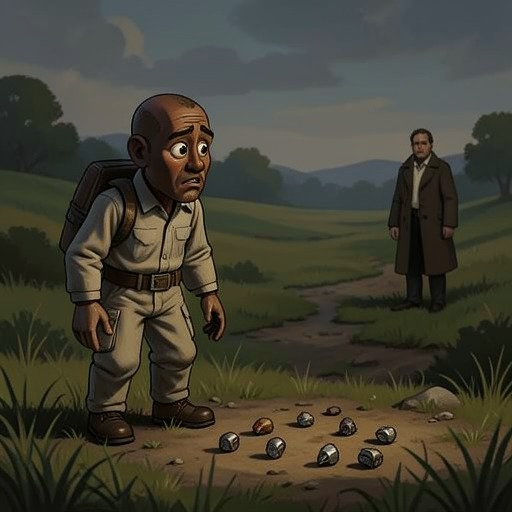
Pinocchio Sells His Primer to See a Puppet Show
Pinocchio (Tania Zamorsky Edition)Pinocchio Sells His Primer to See a Puppet Show is a turning-point episode in which Pinocchio trades the material sign of Geppetto’s sacrifice for the chance to follow a passing attraction. The choice is especially revealing because Pinocchio has just imagined using education to earn money for his father: the primer is at once the means of that hoped-for future and the object he gives up to reach the puppet theater. The sale carries him into a new encounter, where the puppets recognize him and Mangiafoco’s appearance turns the excitement into danger.
The Primer and Pinocchio’s Promise
After the snowfall stops, Pinocchio sets out toward school with his new primer under his arm. On the way, he pictures a sequence of achievements: learning to read that day, to write the next day, and to do arithmetic the day after. He imagines that his growing ability will bring him money, which he will use to buy Geppetto a fine jacket. His fantasy escalates from cloth to silver and gold, with diamond buttons, because he knows that Geppetto has gone without a coat to buy the books and secure his education.
The imagined gift gives the primer a meaning beyond its use as a schoolbook. Pinocchio sees education as a path toward earning money and repaying his father, and he recognizes the cold Geppetto has endured for his sake. For a moment, gratitude and a plan for the future seem to point in the same direction: the book is the first step toward the repayment he imagines. That makes the impending exchange more than a casual change of route. Pinocchio will give up the very object tied to his promise before he has begun to use it.
The Choice to Follow the Music
As Pinocchio thinks about Geppetto’s sacrifice, he hears the distant sound of fifes and a bass drum. The music interrupts the route to school with something immediate and enticing. Pinocchio pauses over the choice, recognizing that he must decide between going to class and listening to the performers. He settles the question by postponing school: he will go to the music today and attend class tomorrow, since there will always be time for school.
That decision reverses the order on which his imagined future depends. Study had appeared in his plan as the beginning of earning and giving back; now he treats it as indefinitely postponable, while the theater’s attraction demands action at once. He turns down a side road and runs toward the increasingly distinct sounds of the fifes and drum. The scene’s turn lies in the gap between the careful future he has just pictured and the impulsive present he chooses instead. Pinocchio does not lack an understanding of Geppetto’s hardship; he has just dwelt on it. Yet awareness does not hold him to his resolve when the music offers another course.
The Sale for Four Soldi
At the theater, Pinocchio learns that admission costs four soldi. He asks another boy to lend him that amount until the following day, but the boy refuses, teasing him that he cannot provide the money. Pinocchio then considers selling his new primer. The hesitation is visible in the delay: he is on the point of making the offer, but lacks the courage to do so immediately and wavers before finally asking whether the boy will give him four soldi for the book.
The boy answers that he buys nothing from children, and the exchange might have ended there. Instead, a used-clothes dealer who has heard them offers four soldi for the primer. Pinocchio accepts, and the book is sold on the spot. The amount is exact: the primer becomes the entrance money Pinocchio needs. Its practical value as a means of study is exchanged for access to the show, making his choice concrete and irreversible within the scene. The contrast is sharpened by Geppetto’s absence. At home, he is trembling in the cold, in his shirtsleeves, after buying the book for his son; the object he sacrificed to provide is now funding Pinocchio’s diversion.
The Theater and Its Immediate Consequence
With the sale complete, Pinocchio can enter the puppet theater. His arrival causes a commotion: the puppets recognize him as their brother and give him a great welcome. The episode thus delivers the attraction for which he has abandoned school, but it does not leave him in uncomplicated celebration. At the height of the welcome, the puppeteer Mangiafoco appears, and Pinocchio faces the danger of meeting a bad end.
The sequence links the choice of entertainment to the next peril without making the theater merely a reward or a punishment. Pinocchio’s impulse brings him into contact with figures who recognize and celebrate him, then places him under the threat associated with Mangiafoco. The sale also establishes a recurring tension in Pinocchio’s conduct: he can imagine care for Geppetto and speak to himself of repayment, yet he readily sacrifices the means of that future when immediate temptation intervenes. Here the cost is legible in a single object, bought through Geppetto’s exposure to the cold and sold for the precise price of admission.