Pinocchio and the Cat: Victim and Deceiver
Pinocchio (Tania Zamorsky Edition)The Cat is Pinocchio’s accomplice in deception and, later, one of the ruined figures who asks him for charity. Their relationship is not presented as a private or intimate bond: the Cat operates alongside the Fox, helping draw Pinocchio into a chain of fraud whose losses reach far beyond the coins stolen from him. When they meet again, the Cat’s blindness and the Fox’s destitution make the consequences of their earlier tricks visible. Pinocchio recognizes them, refuses their appeal, and leaves them behind.
The Cat as a Partner in Deception
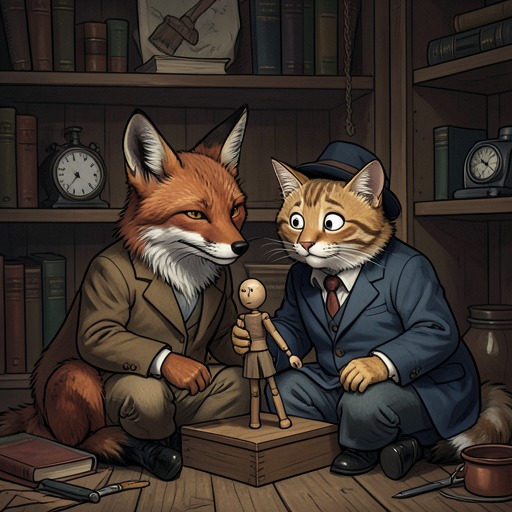
The Cat enters Pinocchio’s account of his misfortunes as one half of a pair. Reunited with Geppetto, Pinocchio recounts how the Fox and Cat led him to the Inn of the Red Crawfish after he had received five gold coins from Mangiafoco to take to his father. The pair ate greedily at the inn; Pinocchio left alone at night, and his journey continued into an encounter with the assassins who pursued and hanged him. The Cat is not singled out as the sole author of this scheme. The narrative places him beside the Fox as a joint deceiver, part of the company that diverted Pinocchio from delivering the money.
The inn episode establishes the pattern that governs the relation: Pinocchio entrusts himself to the pair, and they exploit that trust for their own advantage. The coins were meant for Geppetto, who had sold his coat to buy Pinocchio a primer; instead, Pinocchio spends one coin at the inn and carries the remaining four into the later promise of a miraculous increase. The Cat’s part in the partnership therefore belongs to a broader reversal of the father’s sacrifice: money intended to support Pinocchio’s schooling and family is drawn into a sequence of false hopes and loss.
Deception and Its Consequences
After the inn, Pinocchio’s account traces how the four remaining coins are buried with the Fox and Cat, and how he later discovers that the promised wealth is gone. The Cat is implicated in the joint fraud rather than named as the individual who takes the money. Pinocchio’s recollection stresses the result: he has been robbed, yet when a judge learns of the theft, Pinocchio himself is sent to prison. The episode makes the pair’s deception more than a brief financial trick. Its consequences continue through further danger and punishment, while the person who has lost the coins is treated as the wrongdoer.
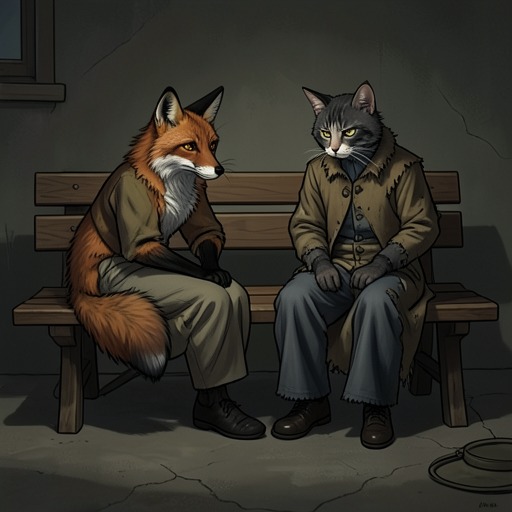
At their later meeting, the Cat’s history of deception has left a mark on his body. The narrator reports that he had pretended to be blind so persistently that he eventually became genuinely blind. The change is a sharp reversal: a false appearance adopted as part of deceit becomes an actual incapacity. The Cat now sits by the roadside with the Fox, asking for alms as one of two sick and impoverished figures. The story does not make the Cat’s present blindness a new trick; it identifies it as the lasting outcome of his earlier performance.
The Beggars’ Appeal and Pinocchio’s Refusal
Pinocchio and Geppetto have set out to find a house or hut where they might receive a little bread and straw for bedding. Before they have gone a hundred paces, they see two ragged-looking beggars on the roadside. The Fox calls to Pinocchio and asks him to show charity to two poor invalids. The Cat echoes the appeal, repeating the Fox’s description of them as sick. His short repetition recalls the pair’s former unity: even in their changed circumstances, he follows the Fox’s lead.
Pinocchio recognizes both of them and answers that they deceived him once and will not trick him again. The Fox insists that they are truly poor and unfortunate, while the Cat repeats the claim. Their present need is thus set against the earlier fraud without erasing it. Pinocchio does not mistake the Cat’s blindness for proof of innocence, nor does he give money simply because the old partners now suffer. His refusal is grounded in recognition and memory: he understands who is asking and what happened when he trusted them before.
Retribution and Moral Reversal
Pinocchio’s response turns the encounter into a reckoning expressed through proverbs. He invokes Stolen Gains Never Bring a Good Outcome, then The Warning to Earn Honestly and Beware of Getting Rich Without Work, and finally the warning that a thief who steals a neighbor’s cloak may end up without a shirt. These maxims answer the Fox and Cat’s pleas with a moral account of their poverty: their present condition is represented as the consequence of the dishonest means by which they once profited.
The reversal is concrete rather than abstract. The Cat who pretended to be blind is now truly blind; the Fox has grown old and impoverished, has lost part of his body, and has sold his tail to a traveling merchant to be made into a flyswatter. The two former deceivers ask for help from the person they once misled, but Pinocchio and Geppetto continue calmly along their road. The Cat’s role in the relation therefore ends not with reconciliation but with a changed balance of power: Pinocchio, once vulnerable to the pair’s promises, can now identify their appeal, reject it, and move on.