Pinocchio's nose growth
Pinocchio (Tania Zamorsky Edition)Pinocchio’s growing nose turns an uncanny feature of his wooden body into a visible consequence of dishonesty. First, it lengthens as Geppetto carves it, for no stated reason; later, in the Blue-Haired Fairy’s house, successive lies make it grow until Pinocchio can no longer move freely or even pass through the door. Its dramatic return in a later scene, when a false account is replaced with a truthful one, makes the nose a recurring measure of the gap between Pinocchio’s words and his conduct.
Creation and First Growth
As Geppetto makes Pinocchio, the nose begins to grow as soon as it has been carved. It becomes enormous within minutes, and Geppetto tries to shorten it by cutting and trimming it. His efforts have the opposite effect: the more he cuts, the longer the nose becomes. This first episode establishes the feature before the story explicitly connects it to lying. The nose is initially a comic, unruly part of the puppet’s making, beyond the control of the craftsman who is trying to shape him.
The contrast between Geppetto’s deliberate handiwork and the nose’s inexplicable growth gives the feature an early double character. It belongs to Pinocchio’s physical form, yet resists the ordinary process by which that form is made. Later episodes give this strange bodily trait a moral function, but its first appearance precedes that explanation: the nose is already excessive before it becomes an instrument for exposing falsehood.
Growth During the Fairy’s Questioning
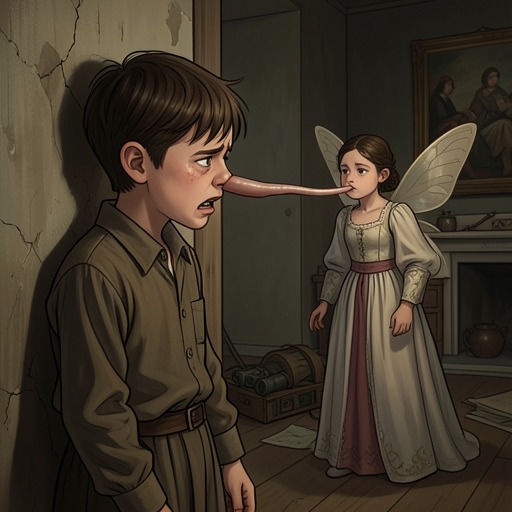
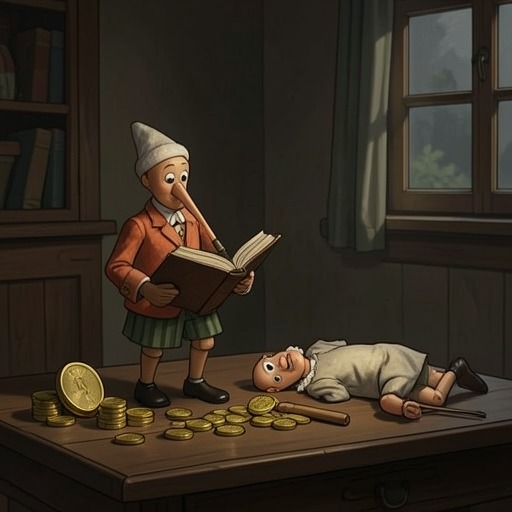
The clearest connection between lying and growth comes when the Blue-Haired Fairy asks Pinocchio what happened to his four gold coins. He claims to have lost them, although they are still in his pocket, and his already long nose immediately grows by two fingers. When she asks where he lost them, he places the supposed loss in a nearby wood; the nose grows again. He then changes his account, saying that he swallowed the coins while drinking the Fairy’s medicine. This third lie produces the most extreme growth of the exchange.
The change is not merely a visible mark. Pinocchio’s enlarged nose restricts his movements inside the room: turning one way, he strikes the bed or the windowpanes; turning the other, he hits the walls or the door. If he raises his head, he risks poking the Fairy in the eye. When he tries to flee from the embarrassment, the nose is too long for him to get through the doorway. Each invented explanation has made the physical problem harder to conceal, until the lie itself obstructs his attempted escape.
The Fairy laughs at Pinocchio’s predicament and explains that lies come in two kinds: those with short legs and those with long noses. His belongs to the latter kind. The explanation makes the nose more than a private bodily oddity: it renders his deception legible to another person even while he is trying to manage what she believes. The increasing size also gives the scene a step-by-step structure. A first false answer prompts a small addition, further answers compound it, and the final lie leaves him unable to move through the room as he wishes.
Correction and Restoration
The Fairy does not immediately release Pinocchio from the predicament. She lets him cry and shout for half an hour, making the discomfort a deliberate lesson intended to correct his habit of lying. When she sees how desperate he has become, however, pity moves her to act. She claps her hands, and a thousand large birds called woodpeckers enter through the window. Settling on Pinocchio’s nose, they peck at it until, within minutes, its enormous length has been reduced to its natural size.
The repair echoes the earlier attempt to shape the nose, but the means and result are different. Geppetto’s cutting could not control its growth; the Fairy’s intervention, carried out by the birds she summons, restores its ordinary proportions. The scene resolves the immediate physical trap without treating the deception as harmless: Pinocchio has first been made to endure the consequences, and relief comes only after his distress has become plain to the Fairy.
A Repeated Test of Truth
The nose’s moral function recurs when Pinocchio describes himself to an old man. He first offers an entirely favorable portrait, calling himself studious, obedient, and devoted to his father and family. As he continues these false claims, he touches his nose and discovers that it has grown by more than a span. Alarmed, he tells the old man not to believe the praise and instead describes himself as disobedient and lazy, someone who goes off with companions rather than to school. As soon as he says this, his nose shortens and returns to its natural size.
This reversal gives the recurring device a different emphasis from the episode in the Fairy’s room. There, a series of lies makes concealment physically impossible; here, Pinocchio’s correction changes the bodily consequence at once. The nose records not simply that he has spoken, but that the account he is giving does not match what he knows about himself. His false self-presentation lengthens it, while his admission of his own faults restores it. Together, the episodes make the nose an outward sign of dishonesty and a comic restraint on Pinocchio’s attempts to control how others see him.