Pinocchio’s Creation
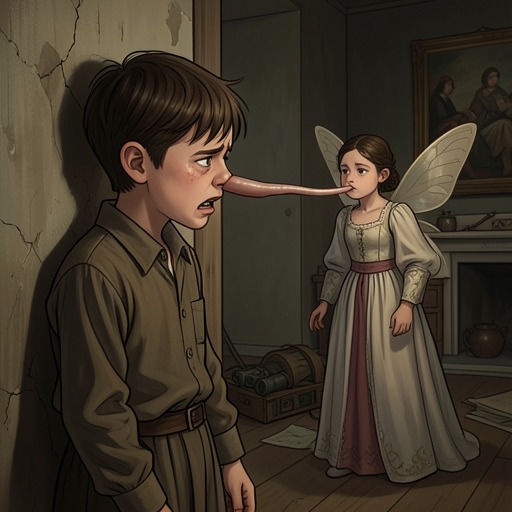
Pinocchio (Tania Zamorsky Edition)Pinocchio’s Creation transforms Geppetto’s piece of wood into a puppet who almost immediately exceeds his maker’s control. The episode unfolds through small acts of workmanship—carving the face, adding the limbs, teaching the feet to move—until an object being shaped becomes an independent runner. Pinocchio’s name is bestowed in hope of good fortune, but his first actions replace Geppetto’s expectation of a finished creation with the urgent task of trying to catch him.
Background and Setting
After settling his quarrel with Maestro Ciliegia, Geppetto takes the piece of wood and limps home. The two men have ended their fight with a handshake and a promise to remain friends; each has paid a small physical price, Geppetto’s opponent bearing two extra scratches on his nose and Geppetto having lost two buttons from his jacket. The creation begins, then, after an encounter marked by both conflict and reconciliation, with Geppetto carrying the material that will occupy his attention at home.
The room where he works is spare: a ground-floor chamber lit by light from beneath a staircase, furnished with a poor chair, an inadequate bed, and a battered little table. Its painted hearth and painted pot create an image of domestic warmth rather than a real fire. The pot appears to boil and sends out smoke that seems genuine, but both the fire and the cooking are only painted. This setting makes the contrast between representation and material action part of the scene: the room’s apparent fire cannot cook, while the piece of wood Geppetto begins to carve will unexpectedly look back at him and then move.
Making and Naming
As soon as he enters, Geppetto takes up his tools and begins carving. Before settling into the work, he decides on the name Pinocchio, believing it will bring good luck. His reasoning turns on a family of people with that name: the father was called Pinocchio, the mother Pinocchia, and the children Pinocchi. Geppetto remembers that they all lived well, only to qualify the claim with a comic reversal: the richest among them begged for alms. The name is therefore given with optimism, but the example behind that optimism already carries a joke about what being well-off might mean.
Once he has chosen the name, Geppetto works steadily, making the hair, then the forehead, then the eyes. The order keeps the transformation close to the craft: Pinocchio is not introduced as a complete figure but emerges part by part from the wood under Geppetto’s tools. Yet the eyes disrupt the ordinary sequence of making. When Geppetto finishes them, he is astonished to find that they move and stare fixedly at him. The episode offers no explanation for this animation; it presents the moving gaze as a fact that confronts the maker in the midst of his work.
Limbs, First Movements, and Escape
The legs and feet remain to be made. Even before the puppet is finished, however, Pinocchio has begun to behave in ways that Geppetto reads as disrespectful. Geppetto rebukes him and wipes away a tear. When the feet are complete, Pinocchio kicks Geppetto on the tip of the nose. Geppetto responds by blaming himself, as though he should have anticipated what would happen, but the scene gives the puppet’s sudden action its own force: the first completed use of his feet is not a careful step but a blow to the person who made them.
Geppetto sets Pinocchio on the floor and takes him by the hand to teach him how to walk, one step after another. At first Pinocchio’s legs are stiff and he cannot manage by himself. Once they loosen, the lesson changes abruptly. He begins walking alone, runs around the room, passes through the doorway, leaps into the street, and bolts. Geppetto runs after him but cannot catch up; Pinocchio moves in bounds like a hare, his wooden feet clattering on the paving stones with a noise compared to twenty pairs of farmers’ clogs.
Consequences and Significance
The escape turns a domestic act of making into a public spectacle. Geppetto cries for people in the street to catch the puppet, but the onlookers stop to watch the wooden figure racing past and laugh. The first consequence of Pinocchio’s new mobility is thus not obedience or a quiet demonstration of his maker’s skill, but separation: Geppetto pursues, Pinocchio flees, and strangers become spectators to the chase.
The episode’s sequence gives the puppet’s material body an active role in shaping events. Eyes that move, feet that kick, and legs that carry Pinocchio through the doorway each change what Geppetto can do next. He begins as a craftsman choosing a name and forming a figure; he becomes a fatherly teacher guiding a stiff-legged child; within moments, he is a pursuer unable to keep pace. Pinocchio’s creation is therefore also the beginning of a conflict between making and control. The wood becomes a moving presence, and the first proof of its independence is its escape from the room in which it was made.