The Fox and the Cat
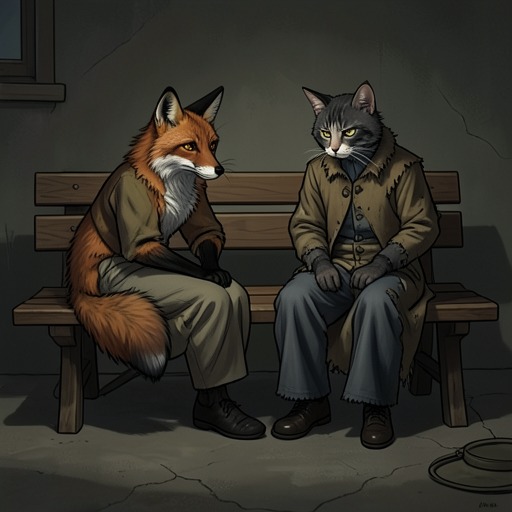
Pinocchio (Tania Zamorsky Edition)The Fox and the Cat are a pair of traveling companions whose apparent mutual dependence gives way to a shared scheme against Pinocchio. The Fox presents himself as lame in one foot and leans on the Cat, who appears blind in both eyes and lets the Fox guide him. Together they turn a chance meeting into a promise of effortless wealth, then exploit the trust they have cultivated to steal the five gold coins Pinocchio buried. Their partnership links outward vulnerability to practiced deception, and makes their coordinated conduct—not either companion in isolation—the instrument of the fraud.
Identity and Partnership
When Pinocchio meets them on the road, the Fox and the Cat seem to be helping one another through misfortune. Their impairments are described in complementary terms: one cannot walk unaided, the other cannot see, so the Fox supports himself on the Cat while the Cat follows the Fox’s guidance. This visible arrangement introduces them as a compact pair, each apparently supplying what the other lacks. The encounter invites sympathy as well as trust, although the story later places that presentation beside their deliberate exploitation of Pinocchio. It does not establish that either disability is feigned; what it does establish is that the companions act together when an opportunity to take his money arises.
Their social manner helps open the conversation. The Fox greets Pinocchio politely and knows his name, prompting the puppet to ask how he recognizes him. The pair’s familiarity is soon joined by mockery: when Pinocchio calls himself a great gentleman and displays the coins, the Fox laughs loudly at him, while the Cat joins in more discreetly, grooming his whiskers with his front paws. Pinocchio resents the laughter and insists that the five gold coins are valuable. The exchange makes the coins visible to both companions and gives the Fox an opening to redirect the conversation from Pinocchio’s intended journey home toward a supposed opportunity.
The Promise of the Field of Miracles
The Fox proposes that Pinocchio could turn his five coins into a much larger fortune if he went with the two companions instead of returning home. He first raises the prospect of hundreds or thousands of coins, then describes a supposed blessed field in the Country of the Owls, known as the Field of Miracles. The procedure is presented as simple and almost domestic: make a small hole, bury a gold coin, cover it with earth, water it with two buckets of fountain water, add a pinch of salt, and go to bed. By morning, the Fox claims, the coin will have sprouted into a tree bearing gold coins as numerous as grains on an ear of wheat.
Pinocchio asks what would happen if he buried all five coins. The Fox turns the promise into arithmetic, claiming each coin could yield a cluster of five hundred and that Pinocchio would find 2,500 coins in his pocket the next morning. The specificity makes the impossible offer sound calculated rather than fantastic: a planting method, a night’s wait, and a multiplication that Pinocchio can imagine checking. The Cat reinforces the scale of the promised reward by repeating the figure of two thousand. Their coordinated persuasion addresses Pinocchio’s astonishment not with evidence but with an increasingly concrete picture of effortless gain.
Companions on the Road
Pinocchio accepts the invitation, and the three travel together toward the promised field. By evening they are exhausted and stop at the Red Shrimp Inn, where the Fox says they should eat and rest for a few hours before setting out again at midnight, so they can reach the field at dawn. The schedule keeps the promised result close at hand: only a brief meal, a night journey, and the anticipated morning harvest stand between Pinocchio and wealth.
The inn scene adds a comic detail to the pair’s performance of hardship. Although none of the three is said to have an appetite, the Cat claims to be seriously indisposed in the stomach and nevertheless eats thirty-five mullets with tomato sauce and four portions of Parmesan tripe. Finding the tripe insufficiently seasoned, he asks three times for butter and grated cheese. The episode does not undo the companions’ apparent disabilities, but its extravagant contrast between professed indisposition and consumption gives their shared journey a vein of comedy. Their attention remains on reaching the field, not on any evidence that the planting scheme could work.
The Second Encounter and the Theft
Later, after the Blue-Haired Fairy tells Pinocchio that Geppetto may be found by taking the forest road, Pinocchio runs into the forest, eager to meet his father. Near the Great Oak, he encounters the Fox and the Cat again—the same fellow travelers with whom he had dined at the inn. The Fox embraces and kisses him warmly, and the Cat echoes the Fox’s greeting. Their affectionate reception revives the impression of an established companionship just as Pinocchio is headed toward a reunion with Geppetto.
The reunion-like greeting sits in sharp contrast with what the Parrot soon tells Pinocchio: while he was away in town, the Fox and the Cat returned to the field, took the buried gold coins, and fled as fast as the wind. Pinocchio refuses at first to believe the report. He digs into the ground with his hands and nails, making a hole so deep that a haystack could have stood upright in it, but finds none of the coins. His frantic search confirms the theft materially; the promise of a tree laden with gold has left only an empty hole. He runs back to town and goes to court to report the two thieves.
Narrative Role and Significance
The Fox and the Cat’s relationship is defined by coordinated action: the Fox greets, mocks, persuades, explains, and sets the travel plan, while the Cat echoes the promised sums and joins the journey. The story establishes this coordination through repeated encounters, first on the road and then again in the forest, before disclosing the theft that gives their earlier assurances their full significance. The return to the field while Pinocchio is away also turns the scheme from an empty promise into a practical theft: the companions do not merely fail to produce wealth; they take the money he entrusted to their instructions.
Their episode makes the wish to gain wealth without work the hinge of Pinocchio’s vulnerability. The Fox even frames the Field of Miracles as a way to multiply the coins, while the later account of the theft exposes the actual result of following that promise. The pair’s apparently reciprocal dependence offers a striking outward image of partnership, but their decisive cooperation is directed against Pinocchio. In the end, his hole in the earth and his report to the court replace the fortune he expected with loss and attempted redress.