The Temptation of Bad Companions
Pinocchio (Tania Zamorsky Edition)The Temptation of Bad Companions names a recurring danger in Pinocchio’s adventures: persuasive companions redirect him from home, study, and promises of reform by making an easier, more pleasurable course seem irresistible. The Fox and the Cat tempt him with effortless riches; Lucignolo turns him toward a life without school or work. In both episodes, the appeal succeeds because Pinocchio’s own good intentions prove weaker than the prospect held out to him, making bad company both an external influence and a test of his judgment.
The First Offer: The Fox and the Cat
After leaving Mangiafoco’s puppet troupe, Pinocchio sets off for home with five gold coins and instructions to take them to his father. He has not gone half a kilometre when he meets the Fox, lame in one foot, and the Cat, blind in both eyes. They move along by helping one another: the Fox leans on the Cat, and the Cat lets the Fox guide him. The appearance of two companions supporting one another gives their partnership an inviting surface before the Fox begins to redirect Pinocchio’s journey.
The Fox greets Pinocchio by name, and soon the pair are talking about the coins. The Fox proposes that Pinocchio could turn five coins into a hundred, a thousand, or two thousand. When Pinocchio asks how, the answer is simple: rather than go home, he should come with them. The offer works by replacing the modest, immediate duty of delivering the money with the prospect of a vastly larger return. Its promised ease matters as much as the imagined wealth: the journey home can be abandoned in favour of a scheme that seems to make fortune available without the labour that would ordinarily earn it.
The Fox and the Cat reinforce the pitch with a performance of selflessness. The Fox claims that they work not for personal gain but to enrich others, and the Cat echoes the declaration. Pinocchio takes this claim as proof of their goodness. In accepting their invitation, he forgets his father, the new jacket, his primer, and all the good resolutions he had made. Those particular objects and obligations show what the temptation displaces: the coins meant for home, the clothing and book associated with his preparation for school, and the intentions that should have guided him. His agreement to go with the pair marks not merely a change of direction on the road but a suspension of the purposes he had just set out to pursue.
School, Good Advice, and Peer Pressure
The same vulnerability appears later in a setting where Pinocchio has been doing well. His classmates have come to like him, and his teacher praises him as attentive, intelligent, and studious. He is the first to arrive at school and the last to get up when lessons end. Yet this success has a weak point: he spends too much time with companions known for their reluctance to study or distinguish themselves. The danger is not that Pinocchio lacks the ability to work; the contrast makes clear that he has already shown diligence. The problem is the company he keeps and the influence he assumes he can resist.
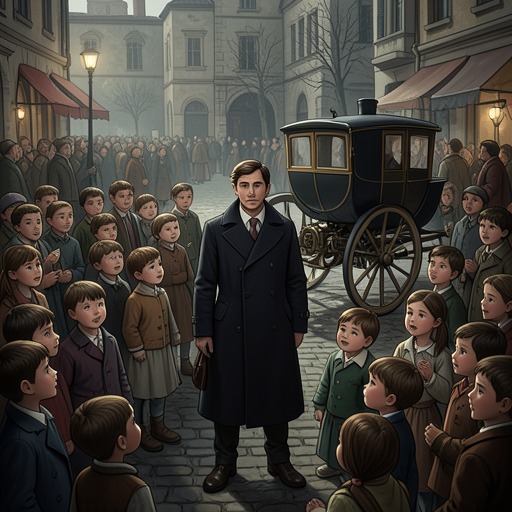
His teacher warns him, and the Blue-Haired Fairy repeatedly cautions that these school companions may make him lose his love of study and bring serious trouble upon him. Pinocchio brushes off the warnings with a shrug and a tap to the middle of his forehead, a gesture meant to show that he believes himself sensible enough to avoid harm. The confidence is undercut by what follows. When the boys approach him on his way to school, they try to draw him away from his lessons and ask whether he is not ashamed to be so punctual and diligent. They say his studying makes them look bad before the teacher. Their pressure turns his good conduct into a source of embarrassment, inviting him to exchange his own standards for the group’s approval.
Lucignolo and the Promise of Toyland
Lucignolo is Pinocchio’s favourite and dearest school companion, despite being described as the laziest and most mischievous boy in the school. His nickname comes from his thin, elongated build, compared to a new wick for a night lamp. The contrast between affection and poor influence is central to their friendship: Pinocchio cares deeply for him, but Lucignolo’s habits and choices pull in the opposite direction from the diligence Pinocchio has begun to practise.
The temptation emerges around Pinocchio’s intended breakfast. After saying goodbye to the Blue-Haired Fairy, whom he regards as a kind of mother, he invites his friends to join him. He goes to Lucignolo’s home and fails to find him twice; on the third attempt, he sees him hiding beneath the portico of a farmhouse. The invitation to share breakfast belongs to Pinocchio’s ordinary, affectionate plans, but the meeting becomes an opening for Lucignolo to describe a different future. He says he is going to live in the most beautiful country in the world, a place of abundance, and asks Pinocchio to come to Toyland.
Pinocchio does not approach the proposal without misgivings. As he considers leaving, he says that the Fairy will be worried about him and asks whether the country really has no schools. Those questions reveal that the duties he is about to neglect remain present to him. Lucignolo’s appeal, as Pinocchio later recounts it, is that study is boring and that Toyland offers amusement from morning until night, with no studying. The contrast is stark: school asks for sustained effort, while the promised country offers pleasure without lessons. Pinocchio later admits that he had wanted to go home, obey, continue studying, and do well; he followed Lucignolo’s invitation instead.
Consequences and the Meaning of the Pattern
After the journey’s consequences become visible, Pinocchio initially blames Lucignolo, calling him a false friend and a bad companion. He recalls Lucignolo’s promise of a place where they would not study and would be happy all day, and threatens to give him a piece of his mind if they meet again. Yet his account does not leave responsibility with Lucignolo. Pinocchio also confesses that he was a puppet without judgment or heart, and regrets abandoning the Blue-Haired Fairy, who loved him like a mother and had done so much for him. He imagines that, had he possessed a little more heart, he might have become a well-behaved boy instead of remaining a puppet.
The physical consequence makes the cost of that choice impossible to conceal: Pinocchio has donkey ears and hides them beneath a large cotton cap, pulling it down over his face so the public will not see them. His first response is blame and anger, but his confession widens the explanation from a companion’s influence to his own willingness to follow it. Across the two episodes, the form of temptation changes—from the Fox and the Cat’s promise to multiply money to Lucignolo’s promise of endless amusement—but its mechanism remains recognizable. Each companion offers an appealing shortcut away from an obligation Pinocchio understands. The repeated pattern gives bad companionship its force in the story: warnings can identify the danger, and good intentions can be sincerely made, but neither prevents harm when Pinocchio chooses the tempting invitation over the course he knows he should follow.