Toyland Carriage
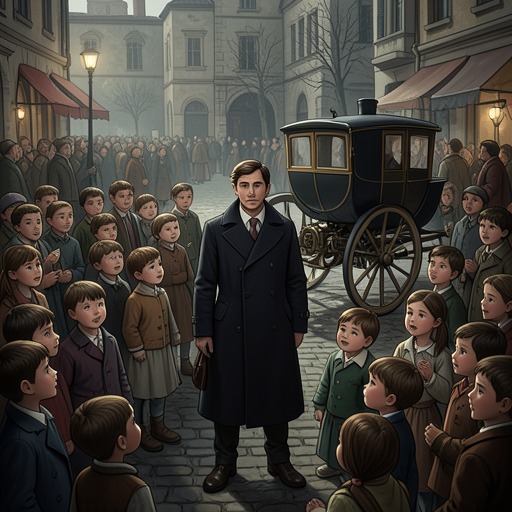
Pinocchio (Tania Zamorsky Edition)The Toyland Carriage is the vehicle that takes Pinocchio, Lucignolo, and a crowd of boys to the country they have been promised will offer uninterrupted play. It arrives almost silently in the night, drawn by twenty-four donkeys in white leather boots, and carries its passengers packed so tightly that they can scarcely breathe. Its journey turns the boys’ desire to escape school into a physical passage, while the carriage’s curious details set the promise of carefree pleasure against the discomfort and warning signs of the ride.
The Promised Journey
Lucignolo tells Pinocchio that more than a hundred boys will make the journey together. They will not have to walk: a carriage is due at midnight to collect them and take them across the border into the fortunate country. The vehicle thus enters the story first as a promise, described through the destination and the company it will bring rather than through its appearance. Pinocchio’s impatience for midnight registers how powerfully the prospect of leaving ordinary obligations has caught his attention.
The carriage’s approach is announced by a tiny light moving in the distance, accompanied by the sound of bells and a trumpet. The noise is so faint and muffled that it resembles a mosquito’s whine. This subdued arrival suits the hour and makes the vehicle seem almost furtive: it comes for the boys in darkness, not as a public conveyance announced by a loud procession. When it finally arrives, its wheels are wrapped in tow and rags, so that it makes not the slightest noise. The muted sounds that announce it give way to deliberate silence as it draws near.
Construction and Passengers
Twelve pairs of donkeys pull the carriage, making twenty-four animals in all. They are alike in size but varied in coloring: some are gray, some white, some speckled like salt and pepper, and some striped in large yellow and blue bands. The detail that most distinguishes them is their footwear. Instead of the iron shoes expected on draft or pack animals, they wear white calfskin boots. The team is at once organized for hauling and made strange by its human-style footwear; the oddity marks the vehicle’s journey as unlike an ordinary trip without explaining away its practical means of transport.
Inside, the carriage is already full of children between eight and twelve years old, heaped together like anchovies packed in brine. They are cramped and can hardly breathe, yet none complains. Their endurance is explained by what they expect at the journey’s end: in a few hours they will reach a place without books, schools, or teachers. The promised freedom makes them accept discomfort, hunger, thirst, and sleepiness without protest. The carriage therefore does not simply offer comfortable escape. Its passengers willingly submit to its crowded conditions because the imagined reward matters more to them than the immediate hardship.
The driver’s appeal is part of the same attraction. The little man is described as short and broad, with a rosy face, a constantly smiling mouth, and a thin, soothing voice. Boys who see him fall in love with him and compete to climb aboard. The account links the carriage’s popularity to the person who controls it: its hold over the children begins before the wheels carry them anywhere. The eager crowd and the packed interior show how readily the promise draws passengers, even when the vehicle has no room to spare.
Pinocchio Boards
Pinocchio does not board at first. After Lucignolo urges him not to dwell on the Fairy’s likely distress, Pinocchio sighs repeatedly and then asks to come along. The seats are all taken, but the little man offers him the place on the box, presenting the accommodation as evidence that Pinocchio is welcome. Pinocchio accepts, and the carriage starts moving. The offer makes his choice possible without changing the journey’s crowded character: he rides outside with the driver rather than taking a place among the boys inside.
As the donkeys gallop and the carriage runs along the road, Pinocchio hears a low, barely intelligible voice warning that he will regret having acted as he pleased. He looks around but cannot discover where the words came from. The scene supplies no identified speaker, and the carriage continues regardless: the animals gallop, the boys sleep, Lucignolo snores, and the little man hums between his teeth. The warning is thus placed against the vehicle’s steady forward motion and the passengers’ obliviousness. It does not turn Pinocchio back; the carriage carries him onward while the consequence of his decision remains ahead.
Arrival and Narrative Function
The carriage brings the boys to their destination by dawn. The country they enter is unlike any other: its population consists entirely of boys, from eight to fourteen years old, and its streets resound with play and uproar. The carriage’s work is consequently more than the movement of passengers between places. It conveys Pinocchio from anticipation into the lived environment he has chosen, where the absence of books, schools, and teachers takes visible form in the boys’ activities and tumult.
After a later encounter on the road, the little man dismisses the sight of a crying donkey and tells Pinocchio to get back aboard. Pinocchio obeys without answering, and the carriage resumes its course; by the first light of dawn, it has reached the destination. This continuation makes the vehicle part of a pattern of forward movement that does not pause for pity. Its first silence concealed the arrival; its onward motion then carries Pinocchio past a distressing sight and into the country he had wanted. The carriage’s central significance lies in that double passage: it makes an enticing escape possible, but also bears its passengers toward consequences that the promise of pleasure has kept out of view.