Pinocchio Is Caught in a Trap and Forced to Guard the Henhouse
Pinocchio (Tania Zamorsky Edition)Pinocchio Is Caught in a Trap and Forced to Guard the Henhouse is an episode in which a journey home turns into an imposed night of punishment and confinement. Released from prison, Pinocchio sets out for the Blue-Haired Fairy's House, but hunger leads him from the road into a field, where a trap meant for weasels catches his legs. The farmer mistakes him for a thief of chickens and makes him serve as a watchdog. The reversal is blunt: Pinocchio leaves one prison only to be fastened by an iron chain to a farmhouse wall.
Causes and Background
Pinocchio has just been released after telling the jailer that he, too, is a rascal. The jailer accepts this explanation, respectfully removes his cap, opens the prison doors, and lets him go. Pinocchio is delighted to be free and immediately leaves the city, taking the road back toward the Blue-Haired Fairy's House. Rain has turned the way into mud deep enough to reach halfway up his legs, making the journey difficult before the later danger appears.
A large serpent lies across the road. Its green skin, fiery eyes, and pointed tail, which smokes like a chimney, make it an alarming obstacle. Pinocchio backs away and waits on a mound of stones, more than half a kilometre off, hoping the creature will move. He waits one hour, then two, then three; the serpent remains in place. When Pinocchio eventually runs, he falls headfirst into the mud with his legs sticking into the air. The sight makes the serpent laugh so violently that a vein in its chest bursts, and it dies. Pinocchio can continue toward the Fairy's house, but the delay and the muddy road have not relieved his hunger.
The Trap and Capture
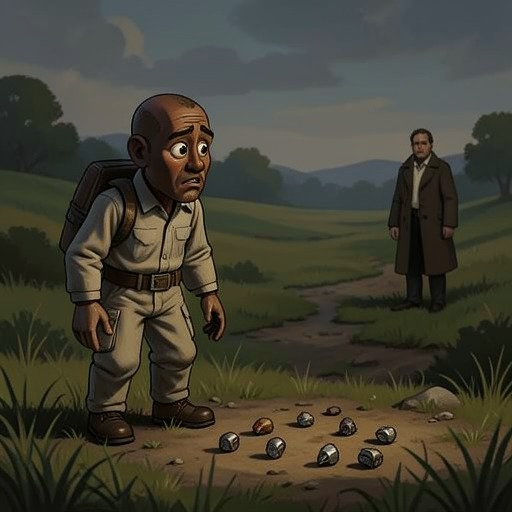
Unable to bear the pangs of hunger any longer, Pinocchio jumps into a field intending to pick a few bunches of muscat grapes. As soon as he reaches the vine, two sharp iron jaws snap around his legs. The trap was set by local farmers to catch large weasels that had been raiding the neighbourhood henhouses. Its purpose is practical, but it does not distinguish between the animals it was meant to catch and a hungry puppet reaching for grapes.
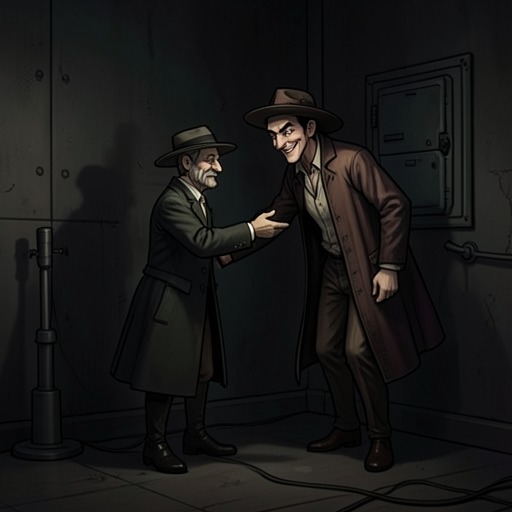
Pinocchio cries out, begs, and protests, but there are no houses nearby and nobody passes on the road. Later, the field's owner approaches quietly to see whether one of the weasels has been caught. He brings a lantern from beneath his coat and is astonished to find a boy in the trap instead. He accuses Pinocchio of stealing his chickens. Pinocchio denies it and explains that he entered the field only to take two bunches of grapes. The farmer treats the attempted grape theft as proof enough of a capacity to steal chickens, and announces that he will teach Pinocchio a lesson.
The farmer opens the trap, seizes Pinocchio by the scruff of the neck, and carries him bodily home, as one might carry a young lamb. In the yard in front of the house, he throws him to the ground and keeps a foot on his neck. Pinocchio's explanation has not changed the farmer's judgment; the movement from the trap to the yard converts suspicion into physical custody.
Forced Service in the Yard
The farmer says it is too late to settle matters that night. His own watchdog has died, so Pinocchio is ordered to take the dog's place and guard the henhouse. This punishment is not simply confinement: it assigns him the work of the animal whose death has left the farm unguarded. The farmer fits a large collar studded with brass spikes around Pinocchio's neck and tightens it so that it cannot be slipped over his head. An iron chain attached to the collar is fastened to the wall.
The farmer gives conditional instructions for the night. If it begins to rain, Pinocchio may shelter in a wooden kennel, where straw remains from the bed used by the farmer's dog for four years. If thieves come, he must keep his ears up and bark. The kennel and the collar make his new role unmistakable: he is treated as a replacement watchdog, with a dog's old sleeping place offered as shelter and the dog's duties imposed on him. The farmer then goes inside, shuts the door, and bolts it.
Reversal and Significance
Pinocchio is left crouching in the yard, nearly overcome by cold, hunger, and fear. The episode turns his effort to satisfy hunger into a loss of freedom and a forced obligation to protect the very household whose property he meant to trespass upon only briefly. The trap's iron jaws first hold his legs; the spiked collar and chain then extend that restraint into the night. His journey home has been interrupted not by a deliberate pursuit but by a sequence of obstacles, a hungry choice, and the farmer's punishment.
The farmer's accusation also sharpens the distinction between what Pinocchio says he has done and what the farmer assumes he is capable of doing. Pinocchio admits to entering the field for grapes, but denies taking chickens; the farmer treats the first act as sufficient evidence for the second. The story does not make Pinocchio's trespass disappear: he intended to take fruit that was not his. Yet the consequence exceeds the act, turning a brief attempt to eat into an enforced night of guarding, chained to a wall. At this point, the episode ends with Pinocchio still confined in the yard, cold, hungry, and afraid.