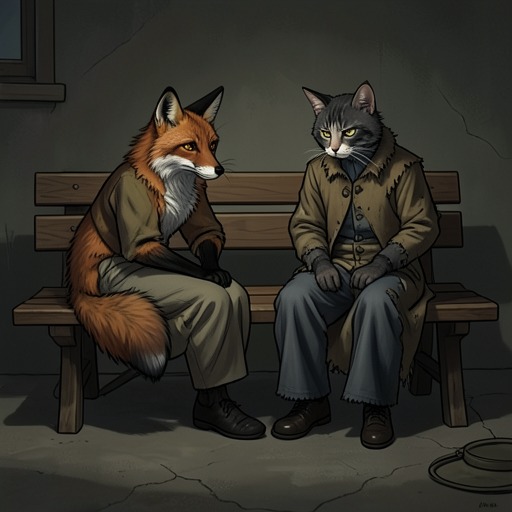
Pinocchio Refuses to Help the Destitute Fox and Cat
Pinocchio (Tania Zamorsky Edition)Pinocchio’s refusal to help the destitute Fox and Cat turns an encounter on the road into a reckoning with their earlier deception. Seeing his former tricksters reduced to beggars, he recognizes them, rejects their appeal, and invokes three proverbs that make their poverty seem like the consequence of their own theft. The scene marks a change in his response to them: this time, their pleas do not win his trust or his assistance.
The Encounter on the Road
Pinocchio and Geppetto are looking for a house or hut where someone might give them a little bread and straw for a bed. Before they have gone a hundred steps, they see two disreputable figures sitting on the roadside as if asking for alms. The narrator identifies them as the Fox and the Cat, but stresses how little they resemble the pair Pinocchio once knew. Their changed appearance makes their reversal visible before they speak.
The Cat has gone blind after pretending to be blind for so long that he has actually lost his sight. The Fox is old, weakened, and missing a tail. In extreme poverty, she sold her once-beautiful tail to a traveling peddler, who bought it to make a fly whisk. The account gives their present need precise, bodily signs: actual blindness where there had been a performance, and a missing tail turned into a marketable household object. Their former act of deception has not merely failed to enrich them; the scene presents them as diminished and dependent.
The Plea and Pinocchio’s Recognition
The Fox calls out to Pinocchio in a plaintive voice and asks him to show charity to two poor invalids. The Cat repeats the description, as if echoing the appeal could help it take hold. Their request is directed to someone who can identify them: the Fox addresses Pinocchio by name, and he answers by recalling that they deceived him once. He does not treat their present distress as proof that they have changed, nor does he allow their appeal to erase what he remembers.
Pinocchio’s reply is a refusal, not an offer to investigate their story or negotiate what help he might give. The Fox insists that they truly are poor and unfortunate now; the Cat repeats her claim. Pinocchio answers that if they are poor, they deserve it, tying their present condition to their past conduct. The exchange sets the pair’s repeated pleas against his increasingly settled judgment: the Cat echoes the Fox, but the repetition does not alter Pinocchio’s response.
The Proverbs and the Reversal of Fortune
Pinocchio supports his refusal with three sayings. First, he recalls the proverb that stolen money never bears fruit. When the Fox and Cat ask for compassion, he repeats the saying about the devil’s flour ending as bran. When they beg him not to abandon them, he invokes the warning that someone who steals a neighbor’s cloak will usually end up without a shirt. The images move from failed wealth, to spoiled produce, to the thief left with less than the person he robbed. Each saying answers a new appeal, so the proverbs become the scene’s refrain rather than a single, passing moral.
The maxims connect the pair’s earlier deception to their present destitution, but the scene delivers that connection through Pinocchio’s judgment. He uses familiar proverbial language to deny that poverty alone obliges him to help people who once tricked him. The Fox and Cat, for their part, offer pleas for charity and recognition of their hardship; they do not answer his accusations with an account of the past. Their alternating appeals and echoed words make their need audible, while his repeated farewell closes off any possibility that the encounter will become a reconciliation.
Departure and Significance
Pinocchio and Geppetto continue calmly along the road. After another hundred steps, they see a handsome straw hut in a lane among the fields, with a roof covered in tiles and bricks. Pinocchio suggests that someone must live there and proposes that they go and knock. The hut redirects the travelers toward their own immediate need for shelter; the scene does not show them giving aid to the beggars or learning what becomes of them afterward.
The episode reverses the earlier relation between the tricksters and their victim. The Fox and Cat now ask Pinocchio for help, but his memory prevents their misfortune from restoring the trust they once exploited. His response is severe: he treats their suffering as the fitting return for stolen gains rather than as a reason for mercy. The three proverbs give that refusal a compact moral structure, while the final contrast—his calm departure with Geppetto, followed by the discovery of a hut—moves the narrative onward without resolving the beggars’ plight.