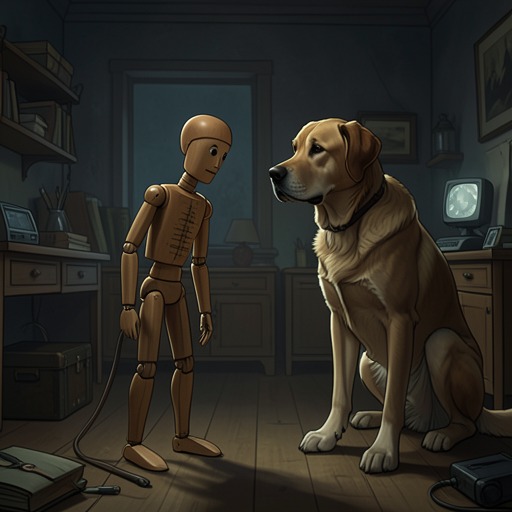
Pinocchio and the Tuna: Mutual Aid in Adversity
Pinocchio (Tania Zamorsky Edition)The relationship between Pinocchio and the Tuna turns shared confinement into reciprocal rescue. They meet as strangers swallowed by the Great Shark, part with little certainty that they will see one another again, and later meet once more in the water outside. The reversal is decisive: Pinocchio’s escape teaches the Tuna a way out, and the Tuna then carries Pinocchio and Geppetto to safety. Their bond is brief, but its shape is clear—help given under pressure returns as help when Pinocchio’s father is in danger.
A Meeting in Captivity
The Tuna first enters the relationship as a voice in the darkness. Pinocchio hears a rough, hoarse sound and is frightened enough to ask who is speaking. The answer identifies the speaker as a poor Tuna, swallowed by the Great Shark along with Pinocchio. The Tuna’s next question—what kind of fish Pinocchio is—exposes the difference between them: Pinocchio is a puppet, not a fish. Their conversation begins not in recognition or kinship but in the shared fact of being inside the monster.
That common confinement makes the Tuna a possible guide in Pinocchio’s thinking. Pinocchio imagines that the unseen fellow prisoner might be an old fish able to show him a way to escape, and decides to go find him. The Tuna answers with a heartfelt wish for good fortune. The exchange is modest, but it establishes kindness before either character can offer practical rescue: the Tuna cannot yet lead Pinocchio out, and Pinocchio has not yet asked him for help. Each is still caught in the same peril.
Parting and the Lesson of Escape
Their first meeting ends in farewell rather than a plan. Pinocchio says goodbye to the Tuna; the Tuna returns the farewell and wishes him good luck. When Pinocchio asks where they will meet again, the Tuna answers that no one knows and that it is better not even to think about it. The uncertainty gives their separation its weight: they are companions in captivity, but neither can promise survival or reunion.
Later, when the Tuna recognizes Pinocchio’s voice, he names their earlier bond directly: he had been Pinocchio’s fellow prisoner inside the Great Shark. Pinocchio asks how he escaped. The Tuna explains that he imitated Pinocchio’s example and followed the way Pinocchio had taught him. What began as a chance encounter has therefore altered the Tuna’s prospects. Pinocchio’s own route out becomes useful to another captive, extending the effect of his escape beyond himself.
The Return as Rescue
The reunion occurs when Pinocchio and Geppetto need help. Pinocchio addresses the Tuna as a friend and appeals to his love for his little Tuna children, asking him to help because otherwise the two escapees will be lost. The appeal connects the immediate danger to the Tuna’s family, but the Tuna agrees readily and wholeheartedly. He tells them to hold on to his tail and promises to guide them to shore in four minutes.
Geppetto and Pinocchio accept the offer at once, though they choose to sit on the Tuna’s back instead of clinging to his tail. Pinocchio asks whether the two of them are too heavy. The Tuna reassures him that they are hardly any weight, comparing the burden to two shells. His large, sturdy body, likened to that of a two-year-old calf, makes the rescue physically possible. The detail gives the exchange a practical tenderness: the question registers Pinocchio’s concern about burdening his rescuer, and the Tuna’s answer removes that concern as he carries both father and son.
At the shore, Pinocchio jumps down first and helps Geppetto follow. He then turns to the Tuna and thanks him for saving his father, saying that he cannot thank him enough and asking to give him a kiss as a sign of lasting gratitude. Pinocchio bends down on his knees and kisses the Tuna on the mouth. The gesture makes his gratitude bodily and immediate, rather than leaving it as words alone.
Reciprocity and Emotional Resolution
The Tuna is so moved by this spontaneous display of affection that he feels ashamed to be seen crying like a child. He pushes his head back beneath the water and disappears. The scene gives the rescuer, not only the rescued, an emotional response: the Tuna’s willingness to help is followed by a moment of tenderness that overwhelms his composure. The daylight arrives as Pinocchio offers his arm to Geppetto, who can barely keep himself standing, closing the rescue on the shore with attention returning to the father and son.
The relationship’s reciprocity is not a simple exchange arranged in advance. In captivity, Pinocchio’s example gives the Tuna a route to freedom; later, the Tuna uses his strength and knowledge of the way to carry Pinocchio and Geppetto to land. Pinocchio’s act of gratitude recognizes that the Tuna has saved his father, not merely himself. Their brief connection thus becomes part of the larger escape: an act of help received in one scene returns as help offered in another, and the final kiss acknowledges the friendship made possible by their shared danger.