The Rule That Lying Makes the Nose Grow Longer
Pinocchio (Tania Zamorsky Edition)The Rule That Lying Makes the Nose Grow Longer gives Pinocchio’s false speech an immediate, bodily consequence. When he lies about the whereabouts of four gold coins, his nose lengthens; repeated denials make it grow until it obstructs his movement and even prevents him from passing through a doorway. In a later encounter, the same visible sign exposes Pinocchio’s flattering account of his own character, then recedes when he replaces that account with an admission of his faults. The rule makes dishonesty not merely a matter of what Pinocchio says, but something his body displays and his speech cannot conceal.
The Rule and Its Visible Sign
The rule is explained by the Blue-Haired Fairy, who distinguishes between lies with short legs and lies with long noses. Pinocchio’s deception belongs to the second kind. This explanation gives a familiar expression a literal form: his nose becomes the outward measure of the falsehood, growing as he continues to lie. The story establishes the effect through successive incidents rather than supplying an abstract account of how the transformation works.
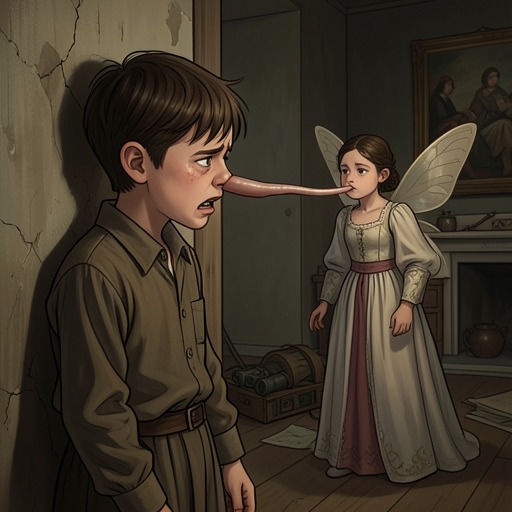
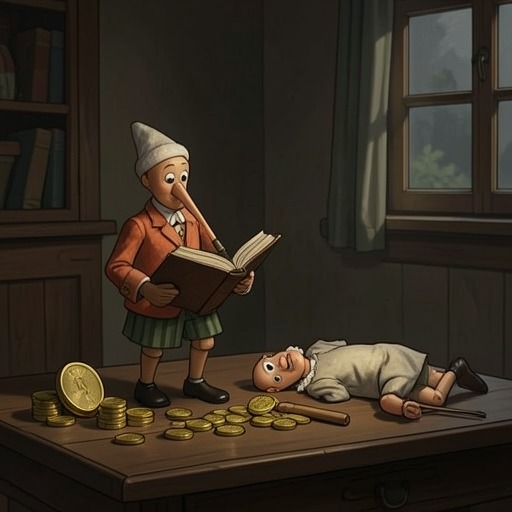
The first clear demonstration is tied to four gold coins. Asked where they are, Pinocchio says that he has lost them, although the narrator states that he still has them in his pocket. His nose immediately grows by two fingers. When the Blue-Haired Fairy asks where he lost the coins, Pinocchio names a nearby wood, and the nose continues to lengthen. He then changes his story again, claiming that he swallowed the coins while drinking the Fairy’s medicine. With this third lie, the growth becomes extraordinary. Each answer attempts to account for the missing coins, but the accumulating physical evidence makes the succession of explanations increasingly untenable.
The Fairy’s Room: Escalation and Exposure
The nose’s growth is measured through its practical effects. Pinocchio can no longer turn without striking something: in one direction he hits the bed or the window glass; in another, the walls or the room’s door. Raising his head risks striking the Blue-Haired Fairy in the eye. The consequence is comic in its escalating scale, but it also makes concealment impossible. Pinocchio’s nose announces what he is trying to hide before he can produce another explanation.
The Blue-Haired Fairy watches and laughs. When Pinocchio, confused and troubled by the nose that keeps growing, asks why she is laughing, she identifies his lie as the cause and explains the distinction between short-legged and long-nosed lies. The scene joins instruction to demonstration: the rule is not merely stated but visibly enacted on Pinocchio’s body. Its immediate consequence is also a restriction. When he attempts to flee the room out of shame, he cannot get through the door because his nose has grown too long. The same sign that reveals his deception now prevents his escape from the situation it has created.
Repetition and Reversal
The rule recurs later when Pinocchio describes himself to an old man. He first presents himself as a good child, eager to study, obedient, and devoted to his father and family. While he delivers this favorable account, he touches his nose and realizes that it has grown by more than a palm. The physical sign contradicts his self-presentation, prompting him to withdraw the praise and describe himself instead as disobedient and idle, a boy who avoids school to misbehave with his companions. As soon as he says this, his nose shrinks back to its natural size.
This later episode gives the rule a reversal absent from the coin scene. The nose does not only grow in response to falsehood; in this instance, it returns to its ordinary size when Pinocchio stops flattering himself and acknowledges the contrary description. The change is presented through an observable sequence: self-praise accompanies the lengthened nose, a more candid account follows, and the nose recedes immediately. The episode therefore connects truthfulness with the removal of the physical sign, without suggesting that the rule has erased the actions Pinocchio admits to.
Narrative Function and Limits
Across these episodes, the nose operates as a public indicator of a private mismatch between speech and fact. In the room, it exposes lies about the coins; later, it exposes a boastful account of Pinocchio’s character. The different subjects of the deception broaden the rule’s reach within the evidence: it applies both to a concrete claim about possessions and to a favorable portrayal of the speaker himself. In each case, the body supplies a counterstatement that Pinocchio’s words cannot control.
The rule also shapes the scenes’ physical action. As the nose grows, the space Pinocchio can move through contracts, until the doorway turns his attempted flight into another consequence of the lie. When the nose shrinks after his later admission, the reversal is equally immediate. The narration thus makes honesty and deception legible through change in the same bodily feature, while the Blue-Haired Fairy’s explanation turns the comic spectacle into an explicit lesson. The episodes establish the rule through these particular consequences; they do not provide a broader account of every possible lie or specify a separate mechanism beyond the nose’s growth and, in the later scene, its return to normal.