The Warning to Earn Honestly and Beware of Getting Rich Without Work
Pinocchio (Tania Zamorsky Edition)The Warning to Earn Honestly and Beware of Getting Rich Without Work is a recurring moral principle in Pinocchio: money gained through honest effort or freely given help is distinct from wealth promised without labor. The story tests that principle against Pinocchio’s desire to turn a few coins into a fortune, then gives it material force when he earns what his ailing father needs through sustained work.
The Principle and Its First Test
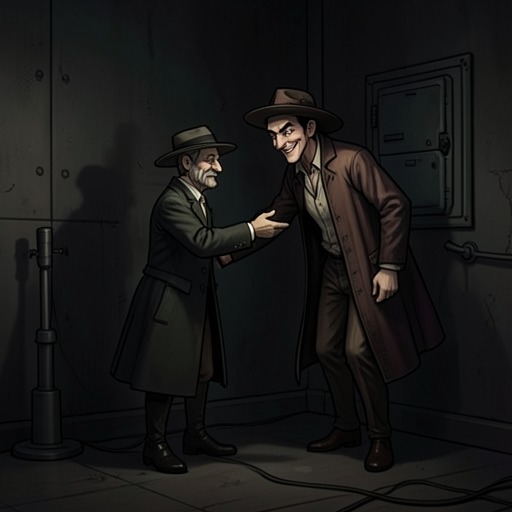
The warning first meets Pinocchio while he is carrying five gold coins given to him by Mangiafoco. After learning that Geppetto sold the only coat he owned to buy Pinocchio a school primer, Mangiafoco is moved to compassion and gives the coins for Pinocchio to take home. This is a legitimate transfer: the money comes as a gift prompted by knowledge of Geppetto’s hardship, not as a promised reward for doing nothing. Pinocchio thanks Mangiafoco and sets out to return to his father, but soon encounters the Fox and the Cat.
After losing one coin, Pinocchio still has four. The Talking Cricket’s shadow urges him to take those remaining coins back to his distressed father and warns him against people who promise to make someone rich overnight, describing such promises as the work of fools or swindlers. Pinocchio rejects the advice. His answer exposes the rule’s central conflict: he does not merely hope for relief but expects his remaining money to multiply into two thousand coins without work.
The False Promise and Its Cost
The Fox and the Cat exploit the very belief the warning identifies. Later, a Parrot laughs at Pinocchio for believing that money can be sown and harvested like beans or pumpkins. The Parrot admits having believed the same thing before, but says that experience taught him that even a small sum must be earned honestly, either through the work of one’s hands or the ingenuity of one’s mind. The lesson therefore comes not only as a rebuke from outside Pinocchio but as a caution grounded in the Parrot’s own past mistake.
The Parrot then reveals the concrete result of Pinocchio’s credulity: while Pinocchio was away in town, the Fox and the Cat returned to the field, dug up the buried coins, and fled. Pinocchio digs into the ground with his hands and nails, making a hole large enough for a haystack to stand in, but finds nothing. The coins Mangiafoco had given out of compassion have been converted, through Pinocchio’s trust in effortless multiplication, into a loss. The contrast is not between having money and having none; it is between a real gift and a fraudulent promise that imitates the language of gain while concealing theft.
Work, Need, and the Right to Assistance
The story makes its ethic more complicated than a simple demand that everyone endure hardship alone. When hungry, Pinocchio considers asking for alms or seeking work, but feels ashamed to beg because Geppetto had taught him that the old and the sick, who cannot earn their bread by working, are the ones entitled to ask for assistance. Others, in this teaching, have an obligation to work; if they refuse and go hungry, they must bear the consequence. The principle links the dignity of earned livelihood to a distinction between unwillingness to work and inability to do so.
That distinction matters when Pinocchio later has to provide for Geppetto, whose health is poor. At the advice of the Talking Cricket, he goes to Giangio, an orchard keeper with cows, to obtain milk for his father. The milk is not simply another windfall: Pinocchio must earn it. He works at the waterwheel, and the exchange turns an immediate need into a concrete obligation he can meet through effort.
The Rule Put into Practice
For more than five months, Pinocchio rises every morning before dawn to turn the waterwheel and earn the glass of milk that benefits Geppetto’s health. He does not stop at this one task. In his spare time he learns to make baskets and hampers from rushes, using the money he earns to meet the household’s daily expenses. He also makes a small cart so that Geppetto can be taken out on fine days for fresh air.
The change reaches beyond earning money. In the evenings, Pinocchio practices reading and writing with a large book bought cheaply in a nearby village, though it lacks both its title page and index. For writing he uses a sharpened reed as a pen and juice from blackberries and cherries in place of ink. Through his willingness to work and make do with what he has, he supports his sick father and saves forty soldi toward a new outfit. The story sets these modest, accumulated results against the imagined fortune of two thousand coins: work yields food, care, learning, and savings, while the fantasy of effortless wealth leaves Pinocchio with an empty hole.
Narrative and Ethical Significance
The warning is expressed through sharply different exchanges. Mangiafoco’s five coins are given openly in response to another person’s poverty; the Fox and the Cat promise abundance while secretly taking what Pinocchio has; and the milk from Giangio is obtained by labor that directly sustains Geppetto. These episodes distinguish generosity, honest earning, and deception by showing what each produces in other people’s lives.
The rule also develops through consequence rather than admonition alone. Pinocchio first hears sound advice and refuses it, then learns that the buried coins are gone; later, he accepts the demands of work and becomes able to care for his father. Honest livelihood is thus measured not by sudden riches but by the dependable goods effort makes possible: nourishment, daily support, care, and a small reserve earned over time.