Death and funeral of Elizabeth II
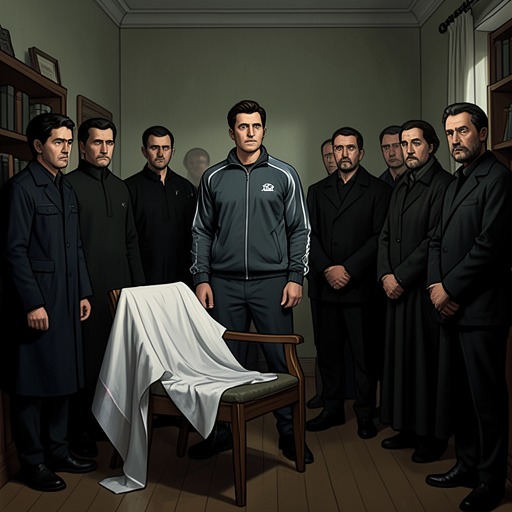
Player Manager: A Sports Progression FantasyDeath and funeral of Elizabeth II marks the period when public mourning interrupts the football calendar and unexpectedly redirects Max Best’s life. The interval is not presented only as a royal succession or civic ceremony: for Max, it becomes the hinge through which he obtains his break as an agent, later carries private notes about the funeral, and measures the distance between his old self and the football professional he is trying to become.
Public Disruption and Private Opportunity
The death of Elizabeth II suspends English football, creating an opening that would not otherwise have existed in Max’s professional life. When Max recounts his “war stories” to Henri Lyons, he identifies his break as having come because the Queen died. The statement is deliberately undignified beside the solemnity of the national event: a constitutional and emotional rupture for the country becomes, in Max’s career narrative, the circumstance that lets him gatecrash an FC United of Manchester training session. The contrast captures the strange mixture of opportunism and vulnerability governing his entry into the sport. He does not inherit a place in football; he finds a temporary gap in its schedule and forces himself through it.
The interruption also helps explain why Max’s progress is so improvised. He is not yet securely recognized as an agent, scout, coach, or club employee. He tells Henri that he had to approach Manchester City’s Under-Sixteens and ask them to give his client a trial after previously beating them in an unscrupulous contest. His professional route therefore begins in a period when normal football routines have been halted, but the chance created by that halt does not make him legitimate automatically. It merely gives him an audience and leaves him to endure the humiliation of asking institutions for access.
The Funeral as a Hidden Archive
The funeral remains present in Max’s private life through the “Queen’s funeral notes” he leaves by the toaster. While helping him into a car, Henri retrieves Max’s baseball cap and sunglasses from the kitchen table. Max later realizes that the notes were there too and worries that Henri could have read them and discovered all his secrets. The funeral is consequently tied to secrecy rather than only ceremony: its written residue sits in an ordinary domestic place, close enough to be exposed by an apparently casual act of assistance.
This scene gives the period a double register. Publicly, the Queen’s funeral belongs to national mourning and shared ritual. Privately, Max experiences it as material evidence of a concealed life that might be deciphered by someone who knows where to look. Henri does not, as far as Max knows, read the notes, but the possibility matters. The notes make the historical interval part of the story’s hidden architecture, suggesting that Max’s relationship to the event contains more than the public explanation he offers to other people.
An Outsider Learning the Profession
The period also frames Max’s gradual acquisition of football’s practical language and privileges. Jackie explains that agents and scouts do not pay to enter matches; they can call a club, identify the player they want to watch, and collect tickets at the turnstile. Max has been paying full price to attend games, an error that exposes how little he knows about the profession he claims to inhabit. His access to football is therefore literal before it is institutional: he can enter the ground, but he does not yet understand the customs that distinguish an insider from an ordinary spectator.
His education continues through documents and procedures. At a match, Jackie presses him to explain a scouting report from Southport, including abbreviations for fitness, role, and score. Max is being asked not merely to watch football but to convert observation into a professional assessment. Later, during his football medical, he recognizes a shared ritual that links him with established players such as Ryan Giggs and Jozy Altidore: “We’ve all had a football medical.” The medical is a sign of entry into the player’s world, even though Max’s own position remains unstable and unusual.
That instability becomes explicit when Max is asked for his Football Association Number and admits that he does not yet have it or his licence. The missing credential stops the process immediately because the Football Association requires it. His career is thus caught between opportunity and authorization. The Queen’s death may have supplied the opening, but professional identity still depends on tickets, reports, medicals, licences, and institutional recognition.
From Interruption to Continuing Work
The consequences of the period extend beyond Max’s first opportunity. Mike Dean later tells him that there is no meaningful role available until Max has gained experience, while Max points out that experience cannot be gained until someone hires him. Mike describes the situation as a Gordian knot and proposes that Max start small, expand his scouting duties, and gradually help with youth recruitment. The arrangement turns the accidental opening created by the Queen’s death into a provisional apprenticeship. Max’s career does not become secure; instead, the temporary exception is converted into a trial period built on observation, trust, and incremental responsibility.
The same movement from outsider to participant appears in Max’s work with the Yalley family. He visits Mr. and Mrs. Yalley to propose signing James Yalley and Kisi Yalley as clients, offering a ten-percent industry-standard rate with no up-front or hidden fees. He presents his short-term role as securing the training needed to develop their potential and his long-term role as balancing their financial and footballing needs. The confidence of the pitch contrasts with the uncertainty surrounding his own licence and experience, showing how Max can speak the language of professional representation before he has fully acquired the status that language implies.
Historical Time and Moral Reassessment
The interval acquires its deepest significance when it exposes the gap between the football opinions Max once held and the values he is forced to confront. While watching pan-disability football, he remembers school friends laughing at a similar match and agreeing that it was not football. The recollection makes the past return as an accusation. The players before him include partially sighted players, players with hearing impairments, players with cerebral palsy, and players with Down’s Syndrome; their competition is explained as a growing form of pan-disability football that creates regular games and pathways into disability-specific teams.
Max then recognizes that the curse has been shaped by his own opinions as much as it has shaped him. Its language about disabled football not being “real football” reflects Max’s earlier prejudice. The death-and-funeral period therefore belongs to a larger process of retrospective understanding: a historical interruption first appears as a lucky career break, but the surrounding narrative gradually makes Max examine what his football identity contains. The interval connects national mourning, professional initiation, hidden documents, and moral embarrassment. Its decisive effect is not simply that it opens a door for Max Best, but that it begins the passage through which he must learn what kind of person is trying to walk through it.