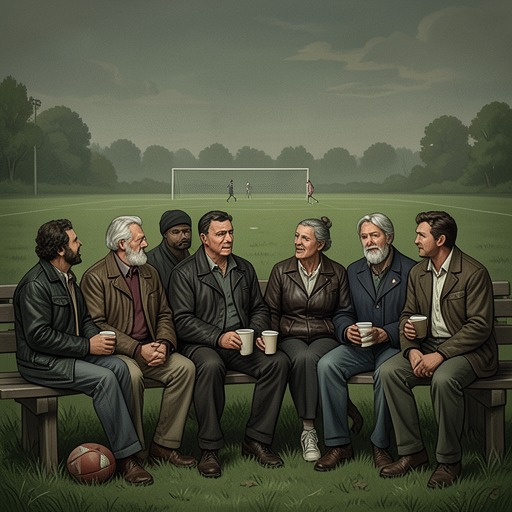
Max Best and Jackie Reaper
Player Manager: A Sports Progression FantasyMax Best and Jackie Reaper form a mentor-partner relationship that changes both men’s understanding of football and of themselves. Jackie sees Max’s unusual technical and perceptive ability before Max can accept it; Max, in turn, learns to read Jackie not merely as a coach but as a wounded former player whose severity conceals loyalty, pain, and a difficult code of care. Their bond gives Max entry into football’s closed professional world, but it also becomes a safety net that Jackie must eventually remove. The relationship therefore carries Max from fascinated outsider to a person capable of making independent judgments, while preserving an emotional connection that neither man initially knows how to name.
Recognition and First Tests
Jackie’s first decisive contribution is to contradict Max’s self-assessment. After watching him play, he calls him a “silky-smooth playmaker” and invites him to bring his boots to a future session because the team could use him and he has potential. Max rejects the judgment, insisting that he is no real player and that Ziggy Graves is the genuinely gifted one who merely needs coaching. Jackie refuses this attempt at modesty or evasion: the club is a football club, not a place where flattering intentions can substitute for evidence. From the beginning, then, the relationship is structured around a conflict between Max’s internal identity and Jackie’s professional eye.
That conflict becomes sharper when Jackie compares Max with Raffi Brown. Jackie grants that Raffi has something and deserves a trial, but says Raffi looked helpless beside Max before Max was injured. In Jackie’s account, Max’s anticipation, imagination, execution, economy of movement, and later improvisation were not ordinary skills that could simply be coached into existence. Jackie remembers Max as both precise and elusive, moving from an efficient pre-injury performance into a crafty, unpredictable second-half style. His conclusion is emphatic: he would not merely give Max a trial; he would offer him a professional contract immediately. The praise is also an accusation, because it exposes how completely Max has misread himself.
Jackie insists that this judgment did not originate in one spectacular performance. He had noticed Max the first time Max kicked a ball at Broadhurst Park, then watched him train with the Met Heads, where Max displayed perfect technique and control. He also remembers Max promising to nutmeg him, narrowing the available space until the only route was through Jackie, and accomplishing it anyway. Jackie’s own background as a once-effective defender makes the recognition more credible and more personal: he knows what he is seeing because he has spent years trying, and failing, to manufacture it in other players.
Opening the Football World
Jackie’s mentorship is practical as well as perceptual. When Max complains about the cost of attending matches while trying to work as an agent, Jackie explains that agents and scouts do not pay ordinary admission. Max can contact a club, identify the player he wants to watch, and have tickets left at the turnstile. The correction is small but revealing. Max has been attempting to enter football through money and enthusiasm; Jackie teaches him that the industry operates through recognized roles, relationships, and institutional access. The lesson is about social knowledge as much as tickets.
Jackie repeatedly turns football activity into a form of professional education. He pushes Max toward scouting work, challenges him to interpret reports, and notices when Max is filling in a Southport FC scouting report template rather than simply watching a match. Even the football medical becomes part of Max’s education in the rituals of recruitment: Max undergoes a medical before a club can judge whether he is fit to sign. Jackie’s influence thus helps Max cross successive boundaries—from spectator to scout, from self-appointed agent to participant in the procedures by which football identifies and certifies talent.
The relationship also teaches Max that knowledge has institutional limits. When Max gets ahead of himself in a discussion about football work, he realizes that he does not yet possess a Football Association Number or the required licence. Jackie’s world is not entered by insight alone. Credentials, paperwork, tickets, reports, training, and recognized experience matter, and Jackie’s guidance makes those barriers visible rather than allowing Max to mistake instinct for professional standing.
Conflict Over Talent and Purpose
Max’s refusal to scout himself becomes the relationship’s clearest intellectual conflict. He describes himself as a poor full-size player with a few party tricks, a decent five-a-side game, and perhaps a current ability of only one with a barely higher potential. Jackie regards this as an absurd distortion. His anger is not simply about football technique; it is directed at Max’s attempt to preserve a safe identity as the observer who can judge everybody else while remaining exempt from judgment.
Jackie therefore proposes a trial for both Max and Raffi. The trial would reveal something about Raffi, but it would also force Max to confront the difference between his imagined incompetence and his actual performance. Max recognizes that appearing beside professionals could be humiliating and psychologically crushing, yet he accepts the proposal partly because he wants to understand what his clients endure. The decision marks a change in his purpose: he is no longer content merely to pronounce on players from outside the process. He is willing to undergo the process himself, even if the experience threatens his self-image.
Their disagreements extend beyond Max’s playing ability to the ethical purpose of football work. In dealing with the Yalley family, Max offers to represent James Yalley and Kisi Yalley, promising to balance their financial and footballing needs while securing the training necessary to develop their potential. Jackie later makes clear that developing a talented youngster who moves to a bigger club can benefit Chester financially through transfer fees or compensation. Yet he also recognizes that Max’s decisions may damage his own position. When Max chooses what he believes is best for the children rather than what would preserve his immediate relationship with Chester, Jackie says the action is so obviously in the children’s interests and so obviously against Max’s interests that he cannot form an opinion on it. Max experiences the phrase “against my interests” as painful confirmation that his idealistic choice has real professional costs, but he tells Jackie he would make the same decision again.
Mutual Vulnerability and Friendship
The relationship deepens after that ethical disagreement because Jackie finally speaks about his own history. He tells Max about the knee injuries that ended his playing career, the despair and desperation of the aftermath, and the moment when the club and its supporters communicated that they would remain with him whatever happened. When he committed himself fully to rehabilitation, Livia Strandon became his physio, nurse, therapist, and principal connection to the outside world. There were periods when she was the only person he spoke to. Jackie’s reluctance to ask her out is framed by his own principles: he sees such a request as a crude cliché and an inadequate reward for everything she did for him.
Max responds by offering pieces of his own life rather than a solution. He tells Jackie that he had once been the leading employee in his call centre and is now deliberately trying to finish each day third in his team because his boss had irritated him. He admits expertise in Love Island despite barely watching it, and recalls the moment during the FC United of Manchester versus AFC Phoenix match when Jackie gave Ziggy direct instructions. That moment remains indelibly fixed in Max’s mind because it was when he understood that Jackie was a great coach. Their intimacy is built through apparently random disclosures, but the disclosures create reciprocal recognition: Jackie reveals the injuries beneath his authority, while Max reveals the evasions and private obsessions beneath his comic self-presentation.
Their shared football language also becomes a form of emotional language. Jackie can identify Max’s instinctive connections with Raffi as something like telepathy, while Max can identify Jackie’s coaching quality in a single intervention with Ziggy. Each man recognizes a capacity in the other that the other struggles to articulate. Jackie sees an exceptional player and judge of players; Max sees a coach whose authority comes from attention, experience, and care rather than from performance alone.
Separation and Forced Independence
Jackie eventually ends the formal part of the relationship. He tells Max that the training, Ziggy’s development, and the Chester work have been enjoyable, but he needs his Wednesdays back. Ziggy is now a professional, Max has been connected with insiders, and Max knows what to do. Jackie says this will be the last training session and the last undefined thing between them. Max experiences the announcement as a breakup, and Jackie confirms the metaphor by saying that he is kicking Max out of the nest: Max will either hit the ground or start flying.
The separation is painful because Max has not realized how much Jackie has become a safety net. In Chester, Jackie’s presence allowed Max to pursue football with intense certainty, even when Max was acting beyond his proper role. Once Jackie withdraws, Max recognizes that he may need to become someone in the football industry independently, and independently means without the protection of the mentor who has translated the world for him. Jackie leaves Max’s belongings in a box outside the front door and changes the locks, an action that turns emotional distance into a literal boundary. Max considers whether Jackie is forcing him to develop a fear of falling or protecting himself from Max’s toxicity and abrasiveness; the uncertainty preserves the relationship’s characteristic mixture of affection, irritation, and incomplete explanation.
Jackie does not abandon Max’s prospects altogether. He leaves him connected to the opportunity for a trial at Chester and to people inside the game, but refuses to continue carrying him through every step. The contradiction is central to his mentorship: Jackie gives Max access, then removes the guarantee of safety. His care is not expressed by making failure impossible; it is expressed by deciding that Max is ready to risk it.
Legacy of the Bond
By the later stages of Max’s development, Jackie’s lessons remain embedded in nearly every area of his football identity. Max has learned how scouts work inside a stadium, how youth and disabled football challenge his assumptions, how talent must be developed rather than merely praised, and how football institutions weigh community, sponsorship, credentials, and financial survival. He has accumulated practical experience and football knowledge, but the relationship’s most important result is not measurable in the numerical systems Max once used to understand players.
The bond teaches Max that human connection cannot be reduced to ability, money, strength, or experience points. Jackie’s recognition helps Max see his own footballing talent; Jackie’s disclosures teach him to see vulnerability beneath professional authority; and Jackie’s withdrawal compels him to act without borrowed legitimacy. Their partnership therefore functions as both apprenticeship and emotional education. It begins with Jackie telling Max that he has potential and ends with Jackie insisting that Max must discover what that potential means when no mentor is standing beside him.