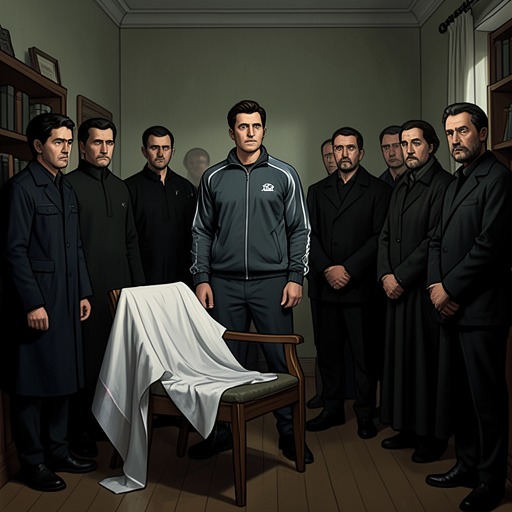
State funeral of Elizabeth II
Player Manager: A Sports Progression FantasyState funeral of Elizabeth II is both a public national ceremony and a decisive interruption in Max Best’s developing football career. Its immediate practical effect is the postponement of football matches, extending an already unwelcome pause; its deeper effect is to make Max confront grief, succession, and the difference between treating history as an administrative change and witnessing it as a personal catastrophe.
Disruption of Football and Ordinary Time
The funeral enters Max’s life first as a disruption to the football calendar. He spends a Friday and Saturday doing very little while thinking about the growing void in his life, and he expects the following weekend’s games to be postponed because of the Queen’s funeral. He considers postponing that round of fixtures understandable in principle, but regards the timing as a mistake. The interruption is then compounded by another long break for national-team friendlies, producing what he experiences as a break followed by a break. Football, normally the structure through which he measures purpose, opportunity, and progress, is suddenly unavailable.
The resulting emptiness sharpens his frustration. He tries to find distraction in light television and sports news, but the coverage is dominated by the Queen. The scale of the broadcasting is presented as almost absurd: the news appears everywhere, while the BBC even cancels comedy programmes for a week as a tribute. Max’s response is not simple hostility to the ceremony; it reflects the clash between a national ritual operating on historical time and a football-minded life organized around fixtures, momentum, and immediate chances.
The Ceremony as Public Spectacle
On the day of the funeral, Max does not have to work, and he accepts that the event appearing on every television channel is appropriate. He leaves the picture on but mutes the sound, finding the commentary foolish, including the elaborate announcement of the Prince of Wales, the Duke of Cornwall, and the Duke of Rothesay as though these were three different people. The muted television allows him to observe the ceremony visually: pomp and ceremony from a bygone age, ancient uniforms surrounding modern faces, and leaders from countries across the world gathered in a single public display.
This visual spectacle initially becomes a backdrop for practical thought. Max uses the day to consider what he has learned, what options remain available, and where he wants to take his football career. He takes out a sheet of paper and begins organizing his thoughts. The funeral therefore creates an unusual juxtaposition: the state is performing continuity through ritual while Max is trying to design a future for himself through lists, calculations, and career plans.
From Career Daydream to Personal Grief
Max’s planning soon turns into daydreaming about the wealth that professional football might bring. Alphonso Davies’s reported salary of 103,000 dollars a week leads him to imagine a future contract, a Porsche or a Rolex, and holidays in Ibiza or the Seychelles. These fantasies reveal how quickly the funeral’s solemn imagery can be displaced by the commercial imagination of football and celebrity.
The turning point comes when Max looks back at the television stream and sees Charles standing beside his mother’s coffin. Charles’s red eyes, trembling lips, and haunted expression make Max understand that the ceremony is not merely a technical transfer of the United Kingdom’s head of state or a demonstration of British soft power. It is a ritual marking the greatest change in Charles’s life. In that moment, the newly made king is not primarily a constitutional figure; he is a son who wants his mother back and does not want the burden of kingship.
That recognition changes the meaning of the entire day for Max. The funeral interrupts his calculations by restoring an individual human face to a spectacle he had been watching at a distance. After a few minutes, he folds the paper containing his plans, places it beside his toaster, takes his car keys, and drives to the care home. The ceremony thus produces a concrete decision: personal responsibility and human connection replace abstract ambition, at least for the immediate moment.
Resonance with Football’s Inclusive Community
The funeral’s significance also extends through the events surrounding Max’s developing involvement in football. His work with FC United of Manchester, Chester FC, and the Chester Knights takes place within a football culture that is repeatedly defined by community rather than by elite spectacle alone. FC United of Manchester exists because former Manchester United supporters rejected the transformation of fans into customers and created a club where they could enjoy football as supporters again. When Max first enters the club’s small stadium, he encounters volunteers carrying black bin bags, sweeping terraces, repairing seats, and scrubbing dugouts. The scene’s humble physical work motivates him to help.
That community logic reappears when Max watches pan-disability football. The teams include partially sighted players, players with hearing impairments, players with cerebral palsy, and players with Down’s Syndrome. The mixed format is explained as a way to ensure that players receive regular competitive games, with outstanding participants able to progress to disability-specific teams. The event challenges the assumption that football’s value depends on uniform bodies or conventional routes to elite performance.
The challenge becomes explicit when Terry responds to the suggestion that the match might not be real football. He points Max back to the players themselves: they experience the match as real football, investing emotion, effort, tackles, and ambition in it. Max is forced to remember that he and school friends once watched a similar game, laughed at it, and agreed that it was not football. The memory exposes a prejudice he had treated as harmless amusement. He realizes that the curse’s contempt for disabled football reflects his own opinions, because the curse has absorbed and reproduces his personal footballing assumptions.
Consequences for Max’s Football Identity
The funeral’s movement from spectacle to mourning parallels Max’s broader movement from abstraction to responsibility. In the same period in which he tries to turn football into a system of contracts, data, status, and career advancement, he is repeatedly confronted by the human communities that make the sport meaningful. The pan-disability match becomes a test of character, especially because Max had invited Henri Lyons to watch on the principle that football reveals character. The match ends in a thrilling five–four victory, with Zoe scoring a last-second screamer, and Terry begins providing Max with coach data. Max celebrates by throwing down his crutches, lifting Wilson, and treating him as though he were three trophies at once.
The victory matters because it changes what Max can see. The players are no longer objects measured only by conventional ability; they are competitors whose effort, emotion, and collective achievement produce an authentic sporting event. The same movement from public role to private person that Max perceives in Charles beside the coffin is reproduced in football, where disability, community, and local commitment resist being reduced to spectacle or commercial value.
Max’s later dealings with Chester’s leadership give the insight an institutional consequence. Chester is a community club owned by its community, without the money to hire a Director of Football at 50,000 pounds a year. Its survival depends on sponsors, parents, supporters, and careful diplomacy. Max has endangered 8,000 pounds in annual sponsorship by disrupting the youth team, and he is told that a Chester player cannot simply be discarded because he is also a local child, a Chester supporter, and part of the club’s social fabric. The funeral does not solve these tensions, but its lesson remains visible: institutions matter because people inhabit them, mourn within them, and depend on them.