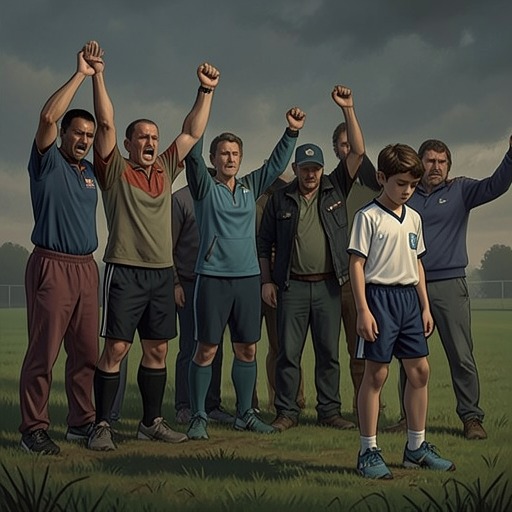
Unit, unit, team. Defend, attack, win.
Player Manager: A Sports Progression Fantasy“Unit, unit, team. Defend, attack, win.” is the compressed football creed Max Best gives to Chester’s under-fourteens: a chant, a tactical instruction, and a test of character. Its force comes from the way Max joins the word “United” to collective responsibility. The phrase begins as an appeal to belonging, becomes a diagram of how players should defend and attack together, and ends as a demand that they choose one another when the team is undermanned.## Origins in Max’s Idea of Football Max introduces the language of unity while explaining why he supports Manchester United. His reasons begin with geography, colour, size, trophies, history, and famous players, but the decisive meaning lies in the club’s name. As a child, he understood “United” as a promise that a whole city could come together as one: a community united and a city united. His adult recognition that people in blue had damaged that fantasy does not erase the ideal; instead, it gives the word a sharper emotional charge. At Old Trafford, he remembers, even a home crowd conceding a goal can answer by chanting “United! United!” The supporters’ response represents loyalty that survives immediate failure, and Max carries that model into his work with young players.
The phrase also reflects Max’s wider development. Earlier, he admits that he does not want to be a conductor and is uncertain that he is good enough, competitive enough, or interested in becoming an elite player. What attracts him is the possibility of seeing football as top managers such as Guardiola and Klopp see it. He wants a different understanding of the game, not celebrity for its own sake. When Jackie Reaper later tells him that he possesses a rare combination of anticipation, imagination, and execution, Max remains unable to judge himself as a player, but he increasingly acts as someone who can interpret relationships on a pitch. “Unit, unit, team. Defend, attack, win.” is the most direct verbal form of that emerging vision.## The Chester Team Talk Max delivers the expression during a disrupted match involving Chester’s youth team and Broughton Under-Fourteens. The side is short-staffed and arranged in what he recognizes as a shambolic 3-3-1, with more gaps than the goal nets. Rather than disguise the weakness of the formation, he turns its exposed structure into a reason for cooperation. He draws the three defenders and the goalkeeper, then tells them that strong individual actions are not enough. A defender must drop back if another misses a header, communicate with teammates, and make sure the goalkeeper is involved rather than isolated. In Max’s formulation, the back line is not merely a collection of capable players; it has to become a unit.
He applies the same principle to the attack. The striker, right midfielder, and central midfielder cannot move as unrelated individuals. The striker must hold the ball so the other two can arrive; if the right midfielder dribbles while the central midfielder remains still, the attack breaks apart. All three must move, or none should move, and communication is presented as the condition of scoring. The expression therefore has a practical grammar: defend together, attack together, and allow coordinated movement to create chances that individual talent cannot produce alone.
Max also addresses the weakest point in the team. With the left side undermanned, one player, probably Boyce, must operate out of position for a difficult thirty-five minutes. Max refuses to let the others treat that burden as Boyce’s private problem. He asks whether teammates will support him or leave him exposed, and he offers contrasting images of selfish and generous football: a poor performance that can be blamed on the coach, or a teammate sprinting thirty yards to cover an overload and surrendering a more entertaining responsibility so another player can contribute. Unity is thus measured not by slogans but by inconvenience, sacrifice, and attention to the player standing nearest.
The speech broadens from tactics into character. Max recalls his father’s belief that football reveals whether someone is a coward, a show pony, a burdened person, or a difficult personality. Yet he insists that fourteen-year-olds are not fixed in those roles. The Chester players may be having a grim time in a weakened team, but that condition gives them one opportunity—perhaps their only opportunity—to act collectively. The expression becomes a developmental challenge: the players are not required merely to display what they already are; they are asked to decide what kind of teammates they will become.## From Instruction to Collective Action Max writes the entire formation on the whiteboard and reduces its meaning to the closing sequence: “Nothing matters except the person playing next to you.” The team must defend together, attack together, and win together. He then repeats the complete formula, “Unit, unit, team. Defend, attack, win.” The repetition is deliberately simple, almost chant-like, because the intended result is not theoretical agreement but shared movement under pressure.
When the captain asks whether the plan will work, Max rejects the comfort of tactical certainty. He says that it does not matter whether the plan works as designed; what matters is that the players try to make it work and show character. He refuses to provide one more theatrical burst of inspiration for them to consume. Instead, he sends the responsibility back to the team, telling the captain to take them out and act. The expression therefore shifts from a coach’s speech act into a collective obligation: the players must give the words meaning through their behaviour.
The response is immediate. The tall centre-back stands, signals to his teammates, and shouts, “Come on!” The players roar onto the pitch, drawing applause from nearby parents. Broughton’s coach sends his players back, the referee ends his break, and the match is ready to restart. In formation, the Chester captain yells, “United!” Max answers, “Come on, Chester!”, and the sound produces goosebumps in him. The depleted group is no longer represented as a tactical inconvenience; for that moment, it has become a team visibly choosing to enter the contest together.## Meaning Beyond the Match The expression links community identity, coaching, and Max’s unstable sense of self. Chester is not presented simply as a venue in which Max can display his football knowledge. It is a proper club on a proper match day, with an inner sanctum that makes him more relaxed and authentic than he expected. The club’s scale does not diminish its reality. Its youth players, coaches, parents, sponsors, and volunteers form a social world in which the meaning of “team” has financial and emotional consequences.
That community dimension becomes explicit when Jackie explains that Chester is owned by and exists for the community. The club cannot casually spend fifty thousand pounds a year on a Director of Football, and it cannot treat every decision as an extension of one ambitious individual’s football fantasies. A youth-team dispute has already endangered an eight-thousand-pound sponsor, while the player Max challenged is a local Chester supporter proud to wear the club’s colours. Jackie’s warning that harming the club’s own supporters would be self-destructive places Max’s creed inside a larger institutional ethic: unity must include the people around the team, not only the players on the field.
The phrase also exposes a tension in Max’s relationships with authority and recognition. Jackie believes Max has extraordinary footballing judgment and says he would give him a professional contract immediately, yet he also insists that Max cannot scout himself. Max is more comfortable identifying talent in others than accepting what others see in him. His earlier refusal to believe that he has potential, and his conviction that he is nearly useless on a full-size pitch, contrast with Jackie’s description of him as unusually efficient before injury and capable of near-telepathic connections with Raffi Brown. “Unit, unit, team. Defend, attack, win.” allows Max to occupy a role he can accept: not the solitary genius, but the person who makes relationships legible and demands that others honour them.
The creed finally carries a cost. Jackie judges Max’s intervention as plainly in the children’s interests and plainly against Max’s own interests. Max understands that he cannot both act as the children’s hero and pursue his position with Chester without consequence; he has made a choice and says he would make it again. The expression therefore signifies more than a successful motivational line. It is the principle by which Max briefly places the team, the vulnerable player, and the community above his own advancement. Its final victory is not guaranteed by the score. It lies in making collective responsibility the standard by which action is judged.