Max calls an ambulance for Simon’s leg injury
Player Manager: A Sports Progression FantasyMax Best’s decision to call an ambulance for Simon’s leg injury is the moment when football stops being an abstract field of ratings, tactics, and entertainment and becomes an urgent matter of bodily survival. During a match at Platt Fields, Max sees an impact that everyone else initially treats as part of the game, recognizes from Simon’s player profile that the damage is severe, and overrides the match’s momentum to summon professional medical help. The incident exposes both the power and danger of Max’s football vision: it gives him knowledge no ordinary spectator possesses, but it also forces him to act before anyone else understands what he has seen.
The Collision and the Invisible Injury
A goalkeeper and an opposing player race for the same ball at near-top speed. The goalkeeper’s hamstring pops as he tries to block it, but the more serious consequence falls on the other player, Simon, whose outstretched lower leg takes the full force of the collision. The goalkeeper is able to climb back to his feet, grimacing and rubbing the back of his leg, while the match continues. Max can see that the goalkeeper’s acceleration and pace have fallen by one point, a change consistent with the relatively minor injuries he has observed before. A long layoff, such as a torn hamstring, can reduce an attribute by a point, but Max expects those numbers eventually to recover.
Simon’s profile is different. His acceleration, pace, stamina, and jumping all collapse to one. The concentration of the decline matters: these are the attributes connected to physical well-being, and their simultaneous implosion tells Max that this is not an ordinary in-game setback. The interface translates physical catastrophe into numbers before the people around Simon acknowledge it as catastrophe. Max briefly panics that Simon may have died, then sees him trying to stand and reacts with anger rather than relief, ordering him to stay still because movement could worsen the damage.
Max Overrides the Match
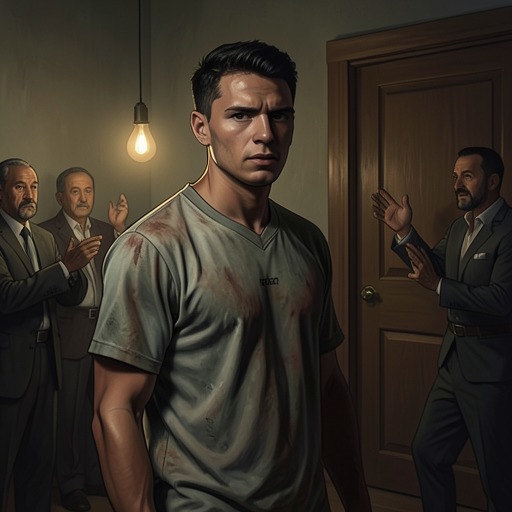
Simon insists that the injury is fine and challenges the stranger who has run onto the pitch. Max answers with abrasive mockery, presenting himself as an improvised doctor while insisting that Simon’s leg is wrecked. The bravado conceals genuine fear. Max has entered the opposing team’s pitch, disrupted play, and found no friendly faces around him; his hands shake, blood pounds in his ears, and the match’s ordinary authority structure suddenly becomes irrelevant to him.
He asks who the team captain is and tells the captain to lie down, then uses his phone to dial 999. He gives the emergency operator the location precisely as Platt Fields, the sports centre by Platt Lane, and reports that an ambulance is needed. This is not a symbolic gesture or a request for someone else to take responsibility. Max makes the call himself, converting private alarm into organized emergency action.
The decision also produces a moral break with the game. When someone asks whether Simon can be moved so that the others can continue playing, Max finds the very idea repulsive. He imagines Simon spending months on crutches or even losing his leg, and football’s continuation becomes grotesque beside the injury. The emergency response advises the players not to move Simon, not to give him painkillers, and to keep him warm with a jacket while help is on the way. Max follows that logic rather than allowing competitive convenience to dictate treatment.
Waiting for the Ambulance
Emre becomes useful during the wait, drawing on his apparent experience of military service and helping keep the situation under control. The next ten minutes are described as agonizing. Simon begins by protesting that he is fine, but then falls quiet and becomes clammy, confirming that the apparent resilience of a footballer in the immediate aftermath of impact is not reliable evidence of safety.
The ambulance drives directly onto the pitch. Paramedics assess Simon, place his leg in a brace, and lift him into the vehicle. Only then do Simon’s screams begin, and only then do his teammates visibly react as though they understand the seriousness of what has happened. Their delayed concern emphasizes the distance between the game’s collective momentum and the injured body at its centre. Max brushes past the teammates who try to speak to him, still too tense and angry to accept their gratitude or their need to make sense of his intervention.
After the ambulance leaves, Max asks Emre to buy him a beer. The request is a small attempt to return to ordinary social exchange, but Emre declines because he has to get back to work and keep grinding. He pats Max on the back and tells him well done before returning to his stall. The gesture gives Max recognition without turning the event into a triumph. Emergency care has been necessary, but it has not made him comfortable, authoritative, or fully accepted by the people whose game he interrupted.
The Aftermath and Simon’s Recovery
The next day, Emre gives Max the news that Simon suffered a very bad break but will be okay. One of Simon’s teammates has gone looking for Emre specifically to ask that Max be thanked. The report supplies limited closure: Simon is alive and expected to recover, yet the severity of the break confirms that Max’s alarm was justified. His vision did not merely dramatize a routine collision; it identified a genuine emergency before the surrounding players grasped it.
Even so, Max cannot simply absorb the news as a clean victory. He admits that it should be closure but knows it is not. The incident has left him with a lasting awareness that the attributes he reads as game data represent vulnerable bodies, not only performance potential. His immediate return to football talk, mentioning that Beth’s team is about to face Manchester City, sounds almost like an effort to re-enter the normal rhythm of matches. Emre’s answer redirects the exchange toward another game and then back to work, revealing how quickly football’s machinery resumes after an injury that has fundamentally changed Max’s perception of it.
A Threshold in Max’s Professionalization
The ambulance call belongs to the wider process by which Max enters football’s closed professional world. At this stage, he is still learning that agents and scouts can obtain free admission to matches by calling clubs and identifying the player they wish to watch. Jackie explains that professionals do not pay full price to attend games, a practical lesson in the hidden privileges and procedures of the occupation. Max is therefore simultaneously learning the industry’s backstage customs and discovering the responsibilities that accompany access to the field.
His later conduct shows that football work is not limited to identifying talent or negotiating with families. Max tells Mr. and Mrs. Yalley that he wants to sign James Yalley and Kisi Yalley as clients, charging the industry-standard ten percent with no up-front or hidden fees and promising to balance their financial and footballing needs while securing the training required to develop their potential. He undergoes a football medical himself, fills in scouting paperwork, and eventually confronts the fact that he lacks a Football Association Number and licence. Mike Dean later proposes expanding his scouting duties toward youth recruitment, but only through a gradual trial period because Max still lacks experience.
Against that professional background, Simon’s injury is a boundary-crossing scene. Max does not yet possess complete institutional credentials: he has no licence, no settled role, and no secure authority. Nevertheless, the crisis grants him a different kind of legitimacy. He recognizes what the body is saying, acts decisively, and accepts the social cost of stopping play. The incident does not make him a qualified medic, and it does not erase his impulsiveness, but it demonstrates a form of responsibility that cannot be reduced to formal status.
Bodily Value and the Limits of the Numbers
The episode also establishes a tension in Max’s way of seeing football. His interface quantifies health through acceleration, pace, stamina, and jumping, making injury legible as a sudden fall in player attributes. That knowledge is valuable because the visible scene is misleading: the match continues, Simon tries to rise, and the others initially treat the collision as ordinary. Yet the numbers do not themselves tell Max what to do. They trigger fear, interpretation, and action; the ethical decision to stop treating Simon as a player in a match comes from Max’s judgment.
This distinction becomes especially important later when Max encounters pan-disability football involving partially sighted players, players with hearing impairments, players with cerebral palsy, and players with Down’s Syndrome. Terry explains that such matches create competitive opportunities that would be unavailable if players could compete only against people with exactly the same disability, and that games are the pathway through which talented players may reach disability-specific teams. Max is forced to confront how easily football culture can mistake unfamiliar bodies for lesser footballers. Simon’s injury begins that education from the opposite direction: it teaches Max that a player is a body before he is a rating, and that the body can require care even while the spectacle insists that play continue.
The call for an ambulance therefore marks a value shift from competition to preservation, from spectatorship to intervention, and from statistical observation to human responsibility. Simon’s eventual safety prevents the scene from ending in death, but the bad break leaves its mark. Max has learned that seeing football clearly is not enough; the knowledge must be used, sometimes against the habits of the game and against the wishes of the people inside it. Именно