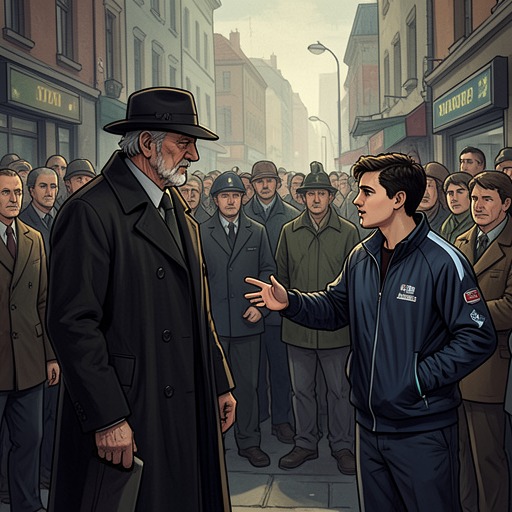
Platt Fields
Player Manager: A Sports Progression FantasyPlatt Fields is a large Manchester park whose ordinary urban familiarity becomes the setting for Max Best’s first sustained encounter with the football-vision curse. Missed bus stops, red-brick streets, student flats, a modern Tesco, chocolate biscuits waiting at home, and the park’s football pitches form a bridge between Max’s routine life and the football world that suddenly becomes impossible for him to ignore.
Setting and Local Football Context
Platt Fields is named after Platt Lane, the nearby road toward which Max initially walks after missing his bus stop. Max describes it as a well-known Manchester park, not far from Maine Road, the former ground of Manchester City. A sports complex on Platt Lane had also been used by Manchester City Academy, giving the area a local football history before Max ever treats it as a place of deliberate investigation. The park is therefore more than a generic green space: it sits inside a landscape where professional, youth, amateur, and recreational football overlap.
The setting first appears through the mundane details of Max’s commute. From the upper deck of the bus, he sees the curry place, second-hand shop, terraced houses, student flats, and the large park he has encountered repeatedly since leaving sixth form. When he realizes that he has missed his stop, walking through Platt Fields seems like an easy choice because the evening is pleasant. The casual detour becomes decisive precisely because it is not planned as an adventure.
The First Test of the Curse
Max’s feet seem to direct him toward Platt Lane and the football taking place there, even when he tries to turn north toward home. He recognizes that he cannot avoid football forever and decides that seeing a match without the mysterious numbers would prove that the previous night had been a hallucination. Instead, the sound of a referee’s whistle makes the hairs on his neck stand up, and he approaches the all-weather pitches expecting confirmation of something he still hopes is impossible.
At the sideline, Max sees numbers hovering over every player, together with names, nationalities, birthdays, and football attributes. The effect resembles an augmented-reality display imposed directly on ordinary vision, but no device is involved. Platt Fields thus becomes the first location where the curse is tested against a live football environment rather than remembered as an isolated anomaly. The experience initially threatens to overwhelm him: he considers hypnosis, nanobots, identity theft, and even a Scottish curse, while the football pitch turns a familiar public park into a site of inexplicable knowledge.
The longer Max watches, however, the calmer he becomes. The park’s game supplies the first practical condition under which the supernatural interface can be studied. He is not merely frightened by what he sees; he begins learning how to remain present long enough to interpret it. The all-weather pitches convert panic into observation, and observation into the beginnings of a method.
XP, Physical Presence, and Training
Platt Fields becomes Max’s first deliberate training ground for the experience system. On the first day of his eleven-day effort, he finishes work, eats an early dinner, and returns to the park to watch as much football as possible. Watching a live match from his sofa produces no experience points and reveals no player attributes, while physically attending games at Platt Fields produces progress. The distinction makes the park crucial: advancement depends on embodied presence, not passive consumption through television or online video.
During his first extended sessions, Max watches games at the pitches and earns experience points by sustaining attention. He records a total of 70 XP on one Thursday, bringing his running total to 110. The matches are not presented as polished football. Many players have low attributes, and some games are poor enough to test Max’s concentration, yet the very sameness of the games gives him repeated exposure to the information displayed above the players. Platt Fields supplies repetition, duration, and access to live bodies in motion—the conditions through which Max can begin to grind his way toward competence.
The park also teaches him the limits of that strategy. In later sessions at Hough End he finds enough simultaneous games to watch football almost continuously from 10 a.m. until the last whistle at 2:30 p.m., earning 225 XP and reaching 475 XP overall. The comparison clarifies what Platt Fields has initiated: the park is the first place where Max discovers that football can be treated as a measurable resource, but the process is physically and mentally draining. The more he tries to force progress, the more tired and distracted he becomes. Experience is available, but it is not effortless.
From Public Park to Football Network
Platt Fields marks the point at which Max’s private curse begins to create public football connections. His encounters with live games lead him away from mere viewing and toward scouting, player evaluation, and club involvement. The larger football world eventually brings him to FC United of Manchester, a club founded by former Manchester United supporters who wanted to feel like fans rather than customers after the sale of their old club. Although FC United is not located in Platt Fields, the park is part of the route by which Max stops treating football as something to watch and starts treating it as a field in which he might work.
That movement is reflected in the contrast between Max’s early uncertainty and his later attempts to pass through football’s professional boundaries. He learns that agents and scouts can obtain complimentary tickets rather than paying at the turnstiles, and that scouting reports contain practical categories such as fitness, fit, and score. He also discovers that football status depends on formal qualifications: at one point he must admit that he has neither a Football Association number nor a licence. The ordinary pitches of Platt Fields are therefore the first classroom in a longer process of vocational socialization, where watching becomes a claim to expertise only when institutions, documents, and people begin to recognize it.
Narrative Significance
Platt Fields functions as a threshold between Max’s old life and his footballing transformation. Before entering the park, he is a customer-service worker whose job has become unusually satisfying because its repetitive problems are easy to solve. After entering it, he has a recurring reason to seek football out, a system that rewards attendance, and a new way of seeing players that cannot be switched off by changing the channel. The park’s familiar landscape makes the transformation more striking: nothing about the curry shops, terraces, student flats, or paths announces a supernatural event, yet the pitches become the place where ordinary sight is permanently altered.
Its significance also lies in the tension between community football and Max’s increasingly ambitious fantasies. The park offers access without ceremony. Anyone can walk through it, hear a whistle, and watch a match, but Max’s new vision makes those informal games valuable as data. Later, football clubs will involve sponsors, community ownership, youth teams, coaches, and institutional risk; Platt Fields is the humble beginning of that system, a public space where football remains close to the ground. It is where Max first learns that the game’s future cannot be reached by imagination alone. He must attend, watch, endure boredom, accumulate experience, and gradually earn the right to be taken seriously.