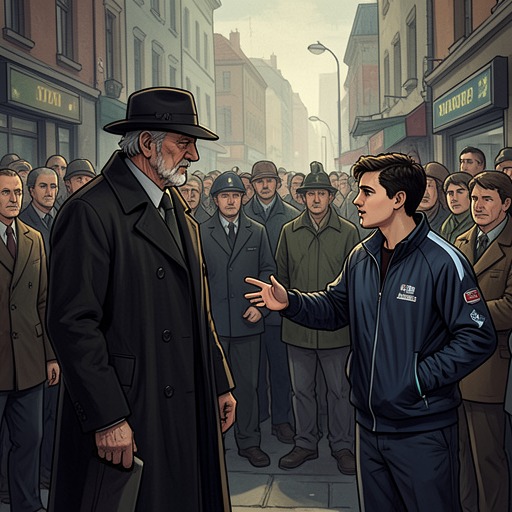
Raffi Brown
Player Manager: A Sports Progression FantasyRaffi Brown is a midfielder whose importance lies in the gap between what a player profile seems to promise and what a human being reveals under pressure. Max Best discovers him almost by accident at Powerleague in Ardwick, where a modest Current Ability rating contrasts with an exceptionally high Potential Ability and with football that appears far more intelligent, balanced, and mature than the numbers initially explain. Raffi becomes not merely a prospective client but a test of Max’s developing judgement: his talent is real, yet its value depends on development, opportunity, and the choices he makes when football collides with responsibility.
Discovery and Profile
Raffi enters the narrative during Max’s attempt to turn weekday five-a-side matches at Powerleague into an efficient source of experience points. Max arrives shortly after six, watches successive games, and accumulates 120 XP by half past nine. He is about to leave after watching only a minute of the latest kick-offs when he sees Raffi. The discovery is presented like an interruption in Max’s calculated routine: the scouting system has produced a person who immediately exceeds the expectations of the exercise.
The profile identifies Raffi as a twenty-one-year-old Argentinian midfielder who plays centrally. His listed attributes are not overwhelming, but his Potential Ability is 139 while his Current Ability is only 2. The discrepancy makes him a classic developmental prospect: almost no present status, but an unusually large suggested capacity for growth. His acceleration is 11, stamina 14, and heading 14; later Max sees that his finishing is only 6. Raffi is also described as perfectly two-footed, a rare and valuable quality in Max’s estimation. The numbers therefore create a tension that persists throughout Raffi’s story. They identify possibility without guaranteeing achievement.
The Player Max Sees
Raffi’s appearance initially works against the glamour of discovery. Max notices an asymmetrical face, mismatched features, and an awkward, lumbering movement, describing him as slightly off rather than grotesque. The contrast is deliberate: away from the ball, Raffi looks physically unremarkable and even ungainly; once possession reaches him, his body seems to reorganize itself around the demands of the game.
His first significant action transforms Max’s perception. Raffi absorbs a challenge, feints a right-footed pass, drags the ball back onto his left, and threads a pass to the striker in roughly seven-tenths of a second. Max experiences the movement as a fusion of a ballet dancer’s balance and an Olympic sprinter’s power. The apparent awkwardness disappears into timing, coordination, and economy. Raffi’s talent is not ornamental skill but the ability to select and execute the useful action before opponents can respond.
That intelligence recurs through the half. He cushions one-touch passes, shoots in ways that send the goalkeeper the wrong way, and turns calmly back to his own goalkeeper when no forward pass exists. He tracks runners, intercepts passes, and repeatedly appears in the place where the match needs him. Opponents kick him and attempt to provoke him, but he remains composed, finishing the half unruffled and, as far as Max can tell, with complete passing accuracy. Raffi’s effectiveness is therefore both creative and defensive. He does not merely produce highlights; he reduces danger, maintains possession, and shapes the game’s rhythm.
Promise and Reassessment
When Max returns to Ardwick’s Powerleague to check on Raffi, none of the principal attributes has changed, but Max can now see the finishing rating of 6. The revelation is a small disappointment because it limits the fantasy of a midfielder scoring absurd numbers of goals. Raffi is not going to become a goal machine modeled on Michel Platini simply because his potential is high. Yet the limitation clarifies rather than destroys his value. He is running the match, pulling the strings, and demonstrating that influence can be more important than spectacular statistical output.
Max’s personal response remains intense. A single exchange of eye contact feels frighteningly concentrated, while Raffi simply continues with his work. The scene places Max’s emotional investment beside Raffi’s professional reserve. Max is already attached to the footballer he imagines, but Raffi has not yet accepted the role of discovery, prospect, or future professional. His silence and concentration keep him from becoming a passive object of Max’s enthusiasm.
Several weeks later, Max’s evaluation becomes more measured. Raffi is no longer the dream client without qualification because James Yalley’s high Potential Ability and ideal position-and-skillset match force Max to recalibrate his idea of value. Even so, Raffi could become a good Championship player, might play in the Premier League if his team were promoted, and could prove financially valuable. Max estimates that Raffi might be worth four Ziggy Graves in the short term, with much greater potential later. The comparison reveals the market logic surrounding young footballers: talent is translated into projected tiers, playing time, promotion scenarios, and possible income.
Yet seeing Raffi play again rekindles Max’s earlier attachment. The player remains powerful, smooth, and, in Max’s footballing language, irresistibly attractive. This second response matters because it survives the statistical correction. Max’s valuation changes, but the spectacle of Raffi’s football continues to persuade him at an embodied level.
Recruitment and Character
Max eventually approaches Raffi as an agent. Raffi recognizes him as the man who has been watching the matches and asks whether he works there. Max explains that he has been scouting him and is looking for a powerful, quick-witted midfielder who can look after himself on the pitch. He asks whether Raffi would like to become a professional footballer. Raffi’s first concern is practical: he asks about the upfront payment, suspecting that Max may be a con artist.
Max answers the suspicion by showing the folder on his phone containing photographs from his existing contract signings. He explains that one client, Ziggy Graves, works in construction and takes odd jobs, while another client is a fourteen-year-old girl whose father is a baggage handler and who receives no pocket money. The exchange gives Raffi a concrete reason to treat Max seriously, but it also preserves the social distance between them. Max arrives with ambition and scouting language; Raffi responds by testing the economic reality behind the promise.
Raffi’s most important qualification emerges not from the profile but from his conduct after Max’s injury. During the match against the Viaduct Vikings, Max is tackled heavily on the ankle and is carried from the pitch. Raffi has a direct opportunity to continue playing and to demonstrate himself before the person who might help him become a professional. Instead, he hands his daughter to his wife, kneels beside Max, asks for the locker key, and offers to retrieve Max’s belongings and take him to hospital. The decision is costly in footballing terms: Raffi might never receive another opportunity of equal importance. It nevertheless establishes that his ambition does not erase his capacity for care.
Max experiences the decision as a moral reversal. His negative thoughts about Raffi disappear, and the pain seems to ease slightly as he understands that Raffi has chosen responsibility over self-promotion. Raffi’s talent had already made him attractive as a client; this action makes him trustworthy as a person. The proposed professional future is therefore attached to a form of character that cannot be reduced to Current Ability, Potential Ability, acceleration, or finishing.
Relationship with Max and Narrative Significance
Raffi’s relationship with Max develops through observation before it develops through conversation. Max first watches him from the edge of the pitch, treating the player profile as an instrument of knowledge and the match as evidence. Raffi, by contrast, remains absorbed in play. Their early connection is asymmetrical: Max knows Raffi’s ratings and studies his movements, while Raffi only gradually notices the persistent spectator.
The injury scene changes that asymmetry. Raffi sees Max not as an agent, scout, or possible gatekeeper but as a vulnerable person lying on the ground. His choice to help Max reverses the usual direction of value. Max had believed he was the one who could open Raffi’s route into professional football; Raffi demonstrates that he can also protect Max when the latter’s body fails. Their relationship consequently becomes reciprocal rather than merely commercial.
Jackie Reaper later places Raffi’s ability in a still more revealing comparison. Jackie considers Raffi genuinely good and agrees that he deserves a trial, but says that Raffi looked like a two-legged dog strapped to a roller skate beside Max before Max was injured. The insult is not a dismissal of Raffi; it is evidence of how exceptional Jackie believes Max to be. Raffi remains the player Max correctly identified, yet Max’s own performance unsettles the hierarchy he had constructed between scout and talent. Raffi functions as the benchmark through which Max’s hidden ability becomes visible.
Raffi therefore occupies a distinctive place in the narrative. He is a high-potential player with a low present rating, an awkward-looking man whose football is graceful, a possible commodity whose most decisive action is generous rather than profitable, and a prospect whose value survives a realistic reassessment. His story shows that scouting is not simply the recognition of numbers or the conversion of talent into money. It is also the recognition of timing, composure, intelligence, and the choices made when the game stops being safe. Raffi’s promise is considerable, but the moment that most fully defines him is the moment he is willing to put that promise aside.