“A black hole larger than anything I can imagine”
Point BlankThe expression “a black hole larger than anything I can imagine” is Ruth Warnecki’s attempt to name the terror of being lost in Winkel’s Cave. It turns darkness from a lack of light into an apparently limitless space closing around her: she cannot find a wall, trust her sense of direction, or make the cave fit the map she remembers. The phrase’s force comes from that collision between a physical problem and a mind struggling to imagine any way out. It also becomes part of a recurring blackness that connects the cave, a later dream, and Ruth’s incomplete account of what happened to her.
The Cave and the Void
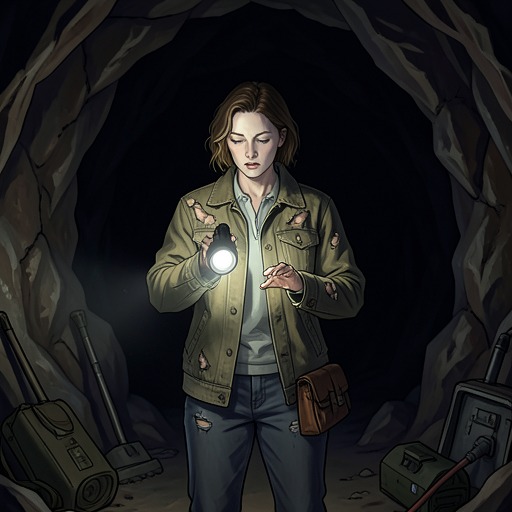
Ruth’s thought follows practical efforts to orient herself. She feeds a measuring tape out to its full twenty-five feet and crawls along it, expecting contact with a surface. Nothing answers. She suspects she has veered off course, then tries moving in a circle with the tape extended; again, there is no wall. The failed measurements matter because they give the fear a concrete cause. Ruth is not simply frightened by darkness: the ordinary tools of distance and direction have stopped reassuring her.
Her body registers the resulting panic before she can reason through it. Dizziness and nausea make her sit down; she is barely breathing, her heart pounds, and her mouth goes dry. Against these sensations, the black hole image enlarges the chamber beyond any scale she can grasp. The phrase expresses a crisis of orientation: Ruth can imagine neither the limits of the space nor a route back to safety. Yet she tries to correct herself. She insists there must be an explanation and reasons that she has crawled farther into a chamber than she thought, perhaps one much larger than the map suggested. The image therefore marks not the abandonment of thought but the point at which fear overwhelms it—and the beginning of her effort to recover a workable account.
That effort is interrupted by a soft, sibilant dragging sound with no visible source. Ruth imagines a huge snake moving toward her, a threat made more frightening by its invisibility and by the absence of anything behind which she can hide. She hurls her compass across the cave floor. The sound stops, and absolute silence returns. The compass is a tool for finding direction, but in this moment Ruth throws it away as if distance might also put distance between her and the unseen threat. The silence offers no explanation; it only removes the immediate stimulus. The cave remains unmeasured and dark.
The Dream’s Dark Pit
The blackness returns in a dream Ruth has while sleeping in Rob’s bedroom. There, she stands in a dark place so complete that she cannot see her hand, but the dream initially gives that darkness a different emotional charge: she is not afraid. She waits for a man who will bring her a million dollars in gold bars, believing the treasure is hers and that she has earned it. The black pit is therefore not only a figure of terror. In the dream it holds anticipation and imagined reward, even as its scale and obscurity echo the cave.
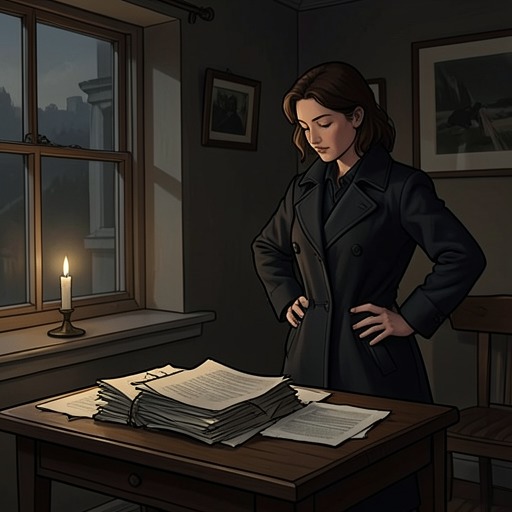
The dream changes when Ruth hears a sound. She first associates it with the expected arrival of the man carrying the gold, then recognizes that it does not sound like footsteps. She wakes to heavy snowfall outside the window and hears scratching below it. Two men in winter clothing are crouched beneath the window; when one looks up, she jerks back just before a bullet splinters the wood inches from her head. The sequence makes the dream’s uncertain sound consequential without establishing that the dream predicts the attack. Rather, the transition from an imagined visitor to an actual danger gives the black setting a new edge: what had seemed to be a private, almost cheerful fantasy ends in a threat from outside.
Recollection and Recognition
Later, Ruth tells Dillon Savich and Lacey Sherlock that her last clear memory is crawling through a low arch in the cave wall and into a chamber, after which events become confused and black. She says the feeling of that blackness resembles the dream from the previous night and wonders whether the dream reflects what happened to her. Her account makes the image a bridge across a gap in memory, not a complete explanation of that gap.
Ruth can recount the dream distinctly. She identifies the dark pit, her inability to see her hand, the expected million dollars in gold bars, and the moment when the sound proves not to be the man’s footsteps. She also interprets the treasure as the gold she had been seeking in Winkel’s Cave. The gold is later identified as a stolen shipment intended for General Lee in Richmond. But Ruth draws a boundary around the dream’s meaning: she understands it as a dream about the treasure and the noise outside her window, not as a full recovery of the cave episode. The blackness resembles what she remembers, while the events that produced it remain beyond her clear recall.
Recurrence and Meaning
The phrase’s significance lies in the way it gives repeated darkness different functions without resolving them into one. In the cave, blackness is oppressive because Ruth cannot measure or escape it; in the dream, it surrounds her while she waits calmly for gold; after waking, the sound draws her from imagined expectation into immediate physical danger. When she later speaks about these experiences, she uses their resemblance to approach a memory that remains fragmented. The image links fear, expectation, and recollection, but does not prove that the dream contains hidden knowledge or that the cave has supernatural properties.
During the subsequent attack, Ruth is told to crouch behind a dresser. Her head is pounding, and images of the dream’s man coming toward her in the blackness continue to score through her thoughts. The earlier image thus persists into a moment of danger, interfering with her sense of what she would ordinarily do. Across these scenes, darkness repeatedly removes reliable reference points: no cave wall, no visible figure in the dream, no clear understanding of the sound, and no complete memory of the cave. The black hole expression is the sharpest verbal form of that disorientation. Its scale is not a measurement of the cave but an account of how, for Ruth, fear makes the unknown seem without limit.