American Civil War
Point BlankThe American Civil War is the historical setting behind the buried-gold mystery that Ruth Warnecki investigates in Winkel’s Cave. At first, an old map seems to preserve a straightforward story of Confederate soldiers hiding gold meant for General Lee. The letters eventually found beside the bars revise that account: they identify a Union officer, Charles Breacken, and reveal that the cache’s history includes not only wartime confusion and concealment but also a family separated by war. The past matters because its fragmentary evidence changes who the treasure belonged to, who risked their life to keep it, and who ultimately benefits from its recovery.
The 1861 setting
Ruth dates the first decisive circumstance to July 21, 1861, when McDowell attacked at Bull Run, also called Manassas in the South. In her initial reconstruction, the battle created confusion that allowed Confederate soldiers to take gold being transported from the rail hub at Manassas Junction to General Lee in Richmond. The soldiers brought it to Winkel’s Cave for temporary safekeeping. Her proposed explanation for their familiarity with the cave is practical rather than mysterious: western Virginia caves were mined for niter, or saltpeter, used to make potassium nitrate, the main ingredient in black gunpowder. Soldiers who knew caves through such mining could have discovered the cavern and recognized its value as a hiding place.
The scale of the loss was uncertain but substantial. Ruth says that after the confusion of battle subsided, reports described more than a hundred pounds of gold missing from Harpers Ferry. Some people believed Union soldiers had captured it. The conflicting accounts leave the wartime transfer unsettled even before the cave is searched: the gold’s disappearance was known, but its route, captors, and final hiding place were not.
A map and an incomplete history
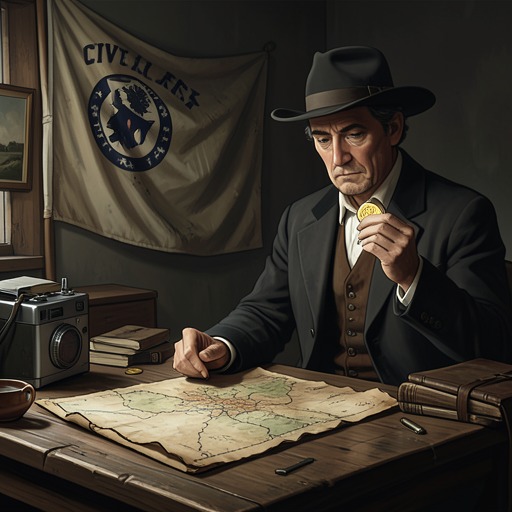
Ruth’s investigation begins not with an official record but with a small map found in a skinny songbook among books she bought at an estate sale in Manassas. The library had belonged to an old home, and the books were more than a century old. The map showed a cave Ruth recognized as Winkel’s Cave and marked gold bars hidden there by rebel soldiers. Its paper appeared old enough and its handwriting seemed appropriate to the period, leading Ruth to regard it as plausible, though those features alone did not establish its history conclusively.
In her first account, the soldiers who hid the gold drew the map so they could return after the war. Ruth reasons that they may all have died, since the map remained tucked into the songbook; perhaps one soldier had left the battlefield to visit family and preserved it without telling them what he had done. Dix Noble cautions that there could have been other maps, since thieves might not have trusted one another with a single copy. The map thus offers a route toward the cache while leaving its makers, their fate, and the chain by which it reached the Manassas attic unexplained.
The map’s wording initially misleads Ruth about where to search. When she and the others first reach the chamber, she examines the limestone niche and finds it empty. Its deep indentations have been shaped by water over thousands of years, and the space appears undisturbed; because the map places the bars beneath the niche, she fears someone has already taken them. On a later visit, she reconsiders the instruction literally. Seeing that parts of the cave lie well below the level where they are standing, she suspects the soldiers meant a lower crevice or cavern, and that the map was deliberately incomplete to keep the treasure from anyone who found the cave.
Breacken’s letter revises the story
The revised explanation emerges from a leather satchel beside the recovered bars. Inside it, Ruth finds a small leather-bound notebook containing roughly a dozen letters. Most are addressed to Lieutenant Charles Breacken. A woman named Missy wrote to her husband; the last letter in the packet is his reply, which he never sent. Written by candlelight in a cave, it says that Breacken and his companions were protecting something they had stolen from the Confederates, who had been taking it to General Lee in Richmond. He describes the Rebels closing in and hopes that, if the Union soldiers prevail, he may next meet Missy as Captain Charles Breacken.
The letter complicates the first explanation rather than smoothing it into certainty. Ruth had told the boys that rebel soldiers stole the shipment; Breacken’s account presents him as a Union officer guarding property taken from the Confederates. The correspondence gives the cache a voice and a personal history, but it does not answer every question. Ruth still wonders how the map reached the old book and why Breacken left his satchel in the cave. Dix proposes that Breacken may have been killed outside, near Lone Tree Hill. Ruth concludes that all the soldiers died without surrendering the gold, while the letter’s unfinished journey home confirms that Breacken never returned to his wife and daughter.
The war’s afterlife
The gold’s recovery turns the Civil War from a distant backdrop into a continuing consequence for a living family. Ruth identifies Linda Massey as the closest surviving descendant of Breacken and visits her at home in Midlothian, Virginia, where Linda is caring for three very young children. Ruth tells her the family story; Linda is then five hundred thousand dollars richer. The discovery therefore resolves the cache’s practical fate while connecting its value to the wife and daughter named in Breacken’s unsent letter and to their surviving descendant.
The sequence also keeps the limits of historical knowledge visible. The map, the letters, the gold, and the modern search illuminate different parts of the story, but they do not establish every detail of the soldiers’ movements or explain the complete passage of the documents across the intervening years. What they do establish is the force of an unfinished wartime act: men hid the gold, Breacken left a letter he could not send, and a map preserved in a songbook eventually led Ruth to a family that could inherit the consequence of both.