Charles Breacken
Point BlankCharles Breacken is a Union officer whose last known letter connects him to the concealment of a Civil War gold cache in Winkel’s Cave. Found beside the bars more than a century later, the letter gives a private human dimension to a treasure mystery and points to the fate of a soldier who never made it home to his wife and daughter.
Identity and wartime circumstances
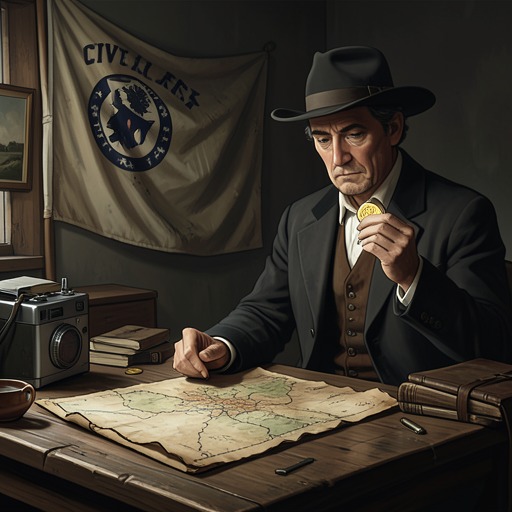
Breacken appears in the recovered correspondence as Lieutenant Charles Breacken, a Union officer serving during the Civil War. A bundle of around a dozen letters found in an old leather satchel includes correspondence addressed to him by his wife, Missy, as well as one letter he wrote but never sent. The letters establish a family life waiting beyond the war: Missy was on a farm with their daughter and her parents, and Breacken asked after the family while facing the possibility of another separation.
His unsent letter places him in a cave during a period of mounting danger. The weather was brutally hot, and the soldiers still wore wool; a battle was expected, though no one wanted to discuss it. Breacken wrote by candlelight after a soldier named Elias had found the cave as shelter. He expected the opposing soldiers to draw closer and ended the letter because he was needed. The document captures an unfinished moment rather than a retrospective account: its writer did not know whether he would see his family the following month.
The gold and the cave
Breacken’s letter describes the soldiers as protecting something they had stolen from the Confederates, who had been taking it to General Lee in Richmond. They were determined not to let the Confederates recover it. This account identifies the hidden treasure not as Confederate gold concealed by its own escorts, as Ruth Warnecki first inferred from the map, but as valuable cargo taken from the Confederates and guarded by Union soldiers. The letter does not establish every step of the theft or the identity of every soldier involved, but its presence with the recovered bars makes Breacken’s group central to the cache’s history.
The map had been discovered by Ruth in a slim songbook among old books bought at an estate sale in Manassas. Its apparent age and its indication of gold hidden in Winkel’s Cave encouraged the search, while an account of more than a hundred pounds of gold missing from Harpers Ferry supplied a possible historical context. At first, the mapped niche proved empty. The eventual recovery came when Ruth and Dixon Noble opened a concealed space beneath rotted wooden planks: six rows of bars, four deep, lay beside the satchel containing Breacken’s letter. The cache and the letter together give physical support to the account of a wartime concealment, although the precise route by which the map reached the songbook remains unresolved.
Family, correspondence, and fate
The letters addressed to Breacken make his separation from his family more than a conjecture. In his own message, he asked Missy to kiss their daughter and mentioned her parents’ help on the farm, including concern about her father’s drinking. He imagined that, if the soldiers prevailed, he might next meet his family as Captain Charles Breacken. That wording expresses an anticipated promotion, not confirmation that he attained the rank.
The letter was never sent. After reading it, Dixon Noble concluded that Breacken had died without returning to his wife and daughter; Ruth likewise believed that all the soldiers had died. The text does not establish exactly when or how Breacken died. Dixon suggested he might have been killed outside the cave near Lone Tree Hill, but this remains a possibility rather than a confirmed account. What survives is the contrast between the future Breacken expected—another meeting, perhaps with a new rank—and the abandoned letter left with the gold.
Discovery and legacy
Breacken’s identity becomes clear through material traces rather than a living witness: the address on the other letters, the signature and contents of his unsent message, and the satchel preserved beside the bars. Ruth recognizes that the writer was a Union officer; the cache gives his words a location and consequence. His letter also revises the treasure story by tying the gold to men who had taken it from the Confederates and sought to keep it from being reclaimed.
The discovery has a present-day consequence for Breacken’s family. Ruth visits Linda Massey, identified as his closest surviving descendant, and tells her the story connecting her family to the Civil War. Linda becomes five hundred thousand dollars richer. Breacken himself remains absent from the modern-day scenes, but the gold and the letters transform that absence into a documented family history: the cache provides material value, while the unsent message preserves the soldier’s interrupted connection to his wife and daughter.