Christie Noble
Point BlankChristie Noble is the missing wife of Dixon Noble and the mother whose unexplained absence unsettles her family long after she vanishes. She appears chiefly through other people’s memories: in the circumstances of Dixon’s return to Maestro, in a prized car that she did not take, and in the sons who still cannot accept that she may be dead. Her story is therefore both personal loss and an unanswered question. Dixon believes Christie would never willingly leave her family, but neither he nor the novel’s characters learn what happened to her in the evidence presented here.
Identity and Background
Christie was the daughter of Chapman Holcombe, widely known as Chappy, a powerful local businessman who owned half of Maestro and held numerous other business interests in Virginia. She married Dixon when he was twenty-two and newly assigned to Manhattan’s Twenty-seventh Precinct. After five years in New York, the couple decided to move back to Maestro. Chappy supported Dixon’s bid to become sheriff, helping him win the election at twenty-six. Christie’s family connections thus meet the public history of her husband’s career: her father’s influence helped make Dixon a local official, while the move back placed their family within the community Christie’s father substantially shaped.
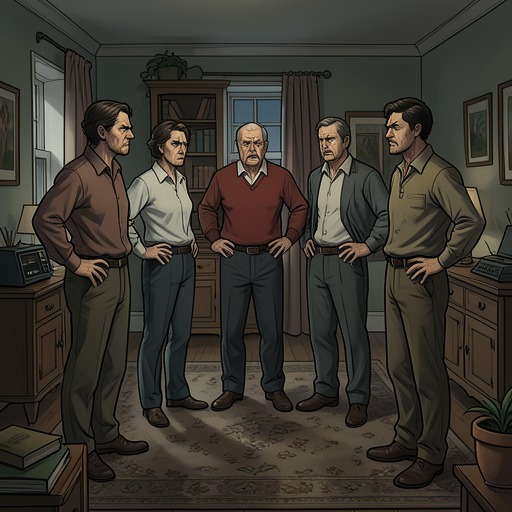
Her place in that family is suggested by the affectionate title her children use for Chappy: Grandpa Chappy. Yet the later scenes at Tara Estate show no uncomplicated family closeness. Chappy’s authority, money, and control become subjects of anger during a dispute with Cynthia Holcombe, and Christie’s absence hangs over that wider family conflict. At a Monday morning gathering, Dixon, Ruth Warnecki, Tony Holcombe, Cynthia, and Chappy sit together in silence after news about Gordon Holcombe has circulated through Maestro. Christie is not there, but the gathering locates her disappearance within a family whose tensions remain unresolved.
Marriage and Domestic Life
Christie’s marriage to Dixon is conveyed through the life they built and the habits that remain after she is gone. She and Dixon returned to Maestro after his New York service, and they had two sons. In Dixon’s household, her absence is not an abstract mystery: it is felt in the boys’ reluctance to face what may have happened and in their father’s struggle to speak plainly about her.
A bedroom preserves one small domestic measure of the loss. After a frightening night, Dixon checks the room where Ruth has been sleeping and sees that the bed is neatly made. The sight recalls that it has not been made so carefully since Christie. The detail turns an ordinary household task into evidence of how memory occupies the house: Christie is no longer present to make the bed, yet the comparison is immediate for Dixon.
Christie also survives in the family’s objects. She loved Dixon’s Range Rover, a Westminster Edition with soft black leather, which Chappy had given her for Christmas three years earlier. Only three hundred of that edition had been imported that year. She enjoyed driving it fast, reaching ninety miles per hour to watch Dixon’s face redden and his fingers tighten on the gear lever. On a later journey, Chappy recalls her pleasure in the car while Dixon falls silent. Ruth notices the practical mystery within the memory: if Christie had left, why had she not taken a car she cherished? The vehicle is at once a vivid recollection of her character and a surviving clue that offers no answer.
Disappearance and Its Effects
By the time Ruth is living with Dixon and his sons, Christie has been gone for nearly a year. Dixon’s grief has changed shape but has not ended. Chappy recognizes the closed expression Dixon has worn through much of that period, while remembering that his despair in the first year after Christie disappeared had been more blank and consuming. Dixon’s continuing reserve is a visible consequence of a loss that has no explanation or confirmed resolution.
The boys have privately tried to make sense of their mother’s absence. Rob asked Tony whether Christie had cancer; Tony did not know, but the boys concluded that whatever had happened must have been something serious and incurable. Their speculation shows how they have tried to supply a cause in the absence of information. Dixon understands their denial because he has felt it himself. He insists that no illness would have made Christie leave without a word and that she would not have abandoned the family willingly.
Dixon has searched for clues but found none. He tells his sons that he believes Christie is dead, while also insisting that he will never stop looking for an explanation. His certainty about her death coexists with the unresolved question of how she died: he prays to discover what happened, and admits that he should have been more direct with the boys sooner. The family’s pain has partly been maintained by silence; his decision to speak more openly changes how they face it, but does not solve the disappearance.
Memory, Absence, and Continuing Search
Christie’s absence also shapes Dixon’s developing closeness with Ruth. After Dixon kisses Ruth, his sons recognize that the moment concerns their mother. Dixon understands that the kiss has broken an unspoken agreement around Christie and forces the family to address what they have kept buried. He tells the boys that he must eventually move forward, while affirming that doing so does not mean that Christie mattered less or that the search for the truth is over.
Ruth, who has lived with Dixon and his sons for a week, finds that the household increasingly feels like home. She would have accompanied Dixon to Christie’s funeral if he had asked, but the exchange makes clear that Christie’s fate has not been established for her either. Ruth believes Christie would not have left Dixon and the boys willingly and concludes that something very bad must have happened to her. This conviction echoes Dixon’s own understanding without turning it into a discovered fact.
Christie’s narrative importance rests on that distinction between emotional certainty and factual uncertainty. Dixon believes she is dead; he cannot explain her fate, and he continues to search. Her remembered speed in the Range Rover, the carefully made bed, and the sons’ unanswered questions give the missing woman a presence in scenes from which she is physically absent. The family can begin to speak about grief and the possibility of new attachments, but Christie’s disappearance remains unresolved.