Dixon Noble
Point BlankDixon Noble, usually called Dix, is the sheriff of Maestro, Virginia, and a father whose work repeatedly carries him from the ordinary demands of a small community into immediate danger. His defining pattern is practical care under pressure: he prepares for winter emergencies, rescues an injured stranger, directs armed deputies through a snowstorm, and pursues questions about Winkel’s Cave. The same grounded attentiveness that helps him protect people also makes him a crucial witness when the story’s violence reaches his own home and the investigation uncovers a dead student.
Identity and Responsibilities
Dix works from the sheriff’s office at Number One High Street. One winter Friday, just before five, he leaves in a leather jacket and gloves as a forecast predicts between one and a half and two feet of snow. He anticipates the practical consequences rather than treating the storm as scenery: downed power lines, stranded drivers, older residents without heat, and sick people unable to reach a hospital. To meet such emergencies, he has trained a substantial group of deputies to handle what he calls disaster situations. His authority is therefore presented not only as a title but as preparation for the predictable ways bad weather can endanger a community.
The February he remembers has otherwise been quiet, though a local domestic dispute supplies an exception. Will Garber brings his wife, Darlene, a three-pound box of Valentine chocolates as an apology; she rubs chocolates into his face, he strikes her, then gets drunk at Calhoun’s Bar, breaks Jamie Calhoun’s nose, and lands in jail. The episode places Dix’s work amid both severe emergencies and familiar local disorder. The sheriff’s world requires him to be ready for a blizzard while also dealing with the consequences of violence between neighbors.
Rescue in the Snow
During the snowfall, Brewster barks at a dark, motionless shape on the forest floor. Dix finds a woman who is unconscious, with blood covering her face and a gash at the side of her head. He checks her pulse and finds it slow but steady. Rather than wait to see whether she wakes, he clears blood from her face with snow and calls emergency services, telling dispatcher Amalee Witten that an injured woman is in the woods by his house and asking for paramedics as quickly as possible.
Once the woman is at his home, Dix identifies himself as the sheriff and introduces his son, Rob, who has made tea. He asks the stranger for her name, but she cannot give one: after beginning to answer, she says she has no idea. Dix connects her inability to remember with the blow to her head, reassures her that a doctor can assess what has happened, and checks her jacket for identification. Its pockets are empty, and she cannot recall carrying a purse or wallet. His response combines immediate medical concern with the basic work of establishing who she is, while the missing identification leaves her dependence on others unresolved.
The woman initially goes by Madonna, but Dix later tells her that her name is Ruth. The revelation startles her into asking who she is and what her full name might be. This is a small but consequential act of recognition: Dix supplies a piece of identity that she cannot yet retrieve for herself. His manner through the encounter is protective without claiming to understand the full cause of her memory loss.
Family and the Attack at Home
Dix’s family life is visible in the same house where he takes in the injured woman. Rob is there, and the boys recall a recent performance of Othello, a sledding plan for Sunday, and a Scrabble game in which Madonna beat them and taught them the word “lichen.” These details show a household with shared routines and play, set against the danger gathering around it. When a car arrives, however, Dix interrupts the domestic exchange to tell the woman that she is Ruth, and then goes to answer the door himself rather than sending the boys. The previous night’s events have made caution more important than habit.
With armed men outside and snow obscuring the view, Dix stays inside long enough to assess the danger rather than stepping into a possible line of fire. When police cars arrive, he takes a Beretta and walks onto the porch, sweeping the area. He tells the deputies that two men are armed and have already shot to kill. He directs them to follow the visible footprints from the ladder toward the woods, warning that the tracks will soon disappear under the falling snow; if the trail is lost among the trees, they are to split up. The episode extends his winter preparedness into field command: attention to changing conditions shapes the urgency and method of the search.
Investigation and Narrative Role
Dix’s involvement continues beyond the rescue and attack. At Tara, he asks Chappy Holcombe about Winkel’s Cave, explaining that Christie had described Chappy as an experienced local cave explorer who knew the cave thoroughly. Dix’s questions are specific: he wants to know whether it has other entrances or connects with any other caves. Ruth emphasizes the importance of the inquiry. The exchange shows Dix using local knowledge to pursue practical investigative leads rather than treating the cave as an isolated curiosity.
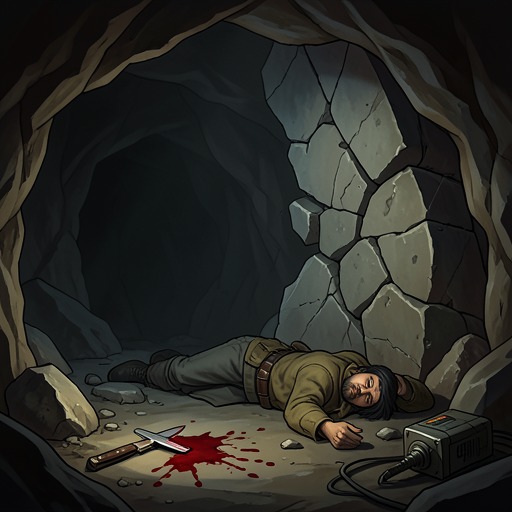
When Ruth discovers a dead young woman in the cave, she identifies the jasmine perfume and the sickening odor coming from the body. Dix drops to his knees beside her and calls for more light from Dillon Savich and Lacey Sherlock, while ordering Chappy to remain back. He then recognizes the victim as a student at Stanislaus, although he does not know her name. That recognition connects the physical discovery to the community beyond the cave and gives the investigation a human and institutional lead. Across these scenes, Dix’s importance lies in the continuity of his response: he notices danger, organizes help, and turns what he knows into the next question the investigation must answer.