Gordon Holcombe
Point BlankGordon Holcombe is the director of the Stanislaus School of Music, a respected musical authority, and Dix Noble’s uncle by marriage. His admiration for gifted young musicians is inseparable from a pattern of sexual relationships with students, including Erin Bushnell and Helen Rafferty. When Erin is found murdered and Helen is later killed, that pattern makes him a central suspect; his departure from Maestro, with his financial accounts closed, ends his immediate presence but not the questions surrounding him.
Identity and Position
Holcombe occupies an influential place at Stanislaus: he teaches and evaluates young musicians, speaks authoritatively about artistic development, and stands at the institution’s head. His status is personal as well as professional. When Dix brings FBI agents to meet him, Holcombe’s eyebrow rises each time the Bureau is mentioned; he pauses when introduced to Ruth Warnecki, recognizing her as the woman Dix found nearly dead from cold in his Range Rover. He asks whether the agents are investigating together and how he can help, but the conversation soon turns to Erin.
Holcombe’s account of Erin establishes both the depth of his musical attention and the authority he holds over her career. He describes her as a fourth-year student due to graduate with a bachelor’s degree in music in May, and says she may stay for a master’s degree. He praises the force and brilliance of her violin playing, especially her performance of Bartók’s Sonata for Solo Violin. He also discusses her technique in terms of control and spontaneity: for him, a great performance should seem to burst into life as if the musician had never played the piece before. The praise is sincere in its detail, but it comes from a director who has also become sexually involved with talented students.
Musical Authority and Student Relationships
Helen Rafferty’s disclosure gives the pattern a longer history. She tells Ruth and Dix that she and Holcombe were lovers for perhaps three months, around five years earlier, in a summer when few students were on campus. Holcombe ended the relationship, saying that being with Helen drained him. According to Helen, he described intimacy with her as an ancient blessing that had lost its power and become suffocating. She had known about his involvement with talented young women even before their affair and confronted him about it.
Helen also explains the justification Holcombe gave for his behavior: he believed he needed the nourishment of young women’s innocent love of music and life in order to create and compose, and feared that without it he could not go on. Helen understood this as a sickness rather than deliberate predation, and continued to regard him as a great man, loving and admiring him despite what he had done. She described Erin as another talented student in a continuing stream of young women ministering to Holcombe’s supposed spiritual needs. Her account links his artistic self-image to his sexual conduct, while showing how affection and admiration helped Helen accommodate that contradiction.
Holcombe later admits another set of relationships. Under Dix’s questioning, he acknowledges sleeping with Ginger Stanford two years earlier and also with Ginger’s mother. He characterizes both involvements as lasting only a couple of months. Asked who ended things with Ginger, he says they stopped liking one another: Ginger had expected more because of his reputation for experience, found the encounter disappointing, and told him to take a sex-education class. The episode adds a bluntly comic detail to the portrait of a man whose cultivated authority and sexual self-regard do not guarantee that he is admired by the women involved.
Erin Bushnell and the Murder Investigation
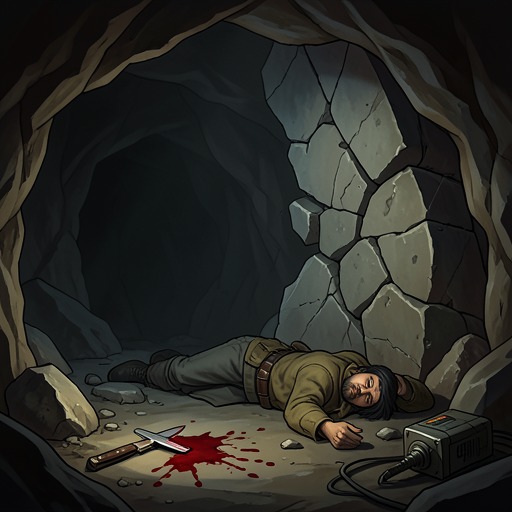
When asked about Erin, Holcombe first responds with startled concern. He says she does not use drugs beyond perhaps marijuana, mentions that she drives her small Miata fast, and wonders whether she has had an accident. Dix tells him that Erin is dead: her body was found in a chamber in Winkel’s Cave, apparently murdered and entombed after the exits were covered. Holcombe’s immediate reaction places him in the position of a teacher receiving news of a student’s death, but his personal involvement with her soon complicates that appearance.
During a later interrogation, Savich presses Holcombe over Helen’s murder and asks whether Erin had seen through him or threatened to expose him. Holcombe’s posture changes: the hunched, pleading man gives way to the director, who meets the investigators with disdain and a renewed sense of superiority. He says he will tell them the truth about Erin, then recounts first becoming involved with her on Halloween. She had come to his house trick-or-treating in a costume as Titania from A Midsummer Night’s Dream and later called him her Oberon. The account joins a student’s flirtatious theatrical gesture to the unequal institutional relationship between a young musician and her director; it is Holcombe’s description of the beginning, not proof of what happened between them.
Holcombe calls Erin the most talented violinist he had heard in a long time. He recalls Gloria Stanford’s confidence that Erin would become known around the world, praises her technique, and singles out her playing of Brahms’s three violin sonatas composed for Joseph Joachim. He says he loved Erin and Helen in different ways, but denies killing either woman. His praise and professed affection do not resolve the central question of responsibility. In the evidence presented, Holcombe makes admissions about his relationships while maintaining that he was not the killer.
Suspicion, Flight, and Significance
The investigation later reveals that Helen Rafferty hired Dempsey and Slater to kill Erin, not Ruth Warnecki. When Dix tells Holcombe that Helen hired the two men, Holcombe’s hand jerks and brandy spills from his glass. He objects that Helen did not even know Ruth the previous Saturday, and Dix clarifies that Ruth was not the intended victim: Erin was. The revelation redirects the apparent motive for the hired attack toward the conflict surrounding Erin, while Holcombe’s startled response registers the news without amounting to a confession.
Holcombe eventually leaves Maestro. Tony Holcombe argues that Gordon was free to go and that Dix has no proof against him; Cynthia Holcombe suggests that he fled because he was ruined and could not face humiliation. Dix rejects that favorable interpretation, saying Holcombe knows he has left tracks and sneaked away while he still could. He also challenges Tony for failing to mention that all of Holcombe’s accounts had been closed, raising the possibility that Tony helped arrange the departure, though Dix does not establish that he did.
Holcombe’s role rests on the tension between the art he can describe with precision and the private conduct disclosed by the women around him. His language of blessing, inspiration, and creative need turns student relationships into nourishment for his own artistic identity; Helen’s account shows how that story could be accepted by someone who still loved him. Yet the murder investigation does not simply convert his sexual history into proof of homicide. Holcombe remains a compromised figure who denies killing Erin and Helen, reacts to the revelation about Helen’s hired attack, and disappears with unresolved evidence and suspicion following him.