Jackie Slater
Point BlankJackie Slater emerges in the novel through investigative disclosures rather than an extended personal history. His significance lies in his partnership with Tommy Dempsey: together they murdered Erin Bushnell and manipulated the appearance of her death to misdirect the investigation. The available evidence portrays Slater as a calculating accomplice whose methods depended on concealment, but offers little independent detail about his life or ultimate fate.
Identity and Criminal Associations
Detective Morales’s investigation places Slater within Dempsey’s circle. A local informant, Eddie Skanky, had known both men in prison and outside it, and investigators were waiting for him to provide a name. This account situates Slater in an established criminal association with Dempsey, while leaving the details of their earlier dealings unspecified.
The later explanation of Erin Bushnell’s murder makes the partnership more concrete. Ruth Warnecki describes Dempsey and Slater as acting together, and Dix Noble characterizes the pair as attentive to their own survival. Their connection is therefore not merely an association known to investigators: it is central to the way the novel reconstructs the crime and its cover story.
Erin Bushnell’s Murder and the False Ritual
Slater and Dempsey used a hallucinogenic drug to disable Erin before killing her. They then embalmed and posed her body, creating the appearance of a ritual murder. The explanation draws on a specific detail about Dempsey: his stepfather had worked in a funeral home, where Dempsey could have observed the embalming process. The evidence attributes the embalming and staging to Dempsey and Slater together; it does not establish that Slater had the same access or knowledge beforehand.
The staging was intended to shape what investigators would believe if Erin’s body were found. Its ritual appearance suggested a serial killer and prompted the investigation to consider whether there were other victims, including among Gordon Holcombe’s former student lovers. Because those people were alive, the serial-killer theory did not fully account for the evidence, but the disguise had still diverted attention and consumed investigative effort. Slater’s role in the scheme was thus both violent and deceptive: the presentation of the body was designed to conceal a contract killing behind a misleading pattern.
Investigation and Exposure
The investigators’ account separates what they initially suspected from what they later concluded. Gordon was confronted with the possibility that he had seemed capable of repeated ritual killings, but Ruth clarified that the apparent pattern had been manufactured by Dempsey and Slater. The revelation reassigns responsibility for the staging and redirects the case away from an imagined serial murderer.
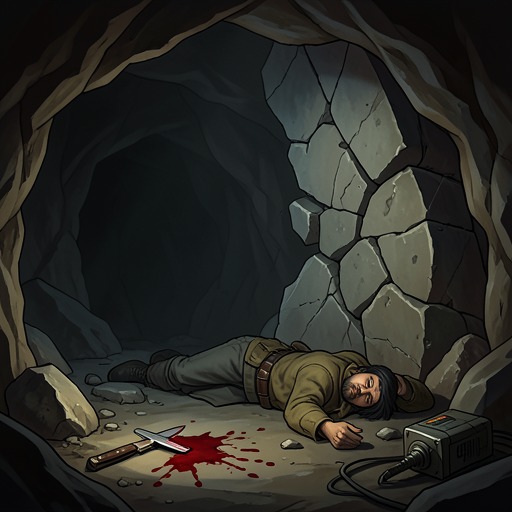
The evidence also links the pair’s concern for survival to their decision to come after Ruth. Dix identifies that pursuit as their mistake. Ruth says that the men would have killed her had they realized she was in the cave; she believes she was disabled after exposure to the drug used on Erin, struck her head, and eventually found a way out after the men had left. Her account makes the attempted concealment of one murder part of the circumstances surrounding a later threat to a witness and investigator.
Characterization and Limits of the Record
Slater is characterized chiefly through conduct attributed to him alongside Dempsey: the murder, the calculated staging of Erin’s body, and a shared concern for avoiding capture. These actions support a portrait of a practical, dangerous accomplice, but the account does not provide his motives beyond the scheme’s apparent aim of misleading investigators and protecting the perpetrators. Nor do the cited disclosures establish what ultimately happens to Slater. His narrative presence remains deliberately bounded by the case: the investigation identifies what he did with Dempsey, explains how their deception worked, and marks their pursuit of Ruth as the point at which their effort to survive exposed them to greater danger.