Maestro
Point BlankMaestro is a Virginia town where the murder investigation unsettles a life otherwise marked by familiar routines and close community ties. The story places its civic center, homes, and roads alongside a nearby music-school campus set in winter landscape; as deaths accumulate, these ordinary places become points of investigation and pressure. The town’s peacefulness is not an abstraction: it is the ordinary world Dixon Noble hears and remembers even as he wonders what is happening to it.
Setting and Nearby Landscape
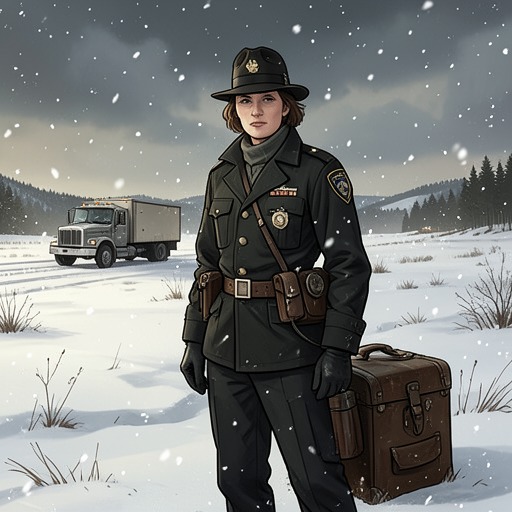
The Stanislaus School of Music lies about four miles east of Maestro, in a private wilderness shaped by mountains, forest, hills, and a snow-covered valley. Mountains form a line to the north, with oak, maple, and pine covering their lower slopes. Closer to the campus, low rises are thick with blackberry bushes; farther east, the terrain opens into a wide, flat valley under snow. This description establishes the region around Maestro as both inhabited and secluded, with the town near a landscape that can feel remote without being far away.
On a late Monday afternoon, the campus itself appears ordered and sheltered: red-brick buildings cluster around a large quadrangle, and snow weighs down the surrounding trees while the walkways are neatly shoveled. Bach’s Brandenburg Concerto drifts from Van Cliburn Hall, named for the pianist after his trust made a substantial grant to the school fifteen years earlier. The scene supplies a quiet counterpoint to the violence investigated in and around Maestro. The campus is close enough for Lacey Sherlock to remark that it is nearly four o’clock and hope Dr. Holcombe is still there, but it remains a distinct neighboring setting rather than part of the town’s civic center.
Civic Center and Community
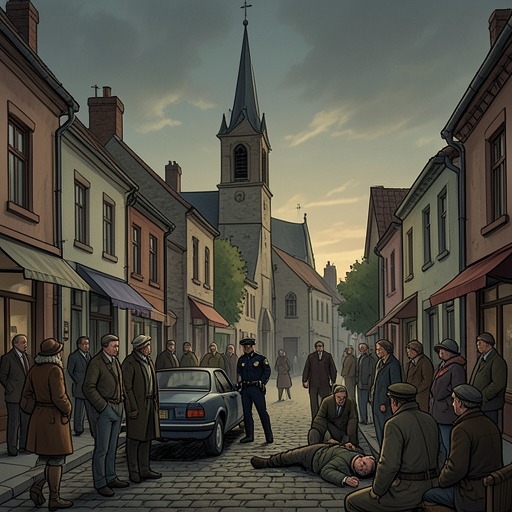
Maestro’s everyday geography is compactly drawn around Main Street. Maurie’s Diner stands across the street from the sheriff’s office, allowing Dixon Noble to walk directly from the diner to confront the delay in sending deputies to Walt McGuffey’s home. That short crossing links a place of meals and conversation to the machinery of law enforcement. It also makes the sheriff’s work visibly public: the investigation does not happen in a distant command center but in the midst of ordinary local routines.
The account presents a community under strain through the demands placed on its sheriff’s office. Penny Oppenheimer explains that deputies have been working overtime to guard Dixon Noble’s house and respond to three deaths already under investigation. Emory is also dealing with storm-downed power lines, hundreds of calls from residents asking about events, pressure from the press, and three teenage driving-under-the-influence cases. These details give the crisis several simultaneous dimensions: danger to a specific household, fear and curiosity across the town, disrupted infrastructure, and the ordinary enforcement work that continues alongside murder investigations. The press’s presence marks the story’s shift from a local disturbance toward a crisis attracting attention beyond the immediate community.
Roads and Houses in the Investigation
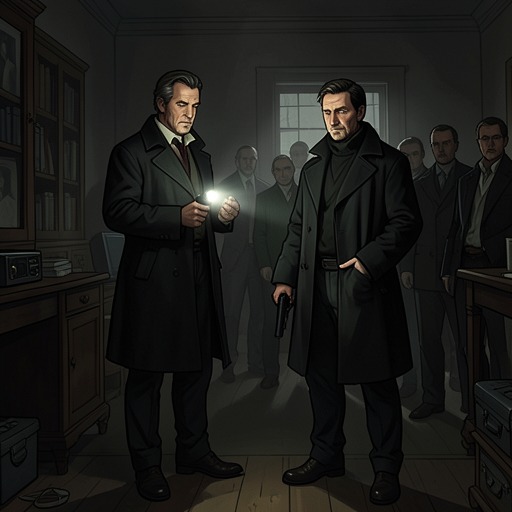
Wolf Ridge Road is identified as part of Maestro, Virginia, and becomes the setting associated with Helen Rafferty’s death. Her brother and running partner, Dave Rafferty, finds her dead early Thursday morning. Dixon Noble reaches the scene with Ruth five minutes after Dillon Savich and Lacey Sherlock arrive; Dr. Himple and the Loudoun County forensic team are already in the bedroom where Dave found her. The road’s name gives the event a precise local anchor, while the arrival of investigators and forensic personnel shows how the town’s streets and homes become working ground for a broader inquiry.
Sheriff Noble’s house supplies a different kind of local setting. At dinner there on Thursday evening, Ruth watches Rafe and Rob compete to eat their corn on the cob without stopping. She claps Rob on the back when she thinks he may choke, gives him water, and responds with a playful challenge about finding larger ears of corn next time. The episode is domestic rather than investigative, but its placement matters: the sheriff’s home is both a place deputies have had to guard and a family space where familiar teasing and care persist. Maestro’s danger does not erase its ordinary life; the town’s domestic scenes make that threatened normality concrete.
Narrative Significance
Maestro’s significance rests on the collision between closeness and exposure. A diner sits opposite the sheriff’s office; a named road leads to a crime scene; the sheriff’s own home requires protection; and residents call in large numbers for news. The short distances make the investigation part of the town’s shared experience rather than a remote process. At the same time, the surrounding forests, hills, and snow-covered valley place the community beside a landscape that opens outward beyond its streets.
Dixon Noble’s nighttime reflection gathers this contrast into the image of a peaceful town whose familiar sounds remain audible even as he wonders what has become of it. His thoughts return to Christie, whose photograph remains on his desk and whose disappearance still shapes his private life. The town’s public emergency and the sheriff’s unresolved grief therefore occupy the same setting: Maestro is at once a community responding to new deaths and a home in which older losses continue to be felt.