Maestro Sheriff's Office
Point BlankThe Maestro Sheriff's Office is the town’s working center of law enforcement during a period of multiple killings, storm damage, and intense public scrutiny. Its role is not only to investigate and respond: the office must also guard the sheriff’s home, manage a flood of public inquiries, and coordinate with federal agents while controlling who knows sensitive investigative information. The pressure on the office makes local policing visible as a contest between limited capacity and a crisis that keeps widening.
Setting and Organization
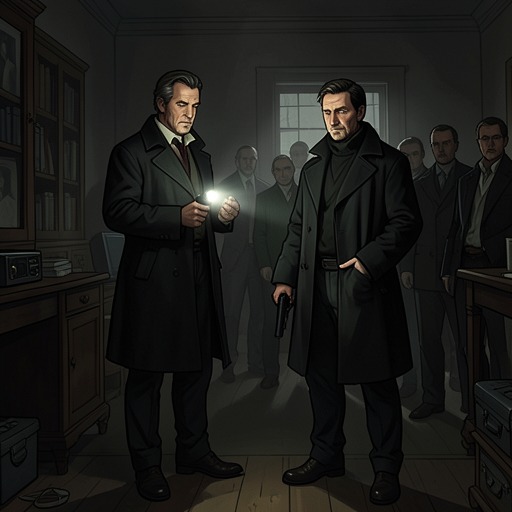
The office is close to the town’s daily life: it stands across the street from Maurie’s, where Sheriff Dix Noble leaves a meal and then walks over to confront his staff about a delayed response. Inside, a public information desk faces a larger room behind a glass partition, where about half a dozen deputies are gathered. That layout places public contact and the work of the deputies within sight of one another, while also making the office a shared space in which federal visitors attract attention.
Penny works at the information desk, taking calls and answering questions from people who come in. After sustaining a head injury, she has been told to rest for several days, but returns on desk duty because staying home and being made to lie on the sofa is harder for her than working. Her bandage is conspicuous enough to prompt a comment from Lacey Sherlock; Penny explains that she hopes it will deter Dix from taking his anger out on the deputy responsible for the delayed response. The exchange presents the office as a workplace where exhaustion and concern are managed through personal familiarity as well as formal duties.
Workload and Public Pressure
The delayed visit to Walt McGuffey’s home becomes a flashpoint because the office is already stretched across several obligations. The deputies have been working overtime to guard Dix’s house and to handle three deaths, while storm-damaged power lines add another demand. The office is also fielding hundreds of calls from residents, dealing with the press, and processing three driving-under-the-influence cases involving teenagers. The backlog is not presented as indifference to McGuffey: it reflects competing tasks in a town where each new development adds to the load.
The Maestro Daily Telegraph’s owner, Milton Bean, repeatedly presses the office for updates, invoking the public’s right to know and a Wednesday deadline. His requests make the investigation a public-information problem as well as a police matter. Dix’s irritation at the delay and at the pressure for news meets Penny’s account of the work already being done; neither perspective cancels the other. The office must answer to residents and reporters while protecting the inquiry from premature disclosure, a balance made more difficult when the town is frightened and the number of deaths is growing.
Investigation and Federal Cooperation
Dix’s interaction with Dillon Savich and the other agents shows that the office cooperates with federal investigators but does not simply absorb their work. Savich explains that MAX alerted the FBI communications center when Moses Grace called again and recorded the call through a Bluetooth transmitter connected to his phone. He also describes the use of warrants covering calls made by a suspect rather than one particular phone number, so changing phones would not by itself defeat the tracking effort. Dix asks how Savich managed to locate the caller from such a distance, and the exchange makes the federal technology legible to the local sheriff without suggesting that it belongs to the local office.
The boundary between local knowledge and restricted information is particularly clear in the handling of forensic work. Dix says he has pressed the morgue technicians for results, but stresses how few people have been told about the matter; none of his deputies knows. The office is therefore both an investigative base and a place where information is deliberately compartmentalized. Later, Savich discloses to Dix and a small group that the FBI had arranged for calls to his phone to be routed through Washington-area cell towers as emergency calls, allowing the caller’s location to appear at the Hoover Building. Dix immediately asks whether that was legal. The conversation assigns the operation to the FBI, while making the sheriff’s office a setting in which its methods and authority are questioned.
Civic Role and Institutional Limits
The office’s work unfolds amid public mourning as well as investigation. At Erin Bushnell’s memorial in the Gainsborough Hall auditorium, Dix studies the faces of a packed audience that includes students, professors, townspeople, and the press. His fatigue at treating everyone as a possible suspect sits beside his awareness of other victims: Helen Rafferty, whose memorial is still to come, and McGuffey, buried in the town cemetery after a smaller gathering of friends. The scene does not make the office the organizer of these observances, but it shows the sheriff carrying the investigation’s burden into the community’s acts of remembrance.
The scale of the crisis eventually exceeds the local office’s remit. After an explosion at the Bonhomie Club, emergency crews and police manage a smoky evacuation, injuries, a fire, and a crowd of patrons, bystanders, and reporters. Savich arrives as a federal agent and is directed to the detectives in charge, a reminder that responsibility is divided among local police and federal investigators rather than consolidated in the sheriff’s office. The later account of the FBI wireless operation confirms that it was decommissioned without disrupting emergency 911 service; the White House briefing also notes that the FBI agent injured by gunfire would recover. Together, these developments frame the office’s significance less as command over every response than as a local institution forced to work amid overlapping jurisdictions, urgent public needs, and surveillance practices whose success does not settle questions about their legality or civil-liberties consequences.