Maestro’s serial murder crisis
Point BlankMaestro’s serial murder crisis turns a succession of deaths and a suspected attempted murder into a threat to the town’s ordinary life. The investigation links the danger to the murder of Erin Bushnell and the attempt on Ruth Warnecki, but the identity of the killer and the precise connections among the victims remain unresolved in these scenes. As the losses accumulate, the crisis reaches a longtime resident’s home, Stanislaus, the sheriff’s office, and the school life of Dixon Noble’s family.
A widening threat
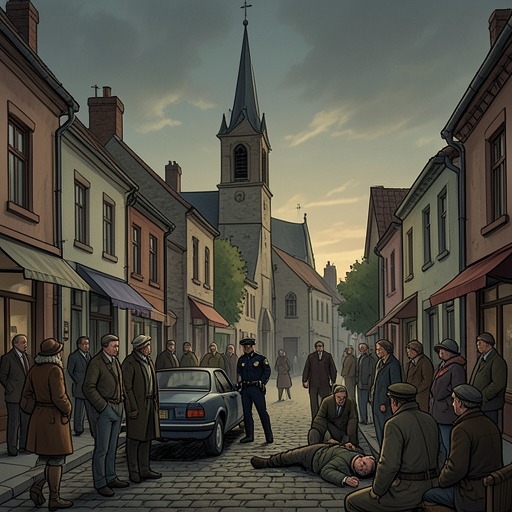
The danger is already taxing local authorities when Dixon Noble learns that Walt McGuffey has been murdered. His deputies found Ruth Warnecki’s BMW in a shed behind Walt’s house, a discovery that places her missing car at a location associated with a new victim. Dixon says Walt was probably dead since Friday and believes the same person who murdered Erin and tried to murder Ruth may have killed him. That is an investigative suspicion, not a confirmed identification of the killer, but it makes the car’s concealment an important point of connection between the attacks.
Dixon had noticed that the snow outside Walt’s house appeared undisturbed and had asked for someone to check on him. The deputies did not reach the house until the morning after that concern arose. The delay turns a seemingly quiet detail in the winter landscape into a sign of how difficult it is to monitor every possible danger during the unfolding crisis. It also leaves Dixon confronting the possibility that a person he knew had been dead for days before help arrived.
Walt McGuffey and the delayed discovery
Walt was eighty-seven and had lived in Maestro all his life. Dixon describes him as a former furniture maker once regarded as the finest in the state, particularly fond of working with bird’s-eye maple. His wife, Martha, had died of cancer in the 1970s. Walt was not an unknown name in the community: Christie Noble had invited him to Thanksgiving dinner, and Dixon had hosted him for the previous two years. His death therefore adds a personal loss to the case, rather than merely another entry in an investigation.
The discovery also reveals the practical limits on the response. Dixon goes to the sheriff’s office intending to challenge Emory for not sending deputies to Walt’s house sooner. Penny Oppenheimer, working despite a head bandage and an expectation that she should be resting, explains that the staff have been guarding Dixon’s house and working on three deaths already known to them. They have also been dealing with storm-damaged power lines, hundreds of public calls, press inquiries, and three teenage DUI cases. Her explanation does not erase the cost of the delay; it shows how the crisis has forced routine public duties and urgent protection to compete for the same people and time.
Helen Rafferty’s death at Stanislaus
A little before six-thirty on Thursday morning, Dixon receives news that Helen Rafferty has been found dead by her brother and running partner, Dave Rafferty. He and Ruth arrive five minutes after Dillon Savich and Lacey Sherlock. Dave is at home, shaken, while the forensic team and Dr. Himple work in the bedroom where he found his sister. The discovery makes Helen’s death immediate and familial as well as professional: she is both a victim in the investigation and a person whose loss her brother must face.
Dixon reproaches himself for not recognizing that he had placed Helen in danger. He cannot tell whether she was killed because someone knew she had spoken with the investigators or because that person feared what she knew. Those competing possibilities give the murder an investigative consequence: Helen may have been targeted for what she had disclosed, or for information she possessed. The evidence here does not settle which explanation is true.
At Stanislaus, investigators find Helen’s desk pristine, with no loose papers, and her computer screen polished. Dr. Holcombe is absent, so Dixon and the others search the desk drawers, but find nothing of interest. The clean workspace offers no immediate explanation for her death or clear lead to what she knew. It also sharpens the contrast between the apparent order of her professional surroundings and the fear taking hold among the people who work there. After Erin Bushnell and now the director’s personal assistant, Dixon expects the campus community to become scared as well as upset and confused.
Strain beyond the investigation
The pressure is visible in the sheriff’s office, where staff have fielded calls from hundreds of people and fended off the press while handling security and the existing deaths. Milton Bean, who operates the Maestro Daily Telegraph, repeatedly seeks updates and cites the public’s right to know, with a Wednesday deadline in view. The newspaper’s demand for current information runs alongside the authorities’ need to investigate and protect people; the passage establishes that tension without suggesting that the press caused the danger.
The crisis also enters Dixon’s conversation with Rafe Noble. Rafe reports that Stup Fulton asked what his father was doing about the violence, and he told him that Dixon and three FBI agents were working hard on it. At school, however, other children are saying Dixon is not as capable as people claim because murders are occurring throughout town. Rafe says he nearly got into fights over the remarks. The killings thus have consequences beyond the crime scenes: they affect Dixon’s standing and leave his son exposed to the fear and accusations circulating among young people.
Significance
The separate scenes accumulate rather than provide a resolution. Walt’s concealed-car connection intensifies suspicion that the attacks are linked; Helen’s death raises the possibility that speaking to investigators or possessing knowledge has made people targets; and the overloaded response shows why protection and discovery do not happen instantly. Meanwhile, pristine desks, apparently quiet snow, and a familiar neighbor’s home cannot guarantee safety. Maestro’s crisis is defined by that collision between recognizable everyday life and repeated violence, with the community’s fear growing faster than the investigation can answer its questions.