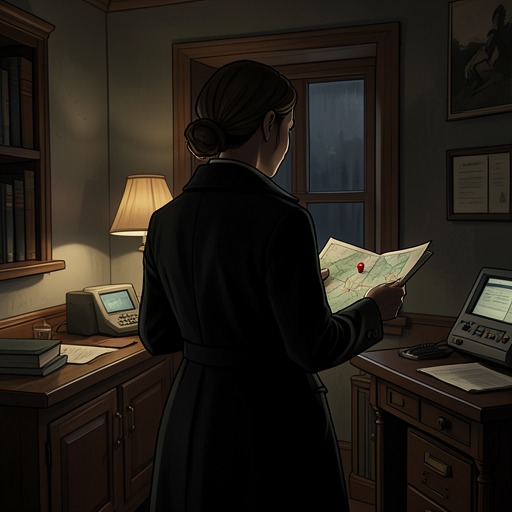
Ruth’s amnesia
Point BlankRuth’s amnesia turns a rescue in the Maestro woods into a temporary loss of identity: she can speak and display specific knowledge, yet cannot name herself or explain how she came to be there. The mystery is not resolved by a single clue alone. A head wound and suspected drug exposure leave the cause uncertain, while a fingerprint identification gives her a name before recognition of familiar colleagues restores her memories.
Identity and Initial Disorientation
When Dixon Noble asks the rescued woman her name, she cannot provide one. Holding Brewster close, she says she has no clue, and her confusion soon gives way to visible fear. Dixon tries to reassure her rather than press for answers, noting the blow to her head and checking for identification. She has no apparent identification in her pockets, and she cannot remember whether she had a purse or wallet. Her amnesia therefore withholds both the basic fact of who she is and the circumstances that might explain her presence in the woods.
The uncertainty also shapes the search for her identity. At the hospital, Dixon asks deputies to look for a missing young woman, search nearby lodging, and prioritize finding her car, which might contain identification or provide a lead through its license plates. He describes her as a tall, lean woman in her mid-thirties with dark hair, a light complexion, and green eyes. Until she can identify herself, the search depends on these physical details and on evidence outside her memory.
A Medical Picture without a Clear Cause
The initial examination finds her physically stable apart from the wound at her temple. A CT scan shows no other anatomical injury, but the doctor considers concussion possible. Her dilated, glassy eyes, restlessness, and elevated heart rate also raise the possibility that she has taken a drug. The symptoms do not match the usual drug effects the doctor sees, so the cause remains open rather than confirmed; a toxicology screen is sent for testing.
The delay in receiving that result prolongs the uncertainty. Because it is the weekend, most of the toxicology findings will not be ready until Monday. Dixon is told that she still cannot remember who she is or how she came to be in his woods, although the head wound appears manageable. The account thus keeps two explanations in view—concussion and possible drug exposure—without resolving which, if either, accounts for the memory loss.
Knowledge Survives the Loss of Personal Memory
Her amnesia does not erase every kind of knowledge. In the hospital room, she suddenly asks Dixon whether he uses meters, then recognizes that she knows about meters and centimeters and can convert between them. She wonders whether this knowledge means she is European, even as she senses that she does not sound European. The episode gives her a fragment of competence without the biographical context needed to interpret it: she can access a particular body of knowledge but cannot use it to establish who she is.
That division between retained information and missing identity recurs when Dixon’s sons discuss their Sunday plans and recall finishing Othello and learning the word lichen. Dixon interrupts the moment to tell her that her name is Ruth, not Madonna. She immediately asks what Ruth’s surname is and who she is. The given name reaches her before the person attached to it does; at this point, identification is information supplied from outside, not yet recovered self-knowledge.
Recognition and Return
The next change comes when IAFIS supplies the identification. Dixon has just learned that the woman is Ruth Warnecki when Dillon Savich and Sherlock Savich arrive. On seeing Dillon, she recognizes him and Sherlock, greets them with relief, and says that she remembers. The sequence distinguishes two steps in her recovery: the fingerprint result gives her the correct name, while encountering familiar colleagues is followed by the return of her memories.
Ruth describes the preceding period as frightening and recalls that strange things had come out of her mouth while she did not know who she was. Her reunion with Dillon and Sherlock is physical as well as verbal: she leaps into Dillon’s arms, laughs, kisses him, and cries. She also identifies Dixon and his sons as the people who cared for her during the interval. Her recovery therefore reconnects personal identity with relationships, while acknowledging the care she received before she could recognize anyone from her former life.
Narrative Function
The episode builds suspense through an uneven return of information. First there is a nameless woman with a head wound; then the medical examination narrows, but does not settle, the possible causes. A stray technical aptitude suggests that some knowledge remains, yet cannot answer the central question. The name Ruth arrives through identification, and recognition follows in the presence of Dillon and Sherlock. Each development supplies a different kind of evidence, so the reader learns her identity through the same staged sequence that ends her uncertainty.
The contrast between the name she is given and the memories that return matters to the episode’s resolution. Dixon can tell her who she is, but she does not regain a sense of herself merely by hearing the name. Her response to familiar colleagues marks the decisive change from externally established identity to remembered connection. The temporary amnesia consequently functions both as a medical mystery—with concussion and drugs still in question—and as a narrative interruption in which recognition restores Ruth to her social and professional world.