Stolen gold shipment
Point BlankThe Stolen gold shipment is a cache of gold bars said to have been diverted from a wartime delivery to General Lee in Richmond and hidden in Winkel’s Cave. Its history reaches back to the confusion of 1861, while its later appearance as a treasure hunt turns a fragment of local history into a present-day mystery. The shipment’s existence is supported in the story by a map and reports of missing gold, but its eventual recovery is never established; by the time Ruth Warnecki investigates, the cache may already be gone.
Intended Delivery and Wartime Disappearance
The shipment was supposed to travel from the rail hub at Manassas Junction to General Lee in Richmond. Ruth dates the pivotal confusion to July 21, 1861, when McDowell attacked at Bull Run—also called Manassas in the South. In the disorder of the battle, the soldiers assigned to escort the gold are said to have seized it rather than deliver it. The intended military cargo thus became a private cache, separated from its official route and purpose.
The account connects this theft to reports that more than a hundred pounds of gold had gone missing from Harpers Ferry. Many people believed Union soldiers had captured the gold. Ruth offers a different explanation: the escorting rebel soldiers took the bars and concealed them themselves. The discrepancy between the public belief and the map’s story gives the treasure its central historical uncertainty. The reported loss provides context for a large quantity of missing gold, but the book does not independently confirm that this shipment and the Harpers Ferry loss were definitively the same cache.
Concealment in Winkel’s Cave
According to the map, the soldiers hid the gold bars in a niche in Winkel’s Cave. Ruth proposes a reason they might have known the cave: caves in western Virginia were mined for niter during the Civil War. Niter, or saltpeter, forms in cave deposits and supplies the main ingredient in black gunpowder, potassium nitrate. Soldiers familiar with cave workings may therefore have discovered the cavern while mining or learned of it through that activity, then judged it a suitable hiding place. Ruth presents this as a plausible reconstruction, not as a witnessed account of how the soldiers found the niche.
The concealment was intended to be temporary. The soldiers allegedly drew a map so they could return for the bars after the war. None, Ruth guesses, survived to reclaim the gold; otherwise, she reasons, the map might not have remained where she later found it. That explanation is also conjectural. The object’s history depends on a chain of absences: the soldiers did not return, their families apparently were not told, and the gold remained associated with a hidden place rather than a known recovery.
The Map and Its Rediscovery
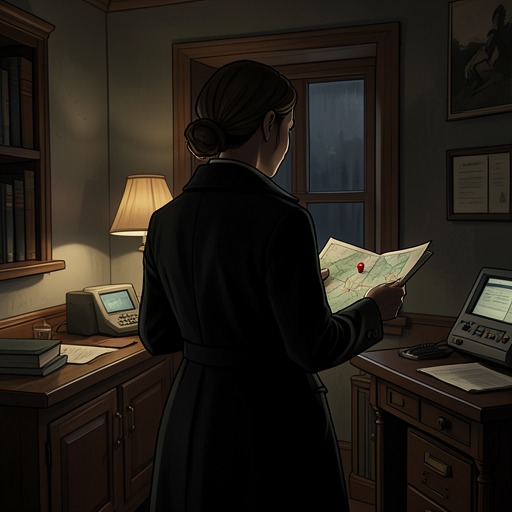
Ruth traces her discovery to an estate sale in Manassas the previous month. She bought a collection of books more than a hundred years old, spanning the subjects expected in an old home library. Inside a slim songbook of popular songs, she found a map that appeared to identify Winkel’s Cave and mark gold bars hidden there by rebel soldiers. The ordinary, portable book became the surviving container for a secret that its owner had apparently kept from family and posterity.
Ruth considers the map’s paper old enough and its handwriting appropriate to the period, and says it looked legitimate. She imagines that it could have been the only map, perhaps left for safekeeping in the songbook by a soldier who had left the battlefield to visit his family. Neither the single-map theory nor that imagined journey is confirmed. Dix Noble cautions that thieves might have made more than one copy, a possibility that would weaken the assumption that possession of the songbook gave Ruth exclusive access to the hiding place.
The Treasure’s Present Status
The shipment’s legendary value first appears to Ruth in a dream: alone in a dark pit, she waits for a man bringing a million dollars in gold bars. She later recognizes the dream as an image of the treasure she has been seeking in Winkel’s Cave. When she wakes, the sound outside her window proves to be the indistinct noise of two men, not the footsteps of the imagined carrier. The dream makes the gold vivid as an anticipated reward, but it does not establish the cache’s amount or condition.
Ruth explains to Rob Noble and Rafe Noble that the treasure is not pirate’s gold or doubloons, but a stolen shipment intended for General Lee. She links the cave’s use to its mineral deposits and the soldiers’ possible familiarity with it, then describes the map’s wartime route and the missing gold. Dillon Savich points out the consequence of other people having been ahead of Ruth in the cave: the gold is probably long gone. Ruth agrees, adding that her map is gone too; whoever entered before her may now have it. The bars’ fate remains open, but the failed promise of the map has already changed the hunt from a straightforward search into an investigation of what happened to Ruth in the cave.