Winkel’s Cave
Point BlankWinkel’s Cave, in Maestro, Virginia, is a limestone cave whose concealed chambers make it central to two intertwined discoveries: Erin Bushnell’s murder and the hiding place of a long-lost shipment of gold. Ruth Warnecki first enters in pursuit of a map said to lead to the treasure; the cave instead becomes the scene where she finds Erin and where the investigation confronts both a crime and Ruth’s own frightening loss of memory. Its passages conceal not just what people have hidden, but the incomplete stories they leave behind.
Setting and hidden structure
On a Friday afternoon, Ruth follows a map through a narrow, twisting passage, crawling where the ceiling is low and checking distances as she goes. The map specifies 46.2 feet to a point where an arched opening should be. When the wall appears solid, she rechecks her measurements, then searches the limestone by touch. A shallow, dust-filled arch, about half an inch wide, finally reveals a concealed opening. The dust packed into its groove is decades old, evidence that the disguise has been in place for a long time.
Ruth works away the soft limestone beneath the arch until she can see into a chamber beyond. She squeezes through an opening about the size of a large dog door. The map estimates the chamber at roughly thirty feet by forty, but her lights cannot find its far boundaries. Its air is unexpectedly fresh, leading her to suspect that an unmapped exit may connect it to another part of the cave. That is her inference, not a passage she locates then. The chamber’s obscured extent and hidden entrance make the cave difficult to read even for someone carefully comparing the terrain with a map.
The cave’s larger openings are also difficult to distinguish from their surroundings. When Dixon Noble, Dillon Savich, and Chappy Holcombe later seek an entrance, Chappy identifies the area beneath brush near a bent old pine across a gully. Snow has fallen through the brush, and Dixon encounters rock where he expects an opening. Chappy remains certain of the location, pointing him toward a twisted bush. The search conveys a practical feature of the cave: access depends on recognizing a particular place in rugged, partly obscured ground, not simply walking up to an obvious entrance.
The treasure map and its history
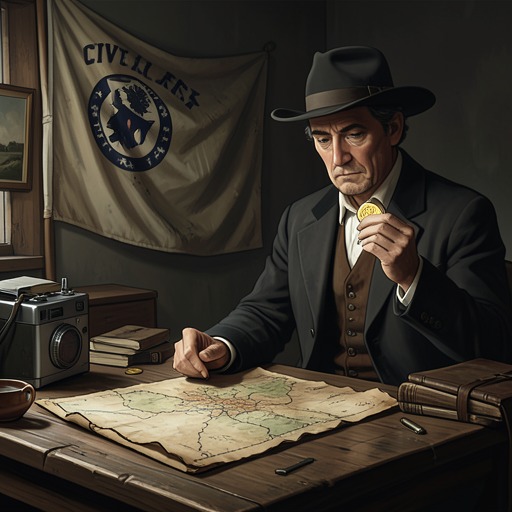
Ruth explains that she found the map inside a slim songbook among a collection of old books bought at an estate sale in Manassas. It depicts Winkel’s Cave and identifies gold bars hidden there by rebel soldiers. According to the account represented on the map, the soldiers were meant to escort the gold from Manassas Junction to General Lee in Richmond. During the confusion of the First Battle of Bull Run on July 21, 1861, they allegedly took the shipment and hid it in the cave for safekeeping until after the war.
Ruth connects the story to reports that more than a hundred pounds of gold went missing from Harpers Ferry. Some people believed Union soldiers had captured it; her theory is that Confederate soldiers concealed it instead. She thinks the men may have left the map in the songbook for safekeeping, perhaps without telling their families what they had done. Its age and handwriting seem plausible to her, but these details support her belief rather than proving the map’s history. Dixon cautions that there could have been other maps, questioning the idea that the thieves trusted a single copy to remain undiscovered.
When Ruth first examines the chamber, the niche marked on the map is empty. She is convinced the gold had been there, but cannot tell who removed it or when. The map’s directions therefore appear to lead to a vanished treasure, and the cave’s first major discovery is instead a concealed crime scene.
Erin Bushnell and the murder investigation
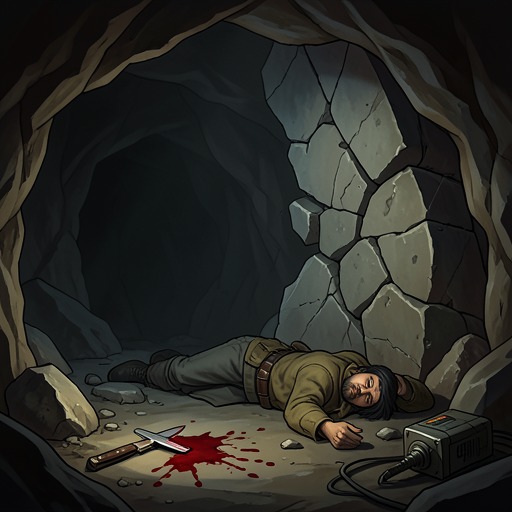
In the chamber, Ruth comes upon the body of Erin Bushnell, a twenty-two-year-old violinist from Sioux City, Iowa, and a student at Stanislaus. Investigators conclude that Erin was murdered and hidden in the cave, with the exits covered to prevent her discovery. Gordon Holcombe, who had been working with her at the music school, remembers her as an exceptionally talented violinist in her fourth year, due to graduate in May. Her body is taken to the county morgue for examination.
The cave’s concealment helps explain why Erin might otherwise have disappeared without a trace. Dixon reflects that without Ruth’s treasure hunt, no one might have known what happened to her. Erin had been drugged with BZ; the amount in her system was greater than the amount in Ruth’s. Ruth’s memories of terror in the chamber are part of the investigation into what Erin experienced, though the precise extent of Erin’s fear cannot be known from Ruth’s account.
The body’s treatment initially points investigators toward a different kind of crime. Erin had undergone an incomplete embalming procedure and had been posed, making the scene appear ritualistic. Later, Ruth and Dixon explain that Helen Rafferty knew the cave entrance and chamber, and they suspect she told the two men responsible that it was a place where Erin’s body could be hidden. They believe the killers chose the method of murder themselves: the staged treatment was meant to make the crime resemble a ritual killing, diverting attention toward a serial killer and possible additional victims. The cave thus serves as more than a hiding place; its isolation gives the staging room to mislead investigators.
Its approaches also connect it to another death. Ruth’s car is found hidden in Walt McGuffey’s shed. His house lies on the way to Lone Tree Hill and another entrance to Winkel’s Cave, and the investigation links that circumstance to his murder. The cave’s multiple approaches make it part of a wider geography of concealment, extending the consequences of the crime beyond the chamber itself.
Memory, return, and the recovered cache
Ruth’s first discovery in the chamber is entangled with her missing memory of what happened there. After finding Erin, she cannot recall whether she stumbled over the body during her earlier visit. Dillon Savich asks her to hold the compass she had used before. The object brings back a fragment: Ruth remembers being terrified, hearing something she perceived as approaching across the cave floor, and running while screaming. She does not recover a complete account, but the compass links her present investigation to the unexplained episode that preceded her rescue in the woods.
When Ruth returns with Dixon on Monday, the chamber no longer seems as frightening to her. The map’s instruction to search beneath the niche prompts a new interpretation: perhaps the soldiers meant beneath it literally, in a lower part of the cave. Ruth taps the earth with her pick and hears a dull wooden sound. Together, she and Dixon uncover rotten planks over a floor roughly three feet square. Beneath them is a natural passage, boarded over like a low basement; its drop is about five feet. Ruth reasons that the arrangement would have allowed the soldiers to lower the bars without carrying them through a more exposed route. A narrow passage below appears to lead toward the underground river and the cliff at the cave entrance.
They continue searching the lower space and find another boarded-over recess in its west wall. Behind the planks are six rows of gold bars, four deep, and an old leather satchel. The treasure has not disappeared after all: it lies beneath the niche, where the map’s wording pointed, but behind a second layer of concealment that the first search did not uncover. The satchel holds a small leather-bound notebook and a dozen or so letters. Ruth identifies the handwriting as a woman’s and finds the name Missy; the letters are addressed to Lieutenant Charles Breacken, whom she believes was one of the soldiers involved in hiding the gold.
The final discovery changes the cave from an apparent dead end into an archive as well as a hiding place. Its upper chamber preserves the aftermath of a modern murder, while the lower passage preserves the physical concealment of the gold and the letters associated with its hiding. Ruth’s return also reverses the first search’s disappointment: the map was not simply pointing to an emptied niche but to a concealed space beneath it. What the letters may reveal about the soldiers and the shipment remains a question opened by the discovery, rather than one answered by the cave alone.