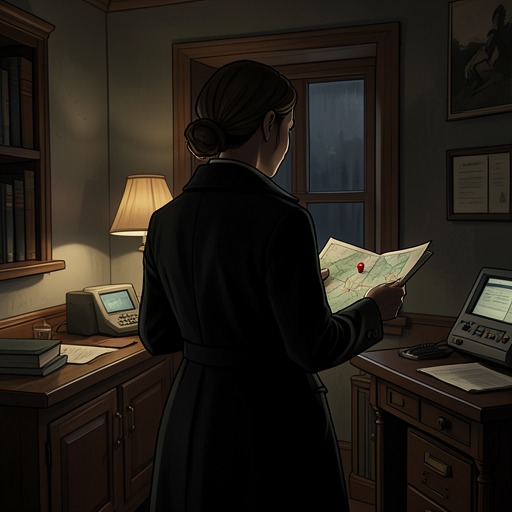
Winkel’s Cave treasure map
Point BlankWinkel’s Cave treasure map is both a practical guide and an uncertain historical document. It draws Ruth Warnecki into a concealed chamber in pursuit of Civil War gold, but its apparent accuracy does not settle who hid the treasure or why. As the map’s promise collides with an empty niche and later evidence, it becomes less a complete answer than the beginning of a more complicated history.
Discovery and Physical Evidence
Ruth finds the map tucked into a skinny songbook among old books she acquired in Manassas. She later explains that she bought the collection at an estate sale and that the books were more than a century old. The map depicts a cave she recognizes as Winkel’s Cave and marks gold bars hidden there. Its paper, ink, and handwriting appear appropriate to the period; Ruth says the paper and writing seem about 150 years old. That apparent age supports her hope that the map is genuine, but it cannot by itself establish who made it or how it reached the book.
The map’s authority is first tested through measurement. Deep in the cave, Ruth checks its distances against the passage: she has traveled the indicated 46.2 feet, and the measurements match to the centimeter. This precision leads her to expect an arched opening in the wall. At first she sees only limestone. Searching again by headlamp, she notices a dust line about two feet above the floor, shaped like an arch and deeply cut into the stone. Dust packed into the groove suggests that the marking has been there for decades, not recently made to imitate the map.
The Route and Its Promise
Ruth tests the apparent outline with her hands and finds that the limestone gives way. Using a small pick, she opens a hole and enlarges it until she can squeeze through. The map has led her not to an ordinary visible doorway but to a concealed entrance: a slab of limestone had been fitted into the wall to disguise the low opening to a chamber. The sequence makes the map operational evidence. Its directions correspond to features that have been hidden, and the physical wall bears signs of deliberate concealment.
Inside, the map continues to shape what Ruth sees. It indicates a chamber roughly thirty feet across and forty feet wide, and she uses her compass to check that the orientation fits. The air is unexpectedly fresh, prompting her to suspect an unmapped exit, while the space ahead remains dark beyond her lights. She believes the chamber is the one shown on the map and that the gold lies within it. That confidence is consequential: the map does not merely describe a past hiding place; it persuades Ruth to enter a sealed, unfamiliar space whose dangers she cannot yet understand.
Historical Claim and Its Limits
When Ruth recounts the map’s story to Dillon Savich and Dix Noble, she describes gold bars supposedly being escorted from the rail hub at Manassas Junction to General Lee in Richmond. During the confusion of the July 21, 1861 battle at Bull Run—also called Manassas in the South—the soldiers are said to have stolen the gold and brought it to Winkel’s Cave. Ruth connects this account to reports that more than a hundred pounds of gold had gone missing from Harpers Ferry. In her reconstruction, the soldiers hid the bars in a cave niche and drew a map so they could return after the war; none survived, which might explain why the map remained in the songbook.
This is a plausible story assembled from the document and remembered reports, not a history the map can prove. Dix points out that there could have been other maps, questioning whether thieves would have trusted one another with a single copy. Ruth acknowledges the possibility but considers the search worthwhile. The distinction matters: the map offers directions and a claim about the gold, but not a verified account of its makers, their number, or the route by which the document passed into the old book.
Loss, Reinterpretation, and Afterlife
The map’s promise falters when Ruth returns to the chamber with the investigators. Its niche is empty. She follows the cavern wall, smells jasmine and an unpleasant odor, and stumbles over a body; the chamber that the map made seem like a treasure destination is also the site of a discovery with a far darker consequence. Savich observes that others appear to have been in the cave before Ruth and concludes that the gold may be gone. Ruth adds that her map is gone too, and fears that whoever took it now possesses it if they did not already have it. A guide that had seemed to make the past legible has itself become missing evidence.
The later recovery of gold bars and a leather satchel deepens rather than simply confirms the map’s story. Ruth and Dix uncover six rows of bars, four deep, beside letters addressed to Lieutenant Charles Breacken. A final, unsent letter is in his handwriting. Ruth identifies him as a Union officer; Dix infers that he never returned to his wife and daughter, and Ruth concludes that those involved died without surrendering the gold. The letters therefore complicate Ruth’s first account of rebel soldiers hiding the treasure. They connect the cache to a Union officer, while leaving unanswered how the map came to be preserved in a book in Manassas and why Breacken left the satchel beside the gold. The map’s lasting significance lies in this gap between a route it can substantiate and a history it can only begin to disclose.