Cemetery
Pokemon Go: The Ultimate Beginner's Guide For Kindle Book Tips And Trick How to Become The Best Pokemon Trainer: This Kindle Book Will Answer Your Unsolved QuestionsCemetery is both a playable landscape in Pokémon GO and the threshold of a nightmarish encounter that unsettles the player’s confidence in what is real. In the game, it becomes a concentrated field of PokéStops and Ghost-type Pokémon; in the narrative, that same abundance draws the player away from ordinary recreation and toward a sealed mausoleum, where familiar game logic gives way to corpses, hidden steps, masked men, and an apparent duplicate of himself.
Definition and Game Function
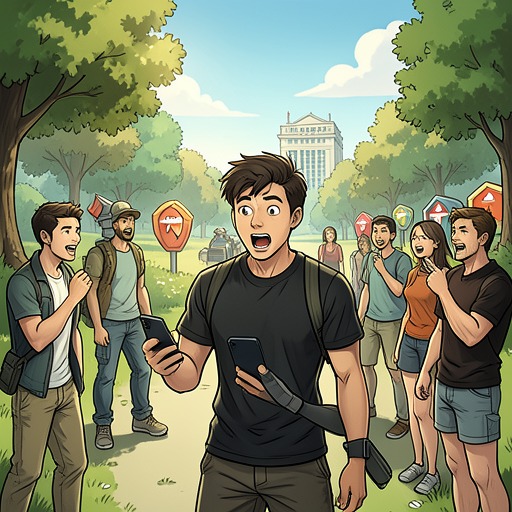
In Pokémon GO, a Cemetery is not merely background scenery. The game encourages participants to enter the real world to capture Pokémon, find PokéStops, and conquer Gyms, and it converts actual landmarks into interactive nodes. A PokéStop may be located at a real-life monument, appearing on the map as an object the player can approach, spin, and claim for items; rewards can be collected from the same PokéStop only once every five minutes. The Cemetery therefore exists simultaneously as a physical site and as coded territory whose meaning is reorganized by the player’s movement and the phone’s map.
The game’s ordinary spatial logic depends on the player’s body. GPS determines the avatar’s position, and movement in real life moves the avatar as well; internet access and location services must be active for the system to function. That rule makes the Cemetery unusually consequential. The player is not simply imagining a visit through a screen but walking among gravestones while pursuing digital rewards. The device turns a place associated with death into an accessible route of collection, while the player’s physical presence keeps the distinction between virtual activity and real danger from remaining purely theoretical.
The location also belongs to the wider resource economy of the game. Parking lots, especially those near PokéStops, are described as places where four, five, or even six common Pokémon may appear, and gas stations can produce similar abundance. The Cemetery surpasses that ordinary density: its map seems crowded with PokéStops, making it appear to the player as a “mother-load” and a “Gold mine.” That language of extraction is revealing. A site marked by graves is approached as a storehouse of loot, and the promise of repeated encounters encourages the player to remain there after dark.
Night Visit and Spatial Transformation
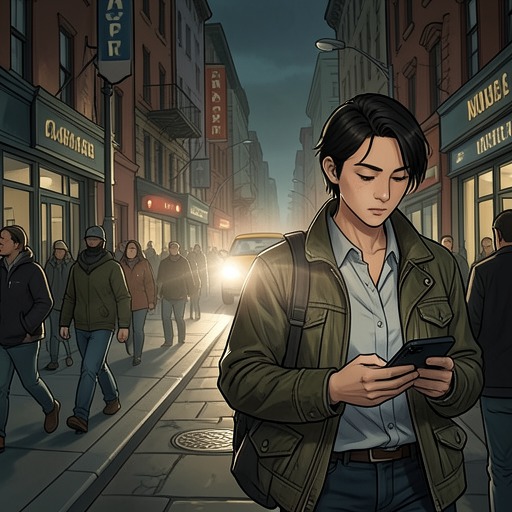
The Cemetery enters the narrative after the player has become absorbed in Pokémon GO. He spends lunch breaks collecting from PokéStops and visiting nearby Gyms, then rides his bike after work in search of more. The night journey is already risky because he is traveling alone by bicycle in the dark, but the discovery of the Cemetery’s concentration of PokéStops changes the outing from routine exploration into a more committed trespass. The game’s reward structure supplies the immediate reason to continue, while the unfamiliar location gives the pursuit an increasingly unstable atmosphere.
He locks his bike near the entrance, takes a flashlight, and moves through rows of gravestones collecting items and encountering occasional Ghost-type Pokémon. He does not claim an inherent fear of cemeteries; he believes in the supernatural but also in mutual respect between the living world and the world of the dead. That stated respect contrasts with his conduct. He crosses into the Cemetery as a player seeking rewards, and the game’s prompts make the burial ground feel temporarily available for consumption. An eerie chill passes through him, though he initially explains it as a gust of wind from a nearby storm.
The Cemetery then narrows into an architectural sequence. The player reaches an area containing several small mausoleums, two medium-sized ones, and one especially prominent Large Mausoleum. Its scale and prominence suggest a dead person who sought to remain the center of attention even after death. As the player enters this section, his phone begins producing notifications for Ghost-type Pokémon from every direction: left, right, behind, and in front. The density is the greatest he has seen in one place, and the setting appears to confirm the game’s logic. Yet the abundance also functions as a lure, directing his attention toward the most ominous structure in the Cemetery.
Near the entrance of the Large Mausoleum, a rare third-evolution Pokémon appears: Gengar. The encounter gives the player a strong game-related motive to approach the building, but a small beam of light leaking from its door introduces a separate mystery. He abandons the precautions taught by his parents, horror films, and friends and walks inside with his flashlight raised. The ordinary entrance to a memorial structure thus becomes a threshold between the mapped outdoor game and a concealed interior whose rules are no longer clear.
The Mausoleum Encounter
Inside the Large Mausoleum, flaming lights hang from the ceiling, apparently lit for a reason. A few steps farther in, the player sees the decaying corpses of what he assumes are a man and a woman. The building’s memorial function is already corrupted: instead of preserving the dead, it exposes decay and conceals a passage. Four steps hidden behind the side associated with the husband lead downward, turning the mausoleum into a layered space of delayed revelation.
Each step intensifies the shift in value from playful discovery to mortal fear. The first produces a blood-curdling scream that sounds strangely familiar. The second produces heavy silence, which the player finds even more terrifying than the scream. The third reveals a large concrete room lit like the chamber above. Six side openings are sized for human bodies; the player speculates that they might once have been intended for the couple’s children, but they are now occupied by countless vials and tubes containing blood, human organs, and chemicals. The family burial space has become an apparent laboratory, and the architecture turns remembrance into concealment.
The fourth step brings six masked men into plain sight. They surround a table on which a naked body lies. The body is the source of the scream, but the deeper horror is its identity. It appears to be the player himself, matching his hair, face, body, and even the birthmark on his thigh. The Cemetery therefore produces more than a threatening encounter: it creates a doubling that makes the player’s own identity uncertain. The supernatural possibility, the possibility of an experiment, and the possibility of hallucination remain unresolved, but each is made frightening by the precise familiarity of the body.
Escape and Unstable Aftermath
The player drops his phone and runs, leaving Pokémon entirely outside his immediate concerns. He reaches the bicycle and discovers that his keys are missing. Because his phone, which could communicate with the Bluetooth tag attached to the key ring, remains inside with the masked men, he has no easy way to locate them. He is more than five miles from home, and the bicycle is valuable, so practical necessity forces him back toward the danger. The pocket knife kept in the bicycle pouch offers only minimal self-defense, emphasizing how poorly ordinary precautions match the threat he believes he has encountered.
Moving through the gravestones, he searches the ground while repeatedly looking toward the mausoleums, hoping to see the keys glinting in the grass. He does not find them. When he returns to the Large Mausoleum, however, there is no sign that anyone followed him. The structure is completely sealed: no crack in the door, no lights inside, and no people. The earlier interior seems to have withdrawn from the physical world.
In a moment of delirious rage, he smashes through the door. The result intensifies rather than resolves the uncertainty. The couple’s corpses remain, as do the stairs and his phone, with the keys only a few feet away, but the masked men, the vials, the containers, and the screaming body have vanished. The room is empty. The Cemetery has preserved enough concrete evidence to make the experience difficult to dismiss while removing the central evidence that could explain it.
The player takes his belongings, returns to his bike, and calls the police during the ride home. The night dispatcher says that a patrol will be sent, though she doubts much can be done; his friends do not believe his account. The Cemetery consequently ends not as a solved crime scene but as an unresolved site of competing interpretations. He insists that he knows what he saw, yet the final uncertainty leaves open the possibility that he saw nothing at all.
Narrative Significance
The Cemetery’s decisive function is to expose the danger in treating every real location as a game resource. Pokémon GO promises exploration, neighborhood connections, and the pleasure of moving through the world with friends, but the player’s solitary nighttime visit shows how quickly that invitation can become hazardous. The book explicitly warns that a player may enter the wrong part of a neighborhood, wander into a busy street while distracted, or encounter something more sinister. The Cemetery embodies the last of these dangers while retaining the ordinary mechanics that led the player there.
Its symbolic force comes from the collision of incompatible spatial meanings. To the game, the Cemetery is a productive cluster of PokéStops and Ghost-type encounters. To the player, it is a place of graves and mausoleums that deserves respect. To the horror narrative, it becomes a hidden structure containing apparent bodies, medical materials, masked figures, and a duplicate self. The same location is therefore successively a map coordinate, a memorial ground, a treasure field, a threshold, and an epistemological trap.
The Cemetery also turns augmented reality into a problem of verification. The player’s phone first guides him toward the site and toward Gengar, then is abandoned during the escape, and is later recovered inside the apparently empty mausoleum. The device connects the location to the game, but it cannot explain what happened there. By the ending, the Cemetery has not yielded a stable truth; it has made the player—and the reader—uncertain whether the most terrifying space was physically present, psychologically produced, or briefly accessible through a reality that the game had already taught him to treat as playable.