Pokémon GO Gym
Pokemon Go: The Ultimate Beginner's Guide For Kindle Book Tips And Trick How to Become The Best Pokemon Trainer: This Kindle Book Will Answer Your Unsolved QuestionsPokémon GO Gym is the game’s central place for organized competition: a real-world location represented on the GPS map as a floating marker with platforms. It transforms ordinary geography into a contested arena, linking a player’s physical movement, team affiliation, Pokémon roster, and tactical decisions to the changing status of a shared location.
Definition and Representation
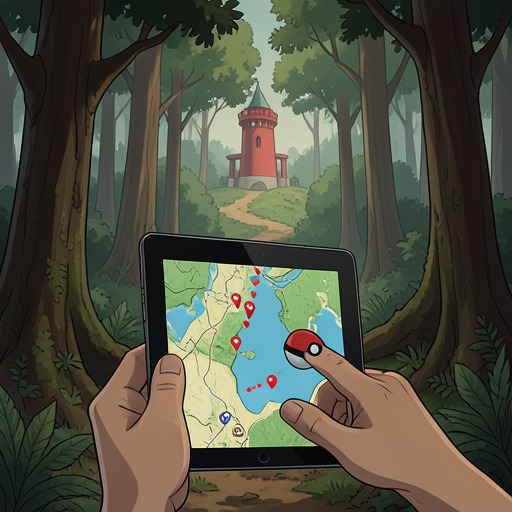
A Pokémon GO Gym is a real-world site that teams battle to control. On the in-game map, it appears as a floating marker with platforms; the number of platforms indicates the Gym Level and therefore the number of potential defending Pokémon. The Gym is thus both a place and a visible status display. Its structure communicates how strongly it is currently defended before the player even enters a battle.
The Gym belongs to the larger location-based design of Pokémon GO. Nintendo and Niantic Labs combine GPS, augmented reality, and mobile graphics to place Pokémon activities in the physical world. Players do not move an avatar solely through buttons or a directional pad: when they walk in real life, the avatar moves as well. The map’s Gym therefore depends on the same technical network as the rest of the game, including an active location signal and an online connection.
Training and Challenging
When a player visits a Pokémon GO Gym, two broad activities are available. Training means battling Pokémon at a friendly Gym, while challenging means battling Pokémon belonging to an opposing team. Although the social meaning of the two modes differs, their basic mechanics are similar. After the player selects a Pokémon team, the battle begins against a defending Pokémon controlled by artificial intelligence rather than by the opposing player directly.
Friendly training strengthens the Gym by increasing its Gym prestige and Gym Level. An opposing Gym is weakened through victories: defeating its Pokémon lowers its prestige and level. The system therefore makes control measurable and reversible. A Gym is not simply owned once and forever; its condition records the recent success or failure of the teams competing around it.
Battle Mechanics and Victory
During a Gym battle, the player can either dodge an incoming attack or select one of the Pokémon’s moves. The decisive objective is to reduce the opponent’s HP to zero. Victory is consequently expressed through a direct depletion of the defender’s health, while the broader strategic result is reflected in the Gym’s prestige and level.
The battle system gives the Gym two connected scales of action. At the immediate scale, the player responds to an AI-controlled opponent through movement and attacks. At the structural scale, those individual encounters alter the strength and accessibility of a team’s shared location. A single battle is therefore both a tactical exchange and a contribution to a continuing contest for territorial control.
Access, Teams, and Social Play
Gym participation is tied to progression. Players must reach level five before they can join one of three teams or take part in running a Gym and competing at other players’ Gyms. Once that threshold is reached, Gym play becomes more than an isolated activity involving a personal collection of Pokémon. It places the player within a team and gives later progress a competitive and social direction.
This development follows Pokémon GO’s broader promise that exploration can produce social contact. The game presents players as people who move through neighborhoods, inspect historical monuments marked as PokéStops, and make connections with other would-be Pokémon Trainers. Gyms intensify that shared geography by turning selected real-world locations into points of rivalry, cooperation, and visible mastery.
Role in the Game System
The Pokémon GO Gym connects several of the game’s main systems: GPS-based movement, the map interface, Pokémon training, team identity, artificial-intelligence opponents, and progression through levels. It also gives purpose to the resources gathered elsewhere. Items obtained at PokéStops and Pokémon acquired during exploration become relevant because they can support participation in battles and training.
The guide presents Gym activity as one of the incentives beyond simply catching Pokémon. Players can earn medals for achievements such as catching a specified number of Pokémon of a type or walking a set distance, but those medals offer little practical benefit beyond recognition. Gym participation supplies a more active form of achievement: players can join a team, fight on its behalf, and test their Pokémon against the defenses established by other trainers around the world.
The concept also points toward a wider device ecosystem. The Pokémon Go Plus was described as a possible future accessory, priced in the guide at $34.99 in one passage and about $30 in another, that could let players visit PokéStops and catch Pokémon without looking at their phones. It is not presented as a replacement for Gym battles, but it illustrates how Pokémon GO extends play through physical movement, location-aware hardware, and a persistent connection between the player’s body and the game world.