Pokémon Gym
Pokemon Go: The Ultimate Beginner's Guide For Kindle Book Tips And Trick How to Become The Best Pokemon Trainer: This Kindle Book Will Answer Your Unsolved QuestionsPokémon Gym is a real-world location transformed by Pokémon GO into a contested arena. Shown on the map as a floating marker with platforms, it connects the player’s physical movement, GPS-based map, Pokémon team, and battle rules: players can train at a friendly Gym, challenge an opposing team, and change the site’s prestige and defensive capacity through the results of those encounters.
Definition and Spatial Interface
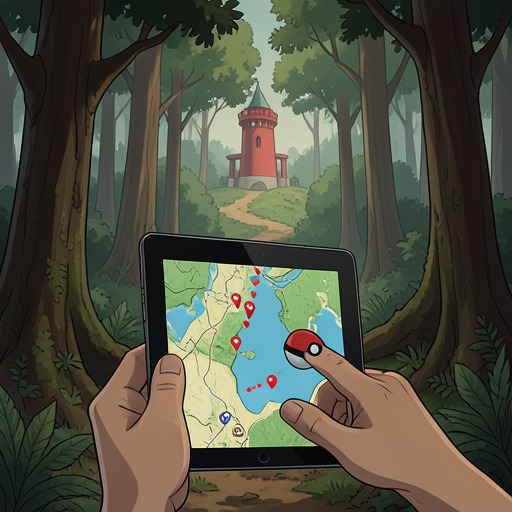
A Pokémon Gym belongs to the same location-based world as PokéStops and nearby Pokémon. The player’s Avatar appears in the current real-world place according to GPS, with streets and a detection range visible on the game map; the Gym is one of the significant sites that can be reached by physically moving through that environment. The game therefore does not treat the Gym as a purely abstract menu. It is anchored to a mapped location that the player must approach and visit.
The Gym’s floating marker includes platforms, and the number of platforms represents the Gym level. That visual arrangement makes the site’s strength immediately legible: the marker does not merely identify a destination but displays how many potential defending Pokémon the location can hold. The map thus turns a physical place into a readable strategic object, while the player’s movement supplies the connection between the ordinary street and the competitive game space.
Teams, Training, and Challenges
When a player visits a Pokémon Gym, two principal actions are available: Training, which means battling friendly Pokémon, and Challenging, which means battling Pokémon belonging to an opposing team. The two modes use similar battle mechanics, but they serve different collective purposes. Training supports the player’s own team by strengthening its Gym, whereas challenging attacks the opposing team’s control of the site.
Before combat begins, the player selects a Pokémon team. The opposing defending Pokémon is controlled by the game’s artificial intelligence rather than by another player directly. This arrangement makes the Gym a meeting point between human decisions and programmed resistance: the player chooses the attacking lineup and actions, while the defense remains an automated obstacle representing the opposing team’s hold over the location.
During a battle, the player can either dodge incoming attacks or choose one of the selected Pokémon’s moves. Victory depends on using those moves to reduce the defending Pokémon’s HP to zero. The Gym’s contest is therefore not settled simply by arriving at the location or displaying a stronger collection; it requires an encounter governed by timing, selected combatants, movement, and the depletion of the opponent’s health.
Prestige and Defensive Capacity
A Gym’s power is determined by its prestige. High prestige makes the site more difficult for an opposing team to conquer, so prestige functions both as a measure of status and as a practical barrier against takeover. The value changes through repeated battles rather than remaining fixed: victories by the Gym’s defenders raise prestige, while defeats against an opposing team lower it.
Friendly players can increase prestige by training their Pokémon at the Gym. As prestige rises, the Gym’s level rises as well, opening additional defense slots for members of the same team. Each friendly player may assign only one Pokémon to defend a Gym, so the expanding capacity distributes the site’s defense among multiple participants rather than allowing one player to fill every position.
The relationship between level and capacity is explicit. A Level 6 Gym can contain six defending Pokémon, while a Level 10 Gym can contain ten. The platforms visible on the map consequently represent more than decoration: they signal the number of defensive positions potentially available and show how collective training has thickened the site’s resistance.
Conquest and Consequences
An opposing team weakens a Gym by defeating its defenders. Each loss lowers prestige, and the site can require multiple lost battles before its protection collapses. If prestige reaches zero, the Gym opens and may be claimed by any team. Control is therefore not transferred by a single abstract ownership switch; it emerges from an accumulation of battles that gradually reduces the location’s established defensive strength.
This system makes the Pokémon Gym a continuing cycle rather than a one-time destination. Training builds prestige and creates more positions for friendly defenders; opposing challenges remove prestige and reduce the site’s security; a complete reduction to zero makes new occupation possible. The Gym’s level, defensive roster, and team control are all temporary states produced by ongoing player activity.
Significance in Pokémon GO
The Pokémon Gym preserves the older Pokémon pattern of training teams and battling rivals while relocating those activities into the player’s actual surroundings. Pokémon GO combines GPS, augmented reality, and mobile graphics so that catching Pokémon, using items, evolving creatures, and battling at Gyms take place in the real world. A player must walk because the Avatar follows real movement, and the same physical exploration that leads to PokéStops can lead to a Gym encounter.
That relocation changes the meaning of competition. The Gym is simultaneously a map marker, a physical destination, an automated battle arena, a repository of prestige, and a shared team project. The game’s stated pleasure includes exploring with friends, visiting historical monuments disguised as PokéStops, and making connections with nearby players; the Pokémon Gym extends that social geography by giving a real-world place an explicitly contested function. It turns movement through a neighborhood into a sequence of strategic choices: where to go, whether to train or challenge, which Pokémon to commit, and whether a defended site can be weakened enough to claim.