Dōkan Seishō
Pokemon Go: The Ultimate Beginner's Guide For Kindle Book Tips And Trick How to Become The Best Pokemon Trainer: This Kindle Book Will Answer Your Unsolved QuestionsGym Prestige is the central resource that makes a Pokémon Gym more than a point on the map. In Pokémon GO, it measures a Gym’s defensive power and converts individual battles into a continuing contest over territory, access, and team membership. Training at a friendly Gym increases its Prestige; successful attacks against it reduce that value. The resulting level determines how difficult the Gym is to conquer and how many Pokémon can be assigned to defend it.
Definition and Function
A Gym is presented as a real-world location where teams battle for control. On the game map, it appears as a floating marker with platforms, and the number of platforms represents the Gym level. Because Gym level also corresponds to the number of possible defending Pokémon, Prestige has both a numerical and a visible consequence: as the Gym becomes stronger, its marker signifies a more substantial defensive presence.
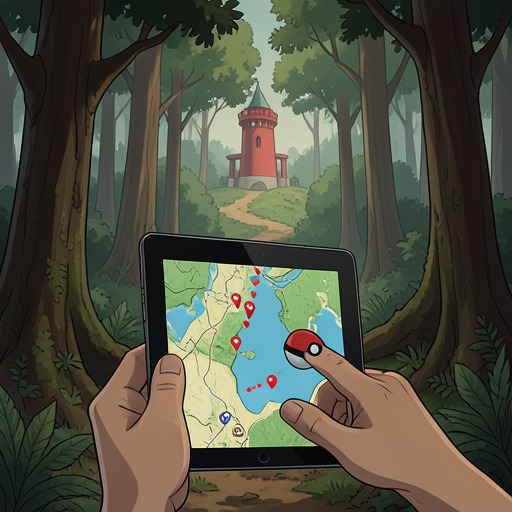
Prestige therefore links the abstract game system to the player’s movement through the real world. Pokémon GO uses GPS, an internet connection, and an enabled location service to place the player’s avatar in a corresponding physical setting. Gyms, like PokéStops located at real-life monuments, become fixed points around which collecting, training, and competition are organized. The game’s location-based structure gives Prestige a territorial quality even though the value itself is recorded digitally.
How Prestige Changes
Prestige rises when defenders at a Gym win battles against an opposing team. It also rises when members of the Gym’s friendly team train their Pokémon there. Training is consequently not merely preparation for future combat; it is a direct contribution to the durability of the shared Gym. The book presents friendly training as a cooperative action whose reward includes both Trainer XP and increased Prestige.
Prestige falls when the Gym’s defenders lose against an opposing team. Winning an attacking Gym battle awards Trainer XP while decreasing the opposing Gym’s Prestige, so the attacker’s advancement and the defender’s weakening occur in the same transaction. Repeated defeats can drive the value down until it reaches zero. At that point, the Gym opens and can be claimed by any team, transforming an established defensive position into contested territory.
Levels and Defense Slots
Prestige determines how resistant a Gym is to conquest: the higher its Prestige level, the harder it is for an opposing team to take control. Increasing Prestige also opens additional defense slots, allowing more friendly players to place Pokémon at the Gym. Each player may assign only one Pokémon, so the number of slots governs not only the Gym’s apparent strength but also the number of team members who can participate in its defense.
The relationship between level and capacity is explicit. A Level 6 Gym can contain six defending Pokémon, while a Level 10 Gym can contain ten. As the Gym’s level rises, its maximum Prestige also rises. A Level 1 Gym has a maximum Prestige of 2,000, whereas a Level 3 Gym has a maximum of 8,000. The system thus creates a compounding structure: a stronger Gym can hold more defenders, and higher levels provide a larger Prestige range that opponents must overcome.
Player Progression and Competition
Prestige belongs to the game’s wider progression system, in which players collect Pokémon, earn experience, accumulate Pokémon Candy, and eventually enter organized team competition. The book identifies level five as the threshold at which a player may join one of three teams and participate in the more competitive and social activities surrounding Gyms. Before that point, the player can learn the basic cycle of movement, PokéStop interaction, item use, and capture; afterward, Gym Prestige gives those preparations a public arena.
The resource also rewards deliberate optimization. Lucky Egg, Incense, and Lure Module use can increase the efficiency of collecting experience and Pokémon, while transferring Pokémon to Professor Willow produces Candy that can be saved for evolution. Those systems do not directly raise Gym Prestige, but they strengthen the player’s available roster and support the broader progression toward Gym participation. Prestige consequently sits at the intersection of several game incentives: personal leveling, Pokémon development, team affiliation, and the defense or conquest of real-world locations.
Significance in Pokémon GO
Gym Prestige gives Pokémon GO a persistent memory of conflict. A single battle does not simply produce a winner and a loser; it changes the condition of a location for the next encounter. Training can reinforce a friendly position, victories can erode an opponent’s accumulated defense, and enough losses can erase the Gym’s current status altogether. Through this cycle, the game translates walking through the real world into a sequence of measurable territorial changes.
Its importance also lies in the way it joins social play to numerical rules. The book describes Gym activity as an opportunity to run a Gym or join another player’s team, to prove Pokémon mastery at other trainers’ Gyms, and to make the game more competitive and social. Prestige is the mechanism that makes those relationships consequential. It determines whether cooperation produces a stronger shared position, whether opposition can force a collapse, and whether a newly opened Gym becomes available for a new team to claim.