Pokémon GO Battle System
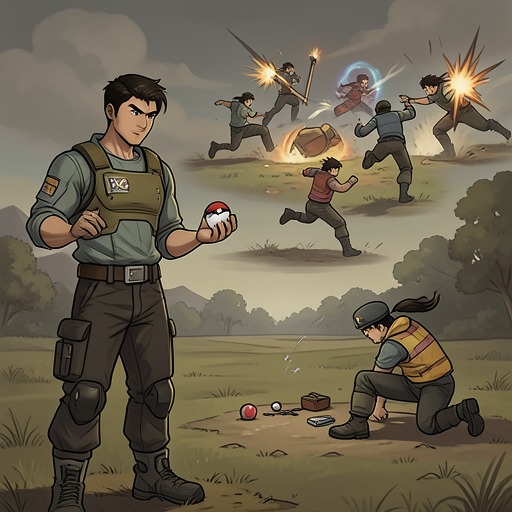
Pokemon Go: The Ultimate Beginner's Guide For Kindle Book Tips And Trick How to Become The Best Pokemon Trainer: This Kindle Book Will Answer Your Unsolved QuestionsPokémon GO’s battle system is the game’s competitive framework, converting the series’ familiar idea of training Pokémon into encounters staged at real-world Gyms. It connects map-based exploration with team conflict: players locate Gym markers, decide whether to strengthen an allied site or attack an opposing one, and use Pokémon whose moves, HP, stamina, and Combat Power determine the result. The system therefore makes progression visible not only through catching and collecting, but also through control, prestige, experience, and access to increasingly competitive play.
Gyms as Competitive Locations
A Gym is a real-world location over which teams fight for control. On the map it appears as a floating marker with platforms; the number of platforms indicates the Gym’s level and, at the same time, the number of Pokémon that may defend it. The visual structure makes the Gym’s condition readable before a battle begins: a larger set of platforms signals greater defensive capacity, while changes in the marker represent the changing strength of the site.
The system gives players two fundamentally different relationships to a Gym. At a friendly Gym, a player trains by battling allied Pokémon, helping increase the site’s Prestige and level. At an opposing team’s Gym, the player challenges the defenders, and victories lower the Gym’s Prestige and level. A battle is consequently part of a wider territorial exchange rather than an isolated contest. Training consolidates control; challenging weakens it.
Training and Challenging
When a player visits a Gym, the game offers either Training or Challenging. Training means battling friendly Pokémon, while Challenging means fighting Pokémon belonging to an opposing team. The two modes use similar battle mechanics, but their strategic purposes differ: one supports an allied Gym, and the other attempts to undermine an enemy Gym’s standing.
After the player chooses a team of Pokémon, the battle begins against a defending Pokémon controlled by artificial intelligence rather than by the opposing player directly. This arrangement preserves the competitive meaning of team conflict while making the immediate encounter a contest between the visitor’s selected lineup and the game-controlled defense. The player’s preparation and decisions therefore matter even when the defender is not actively piloted by another person.
Winning, Health, and Combat Resources
The decisive victory condition is to use a Pokémon’s moves to reduce the opponent’s HP to zero. Both Pokémon display visible HP bars, allowing the progress of the fight to be followed directly. The attacking Pokémon also has a blue Stamina, or Energy, bar beneath its HP. Health determines how long a Pokémon can remain in the fight, while stamina governs access to more powerful actions.
Combat Power, or CP, provides another measure of battle strength. A Pokémon with a higher CP value deals more damage during combat, making CP an important consideration when selecting a lineup. The system thus combines a broad numerical comparison with moment-to-moment action: CP indicates potential damage, HP shows remaining endurance, and the stamina bar determines when stronger moves can be deployed.
The player can either dodge incoming attacks or choose one of the Pokémon’s moves. The recommended attack pattern is to mix Fast and Charge Moves rather than rely on a single action. Fast Moves build the Stamina bar; once enough energy has accumulated, a Charge Move can be released to remove a large portion of the opponent’s HP. Effective play therefore follows a sequence of accumulation and expenditure: ordinary attacks prepare the resource, and the charged attack converts it into a concentrated offensive advantage.
Rewards and Progression
The results of Gym battles affect both the player and the Gym. Winning a training battle awards Trainer experience and increases the Prestige of a friendly Gym. Winning a battle at an opposing Gym also awards Trainer experience, but decreases the opposing Gym’s Prestige. The same basic act—winning a battle—therefore produces different territorial consequences depending on the relationship between the player and the location.
Gym battling is one part of a larger progression system that also includes catching Pokémon, collecting Pokémon Candy, hatching Pokémon eggs, earning medals, and gaining experience. The guide presents these systems as mutually reinforcing: collected Pokémon can be developed for competition, resources can be accumulated for growth, and experience raises the player toward later activities. Medals reward achievements such as catching a specified number of Pokémon of a type or walking a set distance, although the guide notes that their principal benefit is recognition rather than a major mechanical reward.
Access and Social Competition
Gym competition does not begin immediately. Players must reach level five before they can run a Gym or join one of the three teams. Once that threshold is reached, they can fight on behalf of a chosen team at other trainers’ Gyms. Level five therefore functions as an access gate: early play emphasizes learning the map, catching Pokémon, and understanding the interface, while later play opens the game’s explicitly competitive and social layer.
The battle system is also tied to the game’s real-world structure. Pokémon GO uses GPS, requires an internet connection and location services, and moves the player’s avatar as the player moves in physical space. Gyms and PokéStops are consequently not abstract menus detached from geography; they are mapped locations that turn ordinary movement through the world into a route toward supplies, encounters, and contests. The guide presents the social pleasure of exploring with friends and making connections with nearby players as part of the game’s appeal, so Gym battles extend a system that is competitive but also communal.
Strategic Context and Limits
The guide’s broader advice treats battle readiness as the outcome of resource planning. Incense attracts Pokémon around the player for thirty minutes, while a Lure Module attracts Pokémon around a PokéStop for thirty minutes and can benefit other players as well. These tools increase the supply of Pokémon that can be caught, while Pokémon Candy supports later development. A Lucky Egg doubles experience from catches and other experience-generating actions, and the guide recommends combining it with Incense and a Lure Module, gathering Pokémon beforehand, transferring them for Candy, and evolving as many as possible near the end of the Lucky Egg’s duration.
This advice reveals how the battle system is embedded in a larger optimization loop. Exploration supplies encounters; encounters produce Pokémon and Candy; Candy enables evolution; evolution and accumulated experience strengthen the player’s progression toward Gym participation. Even egg hatching contributes to that preparation: players place Pokémon eggs in Egg Incubators and walk the required distance with the game open. The available eggs require 2, 5, or 10 kilometers, with the 10-kilometer egg described as rarer and more rewarding in experience, Stardust, and the quality of the Pokémon it produces.
The guide also distinguishes between transferring and trading. Trading is described as unavailable at the time of writing, while a Pokémon can be transferred to Professor Willow, an act presented as releasing it back into the wild rather than exchanging it with another player. That limitation places greater importance on deciding which Pokémon to retain, strengthen, or convert into Candy before entering the competitive Gym system. Pokémon GO’s battle mechanics thus do not stand alone: they are the visible contest at the end of a chain of movement, collection, resource use, and progression.