Pokémon GO location and movement requirement
Pokemon Go: The Ultimate Beginner's Guide For Kindle Book Tips And Trick How to Become The Best Pokemon Trainer: This Kindle Book Will Answer Your Unsolved QuestionsPokémon GO location and movement requirement is the central rule that makes Pokémon GO a location-based game rather than a conventional screen-bound adventure. The player’s avatar is positioned according to GPS, and movement in the game depends on movement in the real world, a design that makes the phone, network, location signal, and player’s body parts of the same operating system. Its decisive consequence is that catching Pokémon, visiting PokéStops, hatching Pokémon eggs, and reaching Pokémon Gyms become activities organized around physical travel.
Definition and Technical Conditions
The rule requires a player to walk in the real world because the game uses GPS to determine the avatar’s location and movement. The phone must have internet access and its location function turned on; without those conditions, the movement system will not work. The game therefore does not treat the avatar as an independently controlled figure. Instead, the avatar follows the player’s changing position, making ordinary walking the input that advances the virtual journey.
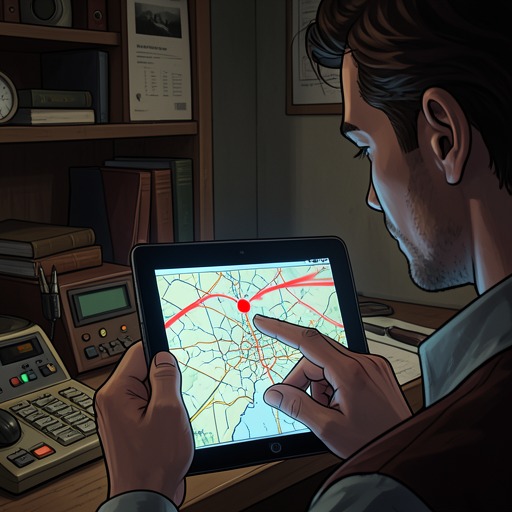
The map presents the avatar in the player’s current GPS-determined place, displaying streets and the range in which nearby Pokémon can be detected. This range makes location more than a background setting: it defines what the player can currently perceive and pursue. A player’s route consequently changes the available field of action, while the game’s interface translates physical position into a visible map, nearby encounters, and reachable destinations.
Movement as the Basis of Play
The movement requirement preserves the basic activities of earlier Pokémon games while relocating their operation into everyday space. Players still catch Pokémon, use items, evolve their creatures, and battle at Pokémon Gyms, but progress now depends on going somewhere rather than merely pressing directional controls. The game’s combination of GPS, augmented reality, and mobile graphics makes the real world the stage on which those familiar actions occur.
The opening encounter demonstrates this principle immediately. After the player chooses a starting Pokémon, the optional method for obtaining Pikachu requires walking away from the three initial choices. The player must continue moving until the choices disappear and reappear near the Trainer, repeating the maneuver four times before the alternative encounter becomes available. Even this early selection is therefore expressed as a bodily journey rather than a static menu decision.
Professor Willow’s early instruction reinforces the same rule after the first Pokémon has been caught: the player must actually walk for the avatar to move. The requirement is presented as a basic lesson in how the game works, but it also establishes the governing relationship between physical action and virtual progress. The player does not simply direct a character through an imagined landscape; the player’s own movement supplies the game with the condition for exploration.
PokéStops, Items, and Real-World Destinations
A PokéStop connects the movement rule to specific places. PokéStops are located at real-life monuments and appear on the map as marked destinations. When the player walks close enough, the PokéStop changes shape and can be tapped. A photo disc then appears; spinning it generates items, which the player collects by swiping or tapping. Rewards can be claimed only once every five minutes at each PokéStop, so movement determines access while the cooldown rule limits repeated extraction from the same place.
This arrangement turns landmarks into functional nodes in a game network. Historical monuments that might otherwise be encountered only as parts of a neighborhood or outing become places to stop, interact, and replenish supplies. The book presents the resulting appeal not only as collection or combat, but as exploration with friends, amusement at checking in at monuments, and the possibility of forming connections with other prospective Trainers in the neighborhood. The location rule thus produces a social geography as well as a mechanical one.
The same location-based structure governs tools that alter encounters. Incense attracts Pokémon around the player for thirty minutes, while a Lure Module attracts Pokémon around a PokéStop for thirty minutes and may benefit other people nearby. These items do not abolish the importance of place; they intensify it. Incense makes the player’s current position more productive, whereas a Lure Module concentrates activity around a shared, fixed destination. In both cases, the game distributes opportunity through the relation between a moving player, a marked location, and a timed effect.
Walking and Pokémon Egg Hatching
The movement requirement becomes especially explicit with Pokémon eggs. A player places an egg in an Egg Incubator and must walk in real life while keeping the game open to complete the required distance. The book identifies three egg distances: 2 km, 5 km, and 10 km. The 10 km egg is rarer, and the longer the required distance, the greater the experience and Stardust rewards and the better the Pokémon that may emerge.
Egg hatching therefore converts distance into a progression resource. The player’s body supplies the measured journey, while the game delays the reward until the required route has been completed. Unlike a single encounter that ends when a Poké Ball succeeds, an egg makes movement cumulative: every eligible stretch of walking contributes toward a future Pokémon, with greater demands promising greater rewards.
The discussion also describes attempts to make the game register movement when the player is not clearly walking. If GPS is unstable enough for the game to interpret shifting position as travel, moving the phone back and forth may eventually cause an egg to hatch. The book warns against placing the phone on a dog, ceiling fan, or record player because of the risk of breaking it. These examples underline the rule’s dependence on detected movement rather than on a simple abstract timer, while the warning marks the physical device as vulnerable within the pursuit of virtual progress.
Networks, Devices, and Consequences
Because the game is continuously tied to GPS and the internet, movement is also a networked condition. A stable online connection and an active GPS signal are required at all times for play, and the game uses mobile data when the player is away from Wi-Fi. The book notes that the amount of data used was not considered terrible in its experience, although the judgment is subjective. Suggestions that downloading Google maps before leaving might reduce data consumption and improve battery life remain unconfirmed in the text.
The screen must remain on while the application runs, creating a further material cost for the movement system. Reports about severe battery drain vary, but the book recommends using the battery-saving option, turning off the camera while catching Pokémon, and zooming out from the avatar. The player’s route is therefore mediated by a device whose battery, connection, camera, and location settings can limit how long the journey continues.
The proposed Pokémon GO Plus offers a possible modification of this relationship between movement and attention. The $34.99 peripheral was described as enabling players to visit PokéStops and catch Pokémon without looking at their phones, although little was known about it at the time. It would not remove the location requirement; instead, it would redistribute the player’s attention while preserving the connection among physical presence, marked destinations, and game actions.
Significance in Pokémon GO
The location and movement requirement is what distinguishes Pokémon GO’s version of the Pokémon formula from the earlier Game Boy games on which the franchise was built. The older framework centers on catching and training fictional Pokémon, completing the Pokédex, and battling other Trainers, but Pokémon GO relocates those aims into streets, monuments, and shared neighborhood routes. The rule makes the player’s body an instrument of navigation and makes the surrounding environment part of the game’s content.
Its effects are both competitive and communal. Pokémon Gyms are real-world locations where teams battle for control; their map markers, platforms, and defending Pokémon make physical destinations into sites of rivalry. Players can train at a friendly Gym or challenge an opposing team, and participation in those activities becomes available at level five. The movement system thus leads from individual wandering to organized territorial play, linking bodily travel to teams, Gyms, and encounters with other players.
At the same time, the rule gives exploration a value that is not reducible to winning battles. Walking reveals nearby Pokémon, opens access to PokéStops, advances Pokémon eggs, and carries players through places where friends and neighbors may gather. Pokémon GO’s most consequential transformation is therefore spatial: it makes progress depend on inhabiting the real world, while GPS, internet connectivity, timed items, landmarks, and wearable technology continually negotiate how that world becomes playable.