
The Collection Economy
Pokemon Go: The Ultimate Beginner's Guide For Kindle Book Tips And Trick How to Become The Best Pokemon Trainer: This Kindle Book Will Answer Your Unsolved QuestionsThis flow follows how catching creatures develops into a system of resources, storage, transfer, and selective investment.
increasing Bearing strength in each event
 decreasing
Bearing strength in each eventdecreasingInitial Resources

A Creature’s Inventory
The player sees combat power, health, type, Stardust, and Pokémon Candy attached to the captured creature. The Pokémon is both a living partner in the fiction and a quantified game asset.
Measured Potential
Powering up requires Candy and Stardust, while evolution requires a larger Candy investment. The interface turns affection into a calculation about future strength.
Narrative Importance
This moment introduces the economic logic that governs the player’s later choices. Every capture can become strength, currency, or surplus.
Transfer Decisions

Releasing the Weak
The player learns that unwanted Pokémon can be transferred to Professor Willow in exchange for one Candy. Collection thus includes loss as well as accumulation.
Strategic Sacrifice
Low-combat-power creatures are treated as resources for improving stronger examples. The player must accept that catching everything does not mean keeping everything.
Narrative Importance
The transfer rule gives the collection arc its first moral tension. Progress requires selection, and selection requires the player to redefine possession as usefulness.
Storage Pressure
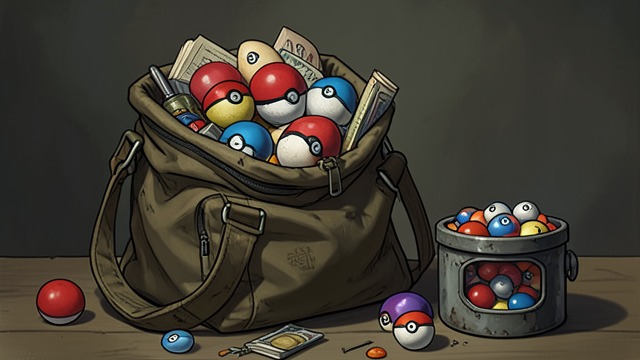
Limited Space
The player encounters limits on Pokémon storage, egg storage, and item storage. The expanding collection is therefore constrained by the architecture of the bag.
Scarcity and Choice
Storage upgrades can be purchased, but the basic problem remains: the player must decide which creatures and items deserve room.
Narrative Importance
The storage system transforms abundance into pressure. The dream of collecting all Pokémon is continually tested by finite capacity.
Resource Hoarding

Saving for Evolution
The player is advised to gather creatures, transfer duplicates, and preserve Candy before spending it. Immediate upgrades are postponed for a more concentrated reward.
Delayed Power
The strategy favors patience over impulse. A stronger creature found later may make an early investment look wasteful.
Narrative Importance
The collection economy becomes a lesson in deferred gratification. The player’s strength grows not only through action but through restraint.
Selective Mastery

Choosing the Best Specimens
The player learns to compare a creature’s level ring and combat power before powering it up or evolving it. Not every member of a species has equal potential.
Collection Reinterpreted
The player’s goal shifts from possessing many Pokémon to cultivating the most promising team. Quantity becomes the raw material of quality.
Narrative Importance
This resolves the resource arc by joining the collector and strategist identities. The player remains committed to collecting, but now collection serves deliberate mastery.
during the first Pokémon inspection
during the early collection phase
after the player begins collecting widely
before the first major experience push
near the end of the strategy sections
