Drowzee
Pokemon Go: The Ultimate Beginner's Guide For Kindle Book Tips And Trick How to Become The Best Pokemon Trainer: This Kindle Book Will Answer Your Unsolved QuestionsDrowzee appears in the guide as a rare Pokémon associated with specific times and places. Although the book does not provide a separate biography, evolution line, combat profile, or plot arc for it, the example gives Drowzee a practical role in explaining how players should search for uncommon encounters in Pokémon GO.
Identity and Rarity
Drowzee is identified as one of the rare Pokémon that players may hope to find while exploring. The guide places it alongside Clefairy as an example of a creature whose availability is influenced by the circumstances of the encounter: players are advised to look for such Pokémon at particular times and in particular locations rather than assuming that every sighting follows the same pattern.
Its rarity is also connected to the difficulty of capture. The guide explains that rarer Pokémon with higher Combat Power can be more troublesome to catch, sometimes appearing with an orange or red circle instead of the easier green circle. Several Poké Ball throws may therefore be required before such a Pokémon remains inside. The text does not state Drowzee’s individual Combat Power or confirm that every Drowzee has the highest difficulty, but its inclusion in the rare-Pokémon discussion makes it part of this broader challenge.
Search Conditions and Misleading Signs
The guide specifically warns players not to chase moving leaves in the hope of finding Drowzee. Green fluttering leaves are described as signs of a Pokémon spawn point: remaining in that vicinity may eventually produce creatures that do not appear on the radar. That indication is only a chance, however, not a guarantee that a rare Pokémon will appear, and it does not identify the location of the Pokémon currently being tracked on the Nearby list. Drowzee therefore functions as the concrete example of a false inference: foliage may mark an area of possible activity, but it is not a reliable promise of this particular rare creature.
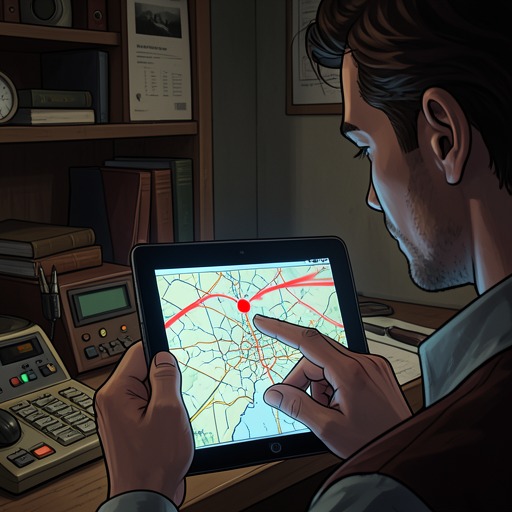
The recommended method is continued observation of the Nearby Pokémon radar while walking and checking the full list when its small grey box blinks. The blinking signal may mean that creatures have moved closer, although it can also mean that they have fallen farther behind. The uncertainty makes tracking an interpretive process rather than a simple reading of a fixed marker, and Drowzee is the creature named to illustrate the danger of confusing a general spawn clue with a confirmed target.
Time, Place, and the Real World
Drowzee’s appearance is tied to the guide’s account of Pokémon GO as a game played through real-world movement. The game combines GPS, augmented reality, and location-based exploration, so the player’s search for a Pokémon unfolds through actual travel rather than through a virtual avatar controlled only by taps or a directional pad. The guide states that rare Pokémon tend to gather in specific places and at specific times, and it gives evening as a better period for seeking Drowzee or Clefairy.
This advice places Drowzee within the game’s larger contrast between familiar franchise goals and an altered method of play. Players still catch Pokémon, use items, evolve creatures, and battle at Gyms, but they must now interpret their surroundings, keep the game open while moving, and use location information to guide the encounter. Drowzee is consequently less a developed character than a precise case study in how Pokémon GO makes rarity depend on the meeting of fictional creature, clock, and physical environment.
Narrative and Practical Significance
The guide’s treatment of Drowzee reveals how its instructional method works. It begins with the promise of helping beginners understand the game from the moment they open it, then moves through starter selection, Pokémon eggs, Gyms, rewards, teams, and future accessories such as Pokémon GO Plus. Within that sequence, Drowzee supplies a memorable example for a narrower lesson: successful play requires distinguishing evidence from rumor and probability from certainty.
The reference also reinforces the game’s recurring mixture of exploration and chance. A player may remain near a possible spawn point, watch the radar, choose a favorable time, and still receive no guarantee of a Drowzee encounter. If one finally appears, its rarity and potentially higher Combat Power can turn discovery into a second task, because finding the Pokémon does not ensure that the capture will succeed. Drowzee thus represents the uncertain reward at the center of the guide’s real-world search system: the player must move, interpret, wait, and throw carefully, without mistaking any single environmental sign for certainty.