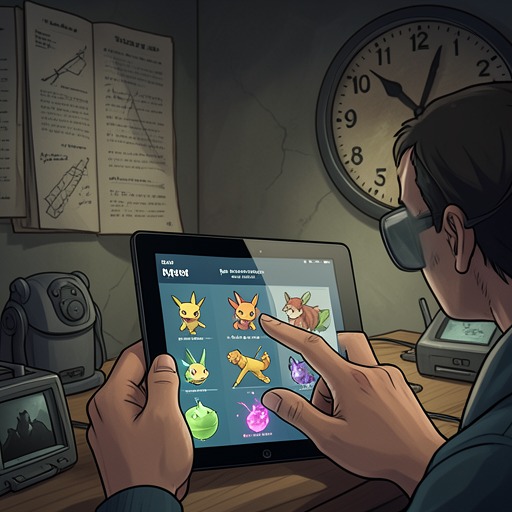
Pokémon evolution
Pokemon Go: The Ultimate Beginner's Guide For Kindle Book Tips And Trick How to Become The Best Pokemon Trainer: This Kindle Book Will Answer Your Unsolved QuestionsPokémon evolution is presented as the transformation that turns ordinary collecting into measurable progression. A caught Pokémon is not merely stored: it can be powered up, evolved into a stronger form, or transferred for Candy, making evolution the point where the guide’s economy of capture, accumulation, and competition becomes visible. The mechanic also preserves the broader Pokémon tradition of collecting species, training teams, and preparing for battles, while adapting those goals to a GPS-based mobile game.
Definition and Resources
Pokémon evolution requires Pokémon Candy, and the amount differs between Pokémon. The guide separates evolution from Power Up: each Power Up consumes one Candy belonging to the relevant Pokémon and a specified amount of Stardust, with the Stardust requirement increasing as Combat Power rises. Evolution uses a larger Candy investment and is described as making the Pokémon much stronger. These costs make every catch part of a longer calculation rather than an isolated reward.
The same resource loop gives weak or unwanted Pokémon a practical function. The Transfer button removes a Pokémon and grants only one Candy of that Pokémon in return. The guide recommends transferring Pokémon with low Combat Power so that the resulting Candy can be reserved for evolving stronger specimens. Transfer therefore connects disposal with advancement: the player sacrifices one individual to improve another, while the limited return encourages repeated catching and deliberate storage of Candy.
Evolution is also tied to a Pokémon’s attacks. After the Power Up and Evolve controls, the player can inspect the creature’s two attacks: one normal attack and one powerful attack. Because different Pokémon have different attacks, evolution is not described as a purely numerical upgrade. It changes the creature within a broader battle system in which strength, Combat Power, and available moves all matter.
The Evolution Strategy
The guide’s most elaborate advice treats evolution as an experience-generating opportunity. It recommends gathering as many Pokémon as possible, transferring selected low-Combat-Power specimens, and saving the Candy rather than spending it immediately. The objective is to create a reserve large enough for a concentrated evolution session instead of making isolated upgrades whenever a single evolution becomes available.
That session is meant to coincide with a Lucky Egg. The guide advises activating an Incense and a Lucky Egg together, then adding a Lure Module at a PokéStop when possible. Incense attracts Pokémon around the player for 30 minutes, while a Lure Module attracts them around a PokéStop for the same period and can benefit other nearby players. The combined arrangement increases the number of available catches while the Lucky Egg doubles experience from catches and from other experience-granting activities.
The timing becomes especially important near the end of the Lucky Egg’s duration. The guide recommends catching Pokémon during the bonus period and evolving every possible Pokémon about five minutes before the Lucky Egg expires. This creates a compressed cycle of capture, Candy accumulation, and mass evolution. The stated reward is 1,000 experience when an evolution is the first time the player has seen the evolved Pokémon, compared with 500 experience when the evolved form has already been seen. Evolution consequently functions both as a permanent strengthening action and as a temporary leveling tactic.
The guide further claims that newly caught Pokémon can provide more than 600 experience and suggests buying coins with real money to purchase Lucky Eggs when affordable. In this version of the strategy, spending money can enlarge the supply of timed experience boosts, while preparation determines whether the boost is wasted or converted into a substantial level increase. The advice is therefore less about evolving one favorite creature than about synchronizing several systems into one efficient burst of progress.
Combat Power and the Strengthening Curve
The guide illustrates the two-stage path toward a strong evolved Pokémon with a Pidgey whose Combat Power begins at 72. Repeated Power Ups raise that value, but the guide also points to the curved half-circle displayed around the Pokémon as a second indicator of progress. As the creature is powered up, the curve moves, and the recommended goal is to push it as close to the end as possible before evolving.
This presentation gives evolution a preparatory phase. The final form is not treated as automatically powerful simply because the transformation has occurred; its eventual Combat Power is linked to how thoroughly the player strengthened the Pokémon beforehand. The guide’s language presents this as the route to a creature that becomes exceptionally difficult to defeat. Whether the player is pursuing collection, experience, or Gym performance, the instruction is consistent: invest resources before evolution when the aim is maximum strength.
The relationship between evolution and battle is reinforced by the guide’s account of Combat Power and moves. A higher Combat Power value means that the Pokémon deals more damage during battle, while combining Fast and Charge Moves is said to improve success. Evolution therefore sits inside a chain of preparation: catches provide Candy and Stardust, Power Ups raise Combat Power, evolution produces a stronger form, and the resulting move set affects how that form performs in combat.
Eevee and Branching Evolution
Eevee is singled out as the guide’s special example of evolution. It requires 25 Eevee Candy and evolves only once, but the result is not fixed to a single form. The guide identifies three possible outcomes: Vaporeon, Jolteon, and Flareon. This makes Eevee different from the otherwise straightforward image of evolution as one known creature becoming one stronger successor.
The Eevee example expands evolution from a simple upgrade into a choice among alternatives. The player must first collect enough of the species-specific Candy, then confront the significance of the possible forms rather than merely pressing an automatic improvement button. The guide does not provide further selection instructions in the supplied passage, but its emphasis on the three outcomes establishes branching evolution as a distinctive feature of the system.
Place in Pokémon GO’s Progression
Pokémon evolution carries forward the older Pokémon structure in which Pokémon Trainers catch creatures, train them, assemble teams, and compete. The guide traces that tradition to the original Game Boy games developed by Game Freak and published by Nintendo, and describes collecting, training, and battling as recurring themes across the franchise’s games, animated programs, manga, trading cards, and toys. In Pokémon GO, evolution is the mobile form of that training ideal: it turns the results of exploration into visible development.
Its importance increases as the player advances. The guide notes that new features appear as the player levels up and that later play opens access to Gym activity and one of three teams at level five. Winning training battles grants Trainer XP and increases the Prestige of a friendly Gym, while winning Gym battles grants Trainer XP and reduces the opposing Gym’s Prestige. Evolution helps prepare the Pokémon that enter this competitive and social phase, even though the guide presents Candy and experience optimization as useful before the player reaches it.
The mechanic also reflects Pokémon GO’s larger transformation of play into real-world movement. Nintendo and Niantic Labs combine GPS, augmented reality, and mobile graphics so that catching, battling, using items, and evolving take place through a player’s movement in the physical world. PokéStops are associated with real-life monuments, and the guide frames exploration with friends and connections in the neighborhood as part of the game’s appeal. Evolution thus gives purpose to the repeated walks and encounters that supply its materials: the player’s movement becomes the beginning of a creature’s digital transformation.
Finally, the guide places evolution within an ecosystem of planned and optional play. Trading is not currently offered, although Niantic is said to have plans for a future update; transferring a Pokémon to Professor Willow is instead compared with releasing it back into the wild. A proposed Pokémon GO Plus peripheral, priced in the guide at $34.99 in one passage and about $30 in another, would let players visit PokéStops and catch Pokémon without looking at their phones. These surrounding systems underline the same principle as evolution: Pokémon GO is organized around continuous collection, resource conversion, and progression, with each new tool intended to keep the loop moving.