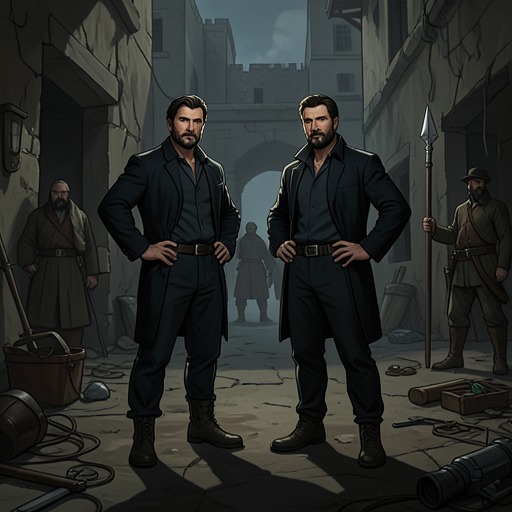
Aditha Karikalan–Vandhiyathevan
Ponniyin SelvanAditha Karikalan and Vandhiyathevan are presented as trusted companions whose bond is made visible through action: Vandhiyathevan stands up for the prince’s interests as a witness, rides beside him when others fall back, and joins his pursuit of game while carrying a weapon suited to protecting him without disrupting the hunt. The relationship links political loyalty with physical proximity, making Vandhiyathevan a credible friend in the court’s suspicions and a ready partner in the forest.
Identity and Political Trust
Vandhiyathevan’s place beside Aditha is stated directly when he is identified as the crown prince’s trustworthy friend. The claim comes amid a discussion of conspirators and the report that the Pazhuvoor Ilaiya Rani had been among them. Vandhiyathevan is described as the one true witness to the gathering, even though he arrived only after the performance was over. His account makes him more than a companion in private: it gives him a role in conveying politically consequential information.
That role is contested. He is dismissed as a spy who had sneaked in and fled, and the reliability of reports from the prince’s many friends is questioned. Against this suspicion, his defender distinguishes him from a spy and grounds his credibility in his friendship with Aditha. The exchange does not show that the report is accepted as proven, or that an inquiry takes place; the king says action must wait until the Pazhuvettarayar and his Ilaiya Rani return. The scene therefore makes the bond consequential but not all-powerful: Vandhiyathevan’s closeness to the prince supports his standing, yet it cannot by itself settle a political accusation.
Riding Beside the Prince
The forest hunt gives the relationship a physical form. At midday, the rest of the party is fatigued and ready to pause, but Aditha keeps driving his exhausted stallion along barely discernible tracks. Kandamaaran, who had ridden close beside the prince through the morning, has fallen back after Aditha’s caustic question. He complains to Parthibendra Pallava, who tries to soothe him. The vacant place beside Aditha does not remain empty for long: Vandhiyathevan neatly takes it, and the two ride ahead of the party together.
The shift in position matters because Vandhiyathevan does not need to be summoned into the prince’s company. He moves into the opening left by the other man’s withdrawal, and the narrative immediately joins them in a shared forward movement. Their closeness is not presented as a formal escort arrangement; it emerges within the hunt, while Aditha presses on despite the group’s fatigue. The scene contrasts the prince’s relentless pace with the party’s weariness, then makes Vandhiyathevan the companion who can keep pace at his side.
A Companion Who Can Protect Without Interfering
Vandhiyathevan has brought no bow and arrow, and the narration notes that he is not proficient with them. Instead, he carries his trusty spear. That choice gives his position beside Aditha a particular balance: he can accompany the prince cautiously without committing the cardinal sin of interfering with the prince’s prey, while remaining ready to throw the spear if danger arises. The passage says that such danger does not arise until high noon. His presence is thus both companionable and alert, but it does not displace Aditha as the hunter or claim a share in the prince’s action.
The distinction becomes concrete when a wild boar survives Aditha’s arrow. Kandamaaran’s scornful chortle prompts the prince to turn the failed shot into a challenge: he and Vandhiyathevan will pursue one boar, while Kandamaaran and Parthibendra pursue another. Aditha launches into a fierce gallop, and Vandhiyathevan follows at his heels. The paired pursuit makes their partnership unmistakable. Vandhiyathevan is not simply standing guard at a distance; when Aditha commits himself to the chase, his friend goes with him.
Shared Action and Narrative Significance
The hunt also clarifies the limits and character of their cooperation. Aditha is the one who shoots, challenges the others, and sets the pace; Vandhiyathevan accompanies him and remains ready to act if needed. The friendship is therefore represented not as equality of rank or identical function, but as trust expressed through complementary roles. Vandhiyathevan can remain near the prince without competing for the prey, and can follow decisively when the prince turns the hunt into a contest.
The sequence then shifts their attention. Following the boar’s destructive trail through the brush, the two reach a small canal, beyond which the animal’s route becomes unclear. Through the opening, they see a wide lake and a boat carrying women; its course changes toward one of the islands along the shore. Their pursuit gives way to this new sight. The interruption places the friendship within a wider pattern of alert movement through uncertain circumstances: together they ride into the forest, pursue the boar, and then turn their attention to what appears across the water. Alongside Vandhiyathevan’s disputed testimony about the conspirators, these actions establish him as a companion whose loyalty is shown both in what he reports and in where he chooses to stand.